Category Archives: Soapbox

Empathy with the continuing background noise in society

Image of book cover for 'a flat place' by Noreen MasudResearch has shown that skimming while reading in digital media reduces the inclination and perhaps ability to engage in higher level reading, while a lack of higher-level reading practice compromises the efficacy of skimming when reading. Higher-level reading implies critical and conscious reading, slow reading, non-strategic reading and long-form reading, according to Schuller-Zwierlein et al, 2202.  The psychologist, Steven Pinker has argued that we learn empathy by immersing ourselves in other people’s minds through reading.  During a recent weekend break, I immersed myself in Noreen Masud’s beautiful book, ‘a flat place’.  It is a memoir about childhood trauma, patriarchy and colonialism told through stories associated with flatlands outside Lahore, at Orford Ness, the Cambridgeshire fens, Morecambe Bay and Orkney.  I read it while staying in the flat landscape around Dunham Massey between Warrington and Manchester which made the physical topography described by Masud resonate with me.  However, her reflections on her and our psyche were also deeply significant – she opens one chapter with a quote from Laura S Brown’s article, ‘Not Outside the Range: One Feminist Perspective on Psychic Trauma’, which perhaps is core to her story: ‘…the constant presence and threat of trauma in the lives of girls and woman of all colors, men of color…, lesbian and gay people, people in poverty and people with disabilities has shaped our society, a continuing background noise rather than an unusual event’.

Brown LS. Not outside the range: One feminist perspective on psychic trauma. American Imago. 119-33, 1991.

Masud N, a flat place, Hamish Hamilton, 2023

Schüller-Zwierlein A, Mangen A, Kovač M, van der Weel A. Why higher-level reading is important. First Monday. 27(5) Sep 5, 2022.

Achievements, happiness and the passage of time

A couple of weeks ago, I wrote about time as ‘a giant wheel rotating through cycles of creation and destruction leading, over aeons, to the birth and death of entire worlds’ [see ‘Aeonian cycles of creation and destruction’ on October 18th, 2023].  I had written previously about Aristotle’s view of time as the measurement of change and how Newton believed that time passes even when nothing changes [see ‘We inhabit time as fish live in water’ on July 24th, 2019].  I recently read ‘The Wall’, a beautiful and thought-provoking, post-apocalyptic novel by Marlen Haushofer, in which the narrator states ‘Time only seemed to be passing quickly.  I think time stands quite still and I move around in it, sometimes slowly and sometimes at a furious rate.’  This aligns with the fish-in-water concept of time rather than the giant revolving wheel.  I recently had a conversation with a colleague about our perception of time as we looked back on our lives which made us feel that time has sped past whereas at the time it appeared to be passing slowly.  Perhaps our familiarity with the past, a landscape through which we have travelled, foreshortens it or is that I might have less than a thousand weeks left [see ‘One just raced past and I have only about 1000 left’ on September 8th, 2021] .  Haushofer’s narrator also says, ‘I had achieved little that I had wanted, and everything I had achieved I had ceased to want’.  In my working life, I have some empathy with this statement, particularly the second part.  I have moved through time at a furious rate, striving towards accomplishments; but now that I have most of them, they seem relatively unimportant.  They are certainly not the key to happiness which can be found anywhere through supporting and valuing others [see ‘A view from the middle’ on March 22nd, 2023] as well as in concentration so intense, for instance though reading or writing, that you lose your sense of time leading to a deep sense of happiness and well-being [see ‘You can only go there in your head’ on May 11th, 2022].  I wrote this post on a Sunday afternoon after spending a couple of hours sitting in the warm October sunshine on the campus of the University of Illinois Urbana Champaign reading ‘Mr President’ by Miguel Angel Asturias – both the reading and writing have left me in a happy state of mind.

Source:

Marlen Haushofer, The Wall, Vintage Classics/Penguin Random House, 2022.

Do you think that you have a miserable job?

Many years ago I attended the Center for Creative Leadership in Greensboro, North Carolina. There I was introduced to a series of books by Patrick Lencioni.  I use one of them, ‘The Five Dysfunctions of a Team‘, regularly as part of module that I teach on Science Leadership and Ethics which is in turn part of a Continuous Professional Development (CPD) programme [see ‘On being a leader‘ on October 13th, 2021].  I pulled the book off my shelf a few weeks ago in preparation for delivering the class and next to it was first one I read and enjoyed, called ‘The Three Signs of a Miserable Job: A Fable for Managers‘.  If you are only reading this post to find out if your job qualifies as miserable, then the three signs are anonymity (you see yourself as being invisible), irrelevance (your work does not matter to anyone, not even the boss) and immeasurement (you have no tangible means of assessing success or failure in your job).  The message of the book is that a manager has a responsibility to ensure none of their team suffers any of these basic signs of a miserable job.

Inconvenient data about electricity generation

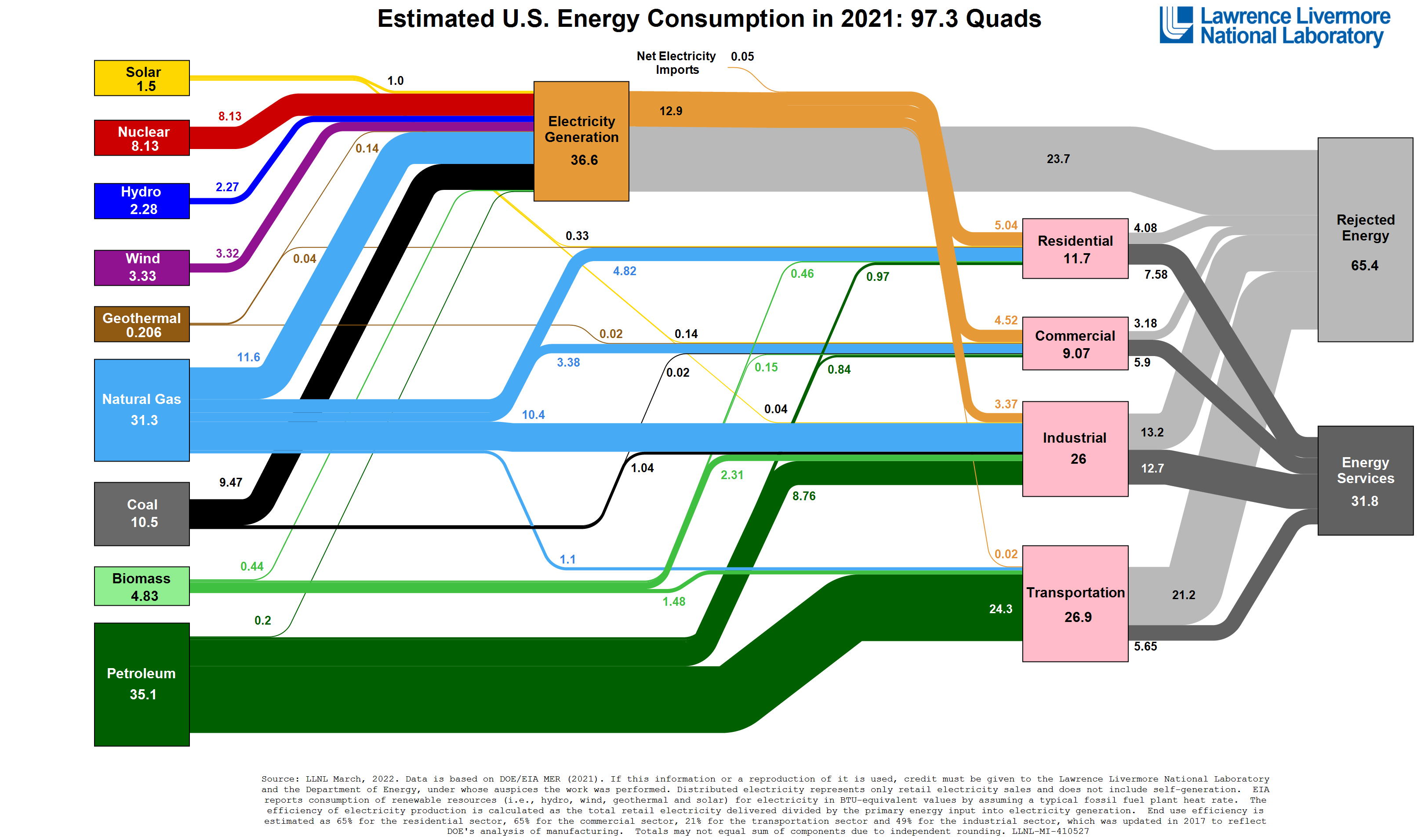
Decorative infographicI like a good infographic and this one showing annual energy flows for a country  is one of my favourites [see ‘Energy blending’ on May 22nd 2013].  Some governments produce them annually.  The image shows the latest one for the UK [2021]. It makes interesting but perhaps depressing reading.  Transportation using fossil fuels accounts for 31% (41.6/134.1 million tonnes oil equivalent) of the UK energy consumption while electricity output accounts for only 21% (28.6/134.1 million tonnes oil equivalent).  This implies that if all vehicles were powered by electricity then the output of our power stations would need to increase to 70.2 million tonnes oil equivalent or between two- and three-fold (excluding conversion & transmission losses).  You can perform a similar analysis for the USA [see 2021 Energy flow chart from LLNL].  Fossil-fuelled transportation accounted for 25%  (24.3/97.3 Quads) and electricity output 13% (12.9/97.3 Quads) so converting all transportation to be electrically powered requires a three-fold increase in electrical output from power stations. It is more difficult to find equivalent data for Japan; however, in 2014 [see Energy flow chart from I2CNER Kyushu University] fossil-fuelled transportation accounted for 32% (3.03/9.52 EJ) and electricity output 38% (3.66/9.52 EJ) so converting all transportation to be electrically powered requires a two-fold increase in electrical output from power stations.  None of the above takes account of space heating mainly via fossil fuel or that many existing power stations are fossil-fuelled and need to be replaced in order to achieve net zero carbon emissions.  Hence, the required scale of construction of power stations using renewable sources, including nuclear, solar and wind, is enormous and in most countries it is barely discussed let alone planned or started; leading to the conclusion that there is little chance of achieving net zero carbon emissions by 2050 as called for by the Paris agreement.