Category Archives: Soapbox

More violent storms

I made a mistake last week by initially publishing two posts.  My apologies for confusing you or tantalising you with the prospect of going bungee jumping and then postponing the trip.  We’ll go bungee jumping next week.  I postponed it because it’s a preview of the new MOOC on ‘Understanding Super Structures‘ that I am writing and there was a delay in publishing the registration page for the MOOC.

When I posted my comment about postponing the bungee jump due to rain, I didn’t realize that, the following day Liverpool would be battered by Storm Doris, with 90 miles per hour winds that closed the Port of Liverpool.  As I sat writing week 4 of the new MOOC, the wind was swirling around our house causing the windows to rattle; and, on the top storey of our narrow but tall house, you could feel the house moving in the gusts of wind.  Across the street, people visiting Liverpool Cathedral were hanging onto the railings as they made their way to the entrance, and the trees were being bent over to an angle that made you think there would be a loud cracking and splintering of wood at any moment.  Fortunately, the storm was short-lived in Liverpool and moved on to wreak havoc inland.  Bungee jumping would have been very hazardous!

The number of violent storms appears to be increasing and the graphic shows the number of storms in the Atlantic basin since 1850.  Although there is a lot of scatter in the data, there is a clear concentration in the last couple of decades of years with fifteen of more named storms, which suggests there has been more energy in the weather systems in recent years.  The primary source of this energy is the temperature of the oceans and atmosphere.  There is a good account of the development of storms cells in Manuel Delanda’s book ‘Philosophy and Simulation: The Emergence of Synthetic Reason‘, see chapter 1 – The Storm in the Computer, which is available via Google Preview.

The increased frequency of high-energy storm systems is a very apparent manifestation of climate change that is having an impact on many people.  Yet, some governments refuse to even consider the possibility that our climate is changing and that they need to lead our society in discussing and planning strategies to mitigate the impacts.  It reminds me of the saying, attributed to Henri Poincare: ‘To doubt everything, or, to believe everything, are two equally convenient solutions; both dispense with the necessity of reflection.’
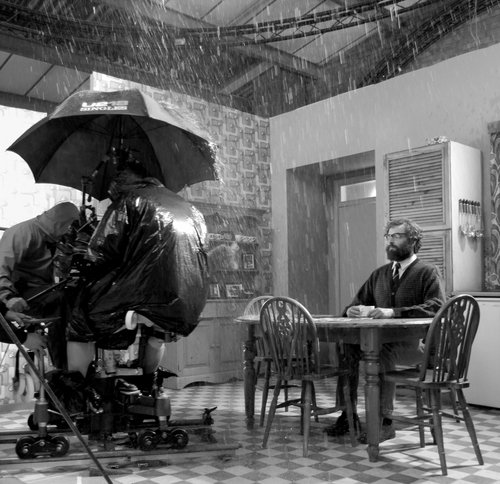
‘Rain bringing out the contours in everything’

16blindness9-custom1Last October I cited John Hull’s audio diary in which he said ‘Cognition is beautiful.  It is beautiful to know.’ [See my post entitled ‘Cognition is beautiful‘ on October 19th, 2016]  Last week, I watched the film ‘Notes on Blindness‘ based on his book ‘Touching the Rock‘.  We found it a moving and life-enriching experience. At one point, John Hull, after he has lost all of his sight, opens his front door during a rain storm and describes the beauty of the rain.  “Rain has a way of bringing out the contours of everything; it throws a coloured blanket over previously invisible things; instead of an intermittent and thus fragmented world, the steadily falling rain creates continuity of acoustic experience.”  You can read more of this extract at www.johnmhull.biz/Touching the Rock.html in which John wishes that rain could fall inside a room to give him a sense of the things in the room.  This seemed particularly poignant to me, a sighted person, who benefits from photons raining down on everything around us during daylight or when the light is switched on.  The photons cause light waves to radiate from every surface in a similar way that the rain drops cause sound waves to radiate from everything as John experienced. Our eyes are amazing with 137 million separate ‘seeing’ elements on the retina, or in digital camera terms, that’s 137 megapixels.  But to quote the Roman poet, Lucretius who in his poem ‘De Rerum Natura’ wrote “Nothing in the body is made that we may use it.  What happens to exist is the cause of its use.”  In other words, we do not have eyes so that we can see but we see because we have eyes.  John Hull discovered new ways to experience the world using what was available to him although he struggled with what he had lost.  It is difficult to imagine losing one’s sight but his diary and the film bring us considerably closer to an appreciation of the loss.

Yes, I know I switched from a particle to wave description of light but I wanted to emphasize that the photons don’t just bounce off surfaces, otherwise all surfaces would look the colour of the illuminating light.


Sources:

John M. Hull, Touching the Rock: an experience of blindness, London: SPCK, 2016

Lucretius (author), Alicia Stallings (translator), The Nature of Things, London: Penguin Classics, 2007.

Charles Sherrington, Making of the eye, in The Faber Book of Science, John Carey (ed), London: Faber & Faber, 1995.

Picture: A production still from the film, Notes on Blindness, from NY Times on January 16th, 2016.


You’re all weird!

bubbleRecently, I attended a talk given by the journalist, Richard Black to a group of scientists and engineers. He used a show of hands to establish that none us read the tabloid newspapers and told us we were all weird.  He went on to discuss how we live in bubble and rarely come into contact with people outside of it.  In media terms, I live in a bubble that can be defined by BBC Radio 4 in the UK or NPR in USA.  And, I was surprised how easy it was to substitute NPR for BBC Radio 4 when we moved to the USA, so the bubble extends across national boundaries.  But, nevertheless we live in a relatively small bubble because the tabloid papers are read by millions of people whereas the serious papers I prefer have only hundreds of thousands of readers. That’s why we are weird – we’re unusual.  It’s also why we are surprised when electorates make apparently irrational decisions.  However, they are only irrational to weird people who have access to the information and analysis available in our bubble.

We should not blame the media because most are simply businesses whose bottom line is profit, which means they have to be attractive to as many people as possible and there aren’t many people in our bubble, so most of the media doesn’t target us.   The same logic applies to politicians who want to be elected.

Interestingly, ‘weird’ is a late middle-English word, originally meaning ‘having the power to control destiny’.  So maybe being weird is a good thing?

Illusion of self

A few weeks ago, I wrote that some neuroscientists believe consciousness arises from the synchronous firing of assemblies of neurons [see my post ‘Digital hive mind‘ on November 30th, 2016].  Since these assemblies exist for only a fraction of a second before triggering other ones that replace them, this implies that what you think of as ‘yourself’ is actually a continuously changing collection of connected neurons in your brain, or as VS Ramachandran has described it ‘what drives us is not a self – but a hodgepodge of processes inside the skull’.

According to Kegan’s schema of cognitive development, new born babies perceive the world as an extension of themselves.  However, as our consciousness develops, the idea of a ‘self’ evolves as a construct of the brain that allows us to handle the huge flow of sensory inputs arriving from our five senses and we begin to separate ‘self’ from the objects around us.  This leads to us perceiving the world around us as separate to us but there to serve our needs, which we see as paramount.  Fortunately, the vast majority of us (more than 90%) move beyond this state and our relationships with other people become the dominant driver of our actions and identity.  Some people (about 35%) can separate their relationships and identity from ‘self’ and hence are capable of more nuanced decision-making – this is known as the Institutional stage. About one percent of the population are capable holding many identities and handling the paradoxes that arise from deconstructing the ‘self’ in the Inter-individual stage.

Of course, Kegan’s stages of cognitive development are also a construct to helps us describe and understand the behaviour and levels of cognition observed in those around us.  There is some evidence that deeper more complex thought processes, associated with higher levels of cognition, involve the firing of larger, more widespread assemblies of neurons across the brain; and perhaps these larger neuronal assemblies are self-reinforcing; in other words, the more we think deeply the more capable we are of thinking deeply and, just occasionally, this leads to an original thought.  And, maybe the one percent of individuals who are capable of handling paradoxical thoughts have brains capable of sustaining multiple large neuronal assemblies.  A little bit like lightning triggered from multiple points in the sky during a (brain)storm.

How does this relate to engineering?  Well, we touch on Kegan’s stages of cognitive development in our continuing professional development courses [see my post on ‘Technology Leadership’ on January 18th, 2017] for engineers and scientists aspiring to become leaders in research and development because we want to advance their cognitive development and, also allow them to lead teams consisting of individuals at the institutional and inter-individual stages that will be capable of making major breakthroughs.

Sources:

V.S. Ramachandran, ‘In the hall of illusions’, in ‘We are all stardust‘ by Stefan Klein, London: Scribe, 2015.

Kegan, R., In over our heads: the mental demands of modern life, Cambridge, MA: Harvard University Press, 1994.

Kegan, R., The evolving self: problem and process in human development, Cambridge, MA: Harvard University Press, 1982.