
Tag Archives: nuclear energy

Small is beautiful and economic

tractorFarm tractors have been growing bigger and bigger, though perhaps not everywhere – the photograph was taken in Donegal, Ireland earlier this year.  The size of tractors is driven by the economics of needing a driver in the cab. The labour costs are high in many places, so that the productivity per tractor driver has to be high too.  Hence, the tractors have to move fast and process a large amount of the field on each pass.  This leads to enormous tractors that weigh a lot and exert a large pressure on the soil, which in turn results in between 1 and 3% of the farm land becoming unproductive because crops won’t grow in the severely compressed soil. But what happens if we eliminate the need for the driver by using autonomous vehicles? Then, we can have smaller vehicles working 24/7 that do less damage and are cheaper, which means that a single machine breakdown doesn’t bring work to halt. We can also contemplate tailoring the farming of each field to the local environmental and soil conditions instead a mono-crop one-size fits all approach. These are not my ideas but were espoused by Peter Cooke of the Queensland University of Technology at a recent meeting at the Royal Society on ‘Robotics and Autonomous Systems’.

It is a similar argument for modular nuclear power stations. Most of the world is intent on building enormous reactors capable of generating several GigaWatts of power (that’s typically 3 with nine zeros after it) at a cost of around £8 billion (that’s 8 with nine zeros) so about 50 pence per Watt. Such a massive amount of power requires a massive infrastructure to deliver the power to where it is need and a shutdown for maintenance or a breakdown potentially cuts power to about a million people. The alternative is small modular reactors built, and later dismantled, in a factory that leave an uncontaminated site at a lower capital cost and which provide a more flexible power feed into the national grid. Some commentators (see for example Editor’s comment in Professsional Engineer, November 2015)believe that a factory could be established and rolling modular reactors off its production line on the same timescale as building a GigaWatt station.

Regular readers will recognise a familiar theme found in Small is beautiful and affordable in nuclear powerstations on January 14th, 2015, Enabling or disruptive technology for nuclear engineering on January 28th, 2015 and Small is beautiful on October 10th, 2012; as well as the agricultural theme in Knowledge-economy on January 1st, 2014.
Enabling or disruptive technology for nuclear engineering?

INDEA couple of weeks ago [see ‘Small is beautiful and affordable in nuclear power-stations’  on January 14th, 2015] I ranted about the need to develop small modular reactors whose components can be mass-produced in a similar way to the wings, cockpit, tail-planes, fuselage and engines of an Airbus aeroplane that are manufactured in factories in different countries in Europe prior to final assembly and commissioning in Toulouse, France. The aerospace industry is heavily dependent on computer-aided engineering to design, test, manufacture, operate and maintain aircraft in a series of processes involving a huge number of organisations. The civil engineering and building services industries are following the same model through the introduction of BIM, or Building Information Modelling. I have recently suggested that the nuclear industry needs to adopt the same approach through an Integrated Nuclear Digital Environment (INDE) that has the potential to reduce operating and decommissioning costs and increase reliability and safety for existing and planned power-stations but more importantly would enable a move towards mass-production of modular power-stations.

Recently I presented a paper at a NAFEMS seminar on Modelling and Simulation in the Nuclear Industry held on November 19th 2014 in Manchester, UK.  To judge from the Q&A session afterwards, the paper divided the audience into those who could see the enormous potential (the enablers?) and those who saw only massive problems that rendered it unworkable (the potentially disrupted?). The latter group tends to cite the special circumstances of the nuclear industry associated with its risks and regulatory environment. These are important factors but are not unique to the industry. From my perspective of working with many other industrial sectors, the nuclear industry is unique in its slow progress in exploiting the potential of digital technologies.  Perhaps in the end, as one of my academic colleagues believes, research on solar power will produce such efficient solar cells that even in cold and cloudy England we will be able to meet all of our power needs from solar energy [given incoming solar radiation is about 340 Watts/square meter], in which case perhaps the nuclear power industry will become extinct unless it has evolved.

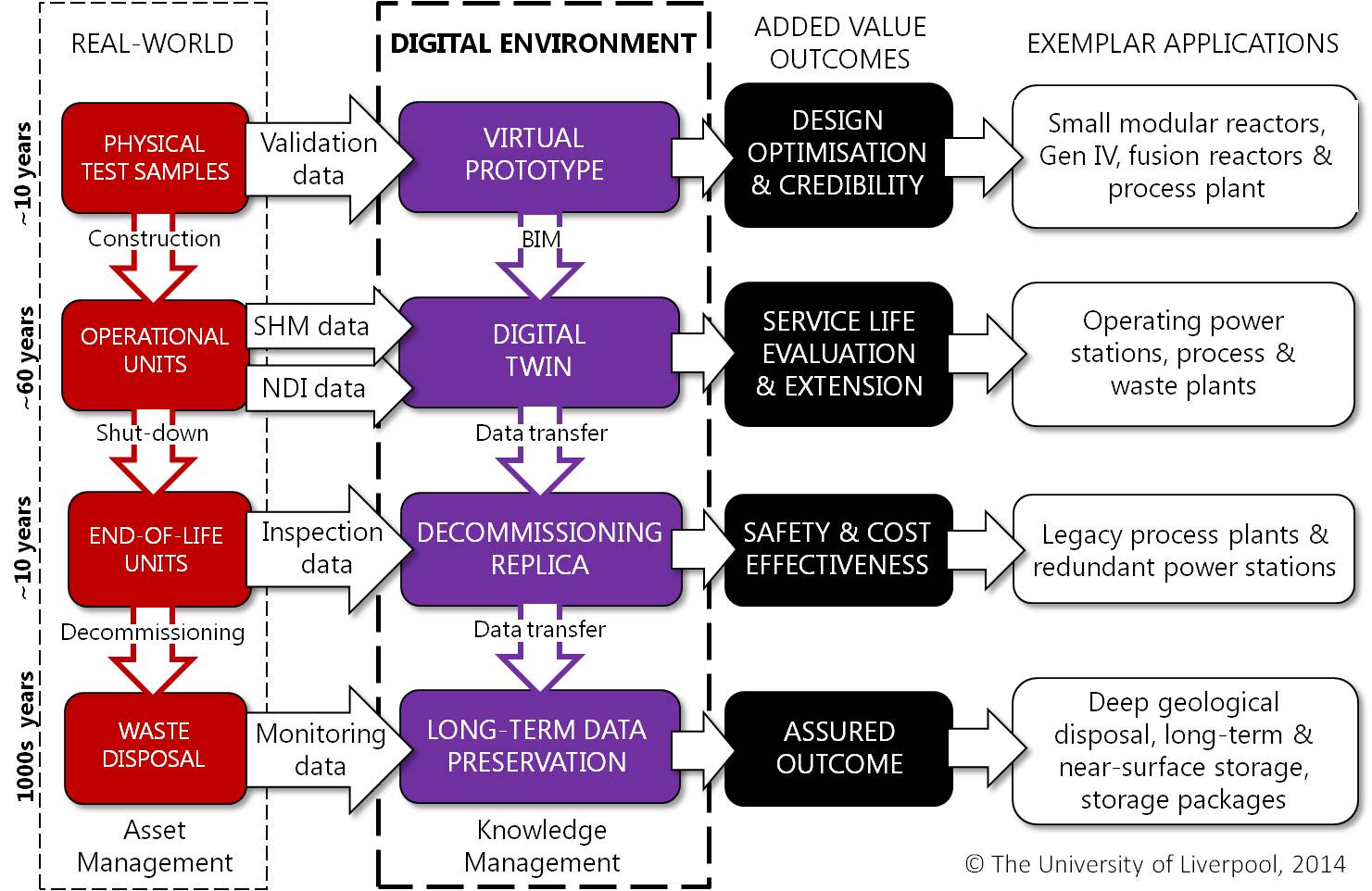
Schematic diagram showing the digital environment (second column from left in purple), its relationships to the real-world (left column in red) and the potential added value (third column from left) together with exemplar applications (right column). Coloured arrows are processes and coloured boxes represent physical (red) or digital (purple) infrastructure.

Schematic diagram showing the digital environment (second column from left in purple), its relationships to the real-world (left column in red) and the potential added value (third column from left) together with exemplar applications (right column). Coloured arrows are processes and coloured boxes represent physical (red) or digital (purple) infrastructure [from Patterson & Taylor, 2014].

The diagram is an extract from Patterson & Taylor, 2014.  The views expressed in this blog post are those of the author and not necessarily of those of his co-authors on other publications, or their employers.

Small is beautiful and affordable in nuclear power-stations

Most of you will have domestic carbon footprints that are similar to mine, i.e. dominated by energy consumption, probably mainly your car and climate control in your home, and you will struggle to reduce your footprint [see my post entitled ‘New Year Resolution’ on December 31st, 2014]. We live in a fossil fuel economy and so even if you make your home entirely powered by electricity and buy a plug-in car then your utility provider is still very likely to use fossil fuel to generate the electricity supplied to you and your carbon emissions will have been simply moved elsewhere. If you are lucky enough to live in a suitable location then installing geothermal, solar or wind power for your home might be viable; but otherwise the majority of us are dependent on power-stations for our electricity.

I discussed the impossibility, with today’s technology, of providing all of our electrical power needs using renewable sources in my post entitled ‘Energy Blending‘ on May 22nd, 2013. The alternatives are either to reduce our power consumption dramatically, which seems unlikely to happen given that everyone would like to enjoy the lifestyle of typical readers of blogs, or to build a very large number of nuclear power stations.  The scale of the problem facing China was the topic of my post entitled ‘Mass-produced nuclear power plants‘ on November 12th, 2014 and it is many times large on a global scale.

A major obstacle to building nuclear power-stations is their exorbitant capital cost, e.g. £24 billion for the planned Hinckley Point C reactor in the UK. This level of investment is beyond the reach of most companies and the construction of a fleet of such power-stations to provide national needs is beyond the budget of most national governments. Small modular reactors (SMR), whose components could be mass-produced and assembled on-site, have been proposed and both their small size and the manufacturing approach would lead to considerable reductions in unit costs. Although many designs for SMRs are under development, with mature designs in China and India, progress towards implementation and mass-production is slow so that the situation is ripe for a disruptive technology from another industrial sector to transform the nuclear power landscape. One possible candidate is the fusion reactor being developed by Lockheed Martin’s Skunk works [see my post entitled ‘Mass-produced nuclear power plants‘ on November 12th, 2014] or the Travelling Wave Reactor being developed by the spin-out company TerraPower.

We need to think big about small affordable solutions instead of thinking and spending big money on massive projects that tend towards a big unaffordable solution.

Also see Bill Gates on Energy-Miracles

Thermodynamic Whoopee

man without a countryThe success of our students in the MyCopter project inspired me a couple of weeks ago to write about the prospect for flying cars [see post on October 2nd, 2014 entitled ‘Origami car-planes‘], which are not good essentially because we don’t know how to manipulate gravity. Everything in the universe is controlled by four forces, i.e. electromagnetic, gravitational, weak nuclear and strong nuclear. Adam Frank, described our understanding and control of electromagnetic forces as god-like because we can manipulate photons, electrons and atoms with enormous precision in flat screen TVs, mobile phones, microwave ovens and much more.

Strong nuclear forces hold protons and neutrons together in the nucleus of atoms and weak nuclear forces control the fusion process in stars. We have managed to take a few tottering steps to control nuclear forces in nuclear power stations but we are blundering apprentices compared to our skills with electromagnetism. However, with gravitational forces we are like toddlers trying to feed ourselves – we have some idea about what we are supposed to be doing but we waste an enormous amount in trying to hit the target. So we use our expertise in electromagnetism to combust fuel in an engine which drives an aerofoil through air faster enough to generate lift. This usually involves burning vast amount of fossil fuel and it gets worse when you want to hover with rotating blades or a vertical jet. Kurt Vonnegut in a ‘A Man without a Country‘ has described our reckless use of fossil fuel as making ‘thermodynamic whoopee’ but if we want fly long distances with significant payloads we don’t have much choice at the moment.

If physicists could work out how to manipulate gravitational forces it would not take engineers long to design and build flying cars that would be as advanced relative to today’s private jet as your tablet computer is relative to an abaqus.

Source:

I was promised flying cars‘ by Adam Frank in the New York Times on June 6th, 2014