Tag Archives: first law

Slowing down time to think [about strain energy]

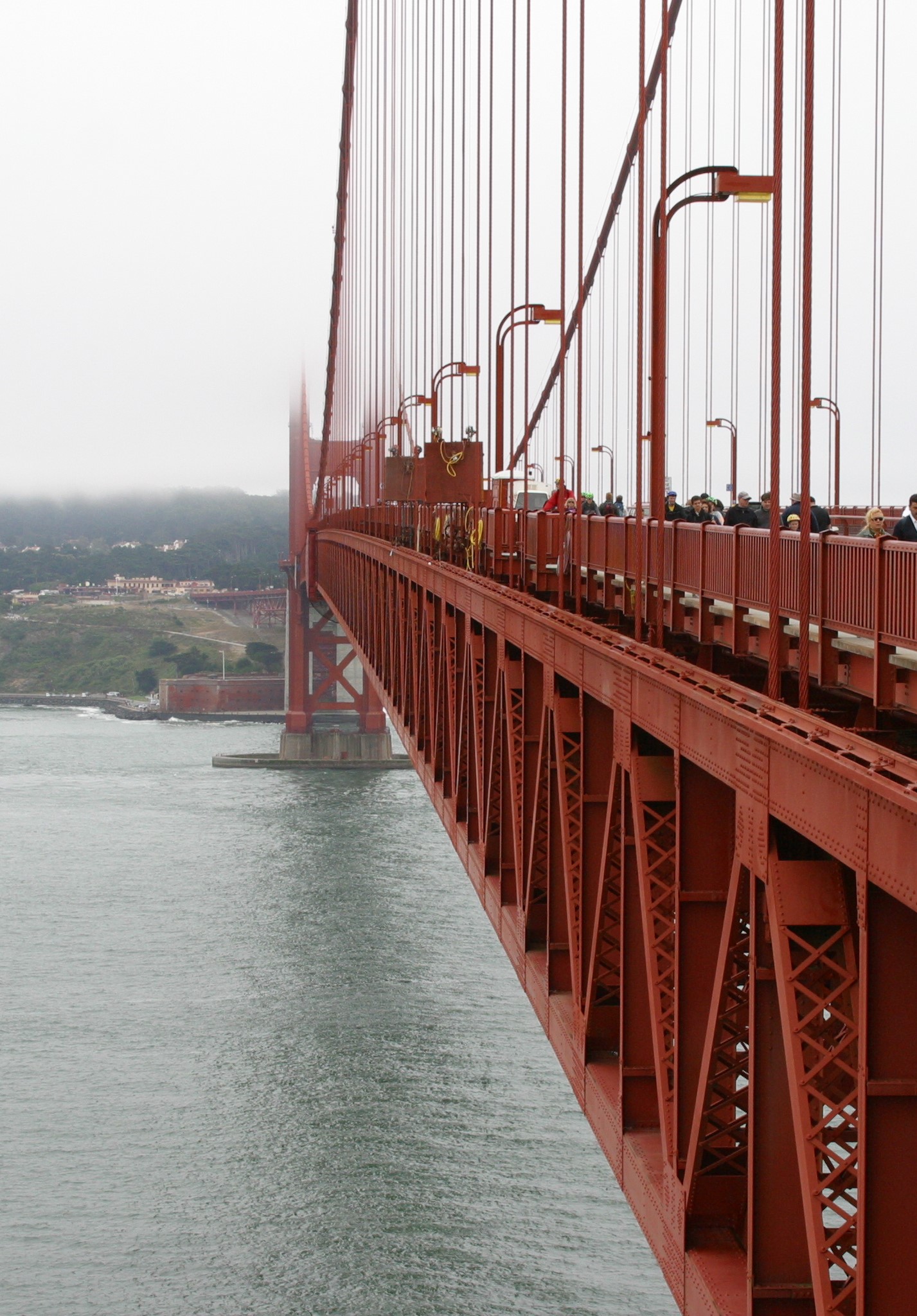
161-6167_imgLet me take you bungee jumping.  I should declare that I am not qualified to do so, unless you count an instructor’s certificate for rock-climbing and abseiling, obtained about forty years ago.  For our imaginary jump, pick a bridge with a good view and a big drop to the water below and I’ll meet you there with the ropes and safety gear.

It’s a clear early morning and the air is crisp and fresh – ideal for throwing yourself off a bridge attached to a rope.  The rope is the star of this event.  It’s brand new, which is reassuring, and arrived coiled over my shoulder.  A few days ago, I asked you how much you weigh – that’s your real weight fully clothed, at least I hope that’s the number you gave me otherwise my calculations will be wrong and you’ll get wet this morning!  I have calculated how much the rope will stretch when it arrests your free-fall from the bridge parapet; so, now I am measuring out enough rope to give you an exciting fall but to stop you short of the water.  I’m a professor of structural materials and mechanics so I feel confident of getting this bit right; but it’s a long time since I worked as an abseiling instructor so I suggest you check those knots and that harness that we’ve just tightened around you.

You’ve swung yourself over the parapet and you’re standing on the ledge that the civil engineers conveniently left for bridge jumpers.  The rope is loosely coiled ready with its end secured to a solid chunk of parapet.  As you alternate between soaking up the beautiful view and contemplating the chasm at your feet, you wonder why you agreed to come with me.  At this moment, you have a lot of potential energy due to your height above the sparkling water [potential energy is your mass multiplied by your height and gravitational acceleration], but no kinetic energy because you are standing motionless.  The rope is relaxed or undeformed and has zero strain energy.

Finally, you jump and time seems to stand still for you as the fall appears to be happening in slow motion.  The air begins to rush past your ears in a whoosh as you build up speed and gain kinetic energy [equal to one half your mass multiplied by your velocity squared].  The bridge disappeared quickly but the water below seems only to be approaching slowly as you lose height and potential energy.  In reality, your brain is playing tricks on you because you are being accelerated towards the water by gravity [at about 10 metres per second squared] but your total energy is constant [potential plus kinetic energy unchanged].  Suddenly, your speed becomes very apparent.  The water seems very close and you cry out in surprise.  But the rope is beginning to stretch converting your kinetic energy into strain energy stored by stretching its fibres [at a molecular level work is being done to move molecules apart and away from their equilibrium position].  Suddenly, you stop moving downwards and just before you hit the water surface, the rope hurls you upwards – your potential energy reached a minimum and you ran out of kinetic energy to give the rope; so now it’s giving you back that stored strain energy [and the molecules are relaxing to their equilibrium position].  You are gaining height and speed so both your kinetic and potential energy are rising with that squeal that just escaped from you.

Now, you’ve noticed that the rope has gone slack and you’re passing a loop of it as you continue upwards but more slowly.  The rope ran out of strain energy and you’re converting kinetic energy into potential energy.  Just as you work out that’s happening, you run out of kinetic energy and you start to free-fall again.

Time no longer appears to stationary and your brain is working more normally.  You begin to wonder how many times you’ll bounce [quite a lot because the energy losses due to frictional heating in the rope and drag on your body are relatively small] and why you didn’t ask me what happens at the end.  You probably didn’t ask because you were more worried about jumping and were confident that I knew what I was doing, which was foolish because, didn’t I tell you, I’ve never been bungee jumping and I have no idea how to get you back up onto the bridge.  How good were you at rope-climbing in the gym at school?

When eventually you stop oscillating, the rope will still be stretched due to the force on it generated by your weight.  However, we can show mathematically that the strain energy and deformation under this static load will be half the values experienced under the dynamic loading caused by your fall from the bridge parapet.  That means you’ll have a little less distance to climb to the parapet!

Today’s post is a preview for my new MOOC on ‘Understanding Super Structures’, which is scheduled to start on May 22nd, 2017.  This is the script for a step in week 2 of the five-week course, unless the director decides it’s too dangerous.  By the way, don’t try this home or on a bridge anywhere.

No beginning or end

milkywayNASAIn the quantum theory of gravity, time becomes the fourth dimension to add to the three dimensions of space (x, y, z or length, width and height), and Stephen Hawking has suggested that we consider it analogous to a sphere. Developing this analogy, we imagine time to be like a flea running around on the surface of a ping-pong ball. A continuous journey, without a beginning or an end. The ‘big bang’, frequently discussed as the beginning of everything, and the ‘big crunch’, proposed by physicists as how things will end, would be the north and south poles of the sphere. The Universe would simply exist. The radius of circles of constant distance from the poles (what we might call lines of latitude) would represent the size of the Universe. Quantum theory also requires the existence of many possible time histories of which we inhabit one. Different lines of longitude can represent these histories.

If you are not already lost (the analogy does not include a useful compass) then physicists would give you a final spin by dropping in the concept of imaginary time! Maybe it is time for the flea to jump off the ping-pong ball, but before it does, we can appreciate that it might move in one direction and then retrace its steps (or its hops if you wish to be pedantic). The flea can travel backwards because in this concept of the Universe, time has the same properties as the other dimensions of length, height and width and so it has backwards as well as forwards directions.”

This is an extract from a book called ‘The Entropy Vector: Connecting Science and Business‘ that I wrote sometime ago with Bob Handscombe.  I have reproduced it here in response to questions from a number of learners in my current MOOC.  The questions were initially about whether the first law of thermodynamics has implications for the universe as a closed system (i.e. one that can exchange energy but not matter with its surroundings) or as an isolated system (i.e. one that can exchange neither energy not matter with its surroundings).  These questions revolve around our understanding of the universe, which I have taken to be everything in the time and space domain, and the first law implies that the energy content of the universe is constant.  The expansion of the universe implies that the average energy density of the universe is getting lower, though it is not uniformly otherwise we would have reached the ‘cosmic heat death’ that I have discussed before.  However, this discussion in the MOOC led to questions about what happened to the first law of thermodynamics prior to the Big Bang, which I deflected as being beyond the scope of a MOOC on Energy! Thermodynamics in Everyday Life.  However, I think it deserves an answer, which is why reproduced the extract above.

Stimulating students with caffeine

milk in coffeeFood and drink seems to have been a recurring theme in my undergraduate lectures recently which as we are approaching a festive season is perhaps not inappropriate. At the moment, I am teaching thermodynamics to three hundred first year undergraduate students.  Zeroth and first laws of thermodynamics before the Christmas break and then the second and third laws in the New Year. Toast, pizza, barbecued steaks, hot coffee, bottled water, and cold milk shakes have all featured as Everyday Engineering Examples of thermodynamic systems in recent lectures. We can define a thermodynamic system as a quantity of matter capable of exchanging energy with its environment. And, most food preparation processes involve heating, chilling and, or doing work on the food by stirring, beating etc. which are all forms of energy exchange, so the opportunities for Everyday Engineering Examples are many and varied.

In one recent lecture, I asked the class to consider the quickest way to cool your coffee with milk. It was a multiple choice question to which students could respond in real-time using their phones and a website called polleverywhere.com. There was more than one correct answer depending on the assumptions you made about the quantity and temperature of the milk as well as the temperature of the coffee and environment. The core issue is that the rate of cooling is proportional to the temperature difference. While discussing the possible answers, I made a throw-away remark about stirring the coffee involving doing work on the coffee and thus increasing its internal energy and temperature, which would be a step in the wrong direction. I was delighted when one of my students picked me up on this and sent me this link about stirring tea.

It is great to know that at least one student is listening and sufficiently engaged to do a little research. Only 299 left to inspire!

Footnote:

The hot coffee will transfer heat to its cooler surroundings by natural convection and radiation at its free surface and by conduction through the ‘walls’ of the cup. Similarly, the cup will transfer heat to its surroundings by natural convection and radiation from its outer surfaces. This process will establish a temperature gradient in the coffee that will induce a very slow convection flow that would be accelerated by stirring, i.e. introducing forced convection. This is likely to increase heat transfer slightly by carrying hotter coffee to the surfaces. The additional heat transfer (loss) might be more or less than the work done to stir the coffee. Who would have thought something as simply as stirring coffee or tea could be so complicated!

Previous posts on Zeroth Law:  ‘All Things Being Equal ‘ on December 4th, 2014, ‘Arbitrary Zero‘ on February 13th, 2013 and ‘Lincoln on Equality‘ on February 6th, 2013.

Previous posts on First Law:Thunderous Applause‘ on July 16th, 2014,  ‘Sizzling Sausages‘ on July 3rd, 2013, ‘Closed system on BBQ‘ on June 19th, 2013 and ‘Renewable energy‘ on January 7th, 2013

Sources:

The Thermodynamics of Pizza‘ by Harold J. Morowitz, Rutger University Press, 1992.

http://what-if.xkcd.com/71/