Tag Archives: education

Knowledge explosions

Photo credit: Tom

When the next cohort of undergraduate students were born, Wikipedia had only just been founded [January 2001] and Google had been in existence for just over a decade [since 1998].  In their lifetime, the number of articles on Wikipedia has grown to nearly 6 million in the English language, which is equivalent to 2,500 print volumes of the Encyclopedia Britannica, and counting all language editions there are 48 million articles.  When Leonardo Da Vinci was born in 1452, Johan Gutenberg had just published his first Bible using moveable type.  By the time Leonardo Da Vinci was 20 years old, about 15 million books had been printed which was more than all of the scribes in Europe had produced in the previous 1500 years.  Are these comparable explosions in the availability of knowledge?  The proportion of the global population that is literate has changed dramatically from about 2%, when Leonardo was alive, to over 80% today which probably makes the arrival of the internet, Wikipedia and other online knowledge bases much more significant than the invention of the printing press.

Today what matters is not what you know but what you can do with the knowledge because access to the internet via your smart phone has made memorisation redundant.

Pluralistic ignorance

This semester I am teaching an introductory course in Thermodynamics to undergraduate students using a blended learning approach [see ‘Blended learning environments‘ on November 14th, 2018].  The blend includes formal lectures, example classes, homework assignments, assessed coursework questions and an on-line course, which I delivered as a MOOC a couple of years ago [see ‘Engaging learners on-line‘ on May 25th, 2016].  It is not unusual in a large class, nearly two hundred students this year, that no one asks questions during the lecture; although, at the end of each lecture and example class, a small group of students with questions always forms.  The on-line course has extensive opportunities for asking questions and discussing issues with the instructor and fellow learners.  These opportunities  were used heavily when the course was offered as a MOOC  with 6600 comments posted or 1 every 7.7 minutes!  However, this year the undergraduates have not made any on-line comments and it was a similar situation last year.  Is this a case of pluralistic ignorance?  The term was coined by psychologists Daniel Katz and Floyd Henry Allport in 1931 to describe students who pretend to understand everything explained in class and don’t ask any questions because they believe everyone else in the class has understood everything and they don’t want to damage their reputation with their peers.  Perhaps we have all done it and been very grateful when someone has asked the question that we wanted to ask but did not dare.  Would be it ethical to pretend to be a student and post questions on-line that I know from the MOOC they are likely to want to ask?

Sources:

Patterson EA, Using everyday engineering examples to engage learners on a massive open online course, IJ Mechanical Engineering Education, in press.

Katz D & Allport FH, Students’ attitude, Syracuse, NY: Craftsmann, 1931.

Origgi G, Reputation: what it is and why it matters, Princeton, NJ: Princeton University Press, 2018.

Image: Author speaking at National Tsing Hua University, Taiwan

Time at the heart of our problems

This week I started teaching thermodynamics to first year undergraduate students for the first time in twelve months.  I have had a break for a year because my course, which is only delivered once per year, was moved from first to second semester.  Although I have continued to teach postgraduate courses, it’s been like a sabbatical enforced by timetable changes.  Sadly, it’s over and I am back in the large lecture theatre in front of a couple of hundred of students – that makes it sound as if I don’t enjoy it which is not true but it does increase the intensity of the job because all of the other aspects of the role continue unabated.  So, for me time appears to accelerate as I attempt to jam more activities into a week.

Time lies at the heart of much of thermodynamics although we tend not to deal with it explicitly; however, it is implicit in our use of changes in the state of a system to understand it.  Quote Anaximander, the pre-Socratic philosopher & pupil of Thales of Miletus: ‘We understand the world by studying change, not by studying things’.  Time also lies at the centre of the tangle of problems found at the intersection of the theories of gravity, quantum mechanics and thermodynamics.  As Carlo Rovelli has remarked we are still in the dark about this tangle of problems; so, I will touch on it in my thermodynamics course but just to show students the limits of our knowledge and perhaps inspire one or two of them to think about tackling them in postgraduate studies.

Meanwhile, I plan tackle my challenges with time by slowing it down once a week with a walk in the Clwydian Hills where the landscape appears unchanging so that time stands still allowing me to relax.

Sources:

Rovelli C, Seven brief lessons on physics, London, Penguin Books. 2016.

Wohllerben P, The hidden life of trees, London, William Collins, 2017.

Blended learning environments

This is the last in the series of posts on Creating A Learning Environment (CALE).  The series has been based on a workshop given periodically by Pat Campbell [of Campbell-Kibler Associates] and me in the UK and USA, except for the last one on ‘Learning problem-solving skills’ on October 24th, 2018 which was derived on talks I gave to students and staff in Liverpool.  In all of these posts, the focus has been on traditional forms of learning environments; however, almost everything that I have described can be transferred to a virtual learning environment, which is what I have done in the two MOOCs [see ‘Engaging learners on-line’ on May 25th, 2016 and ‘Slowing down time to think (about strain energy)’ on March 8th, 2017].

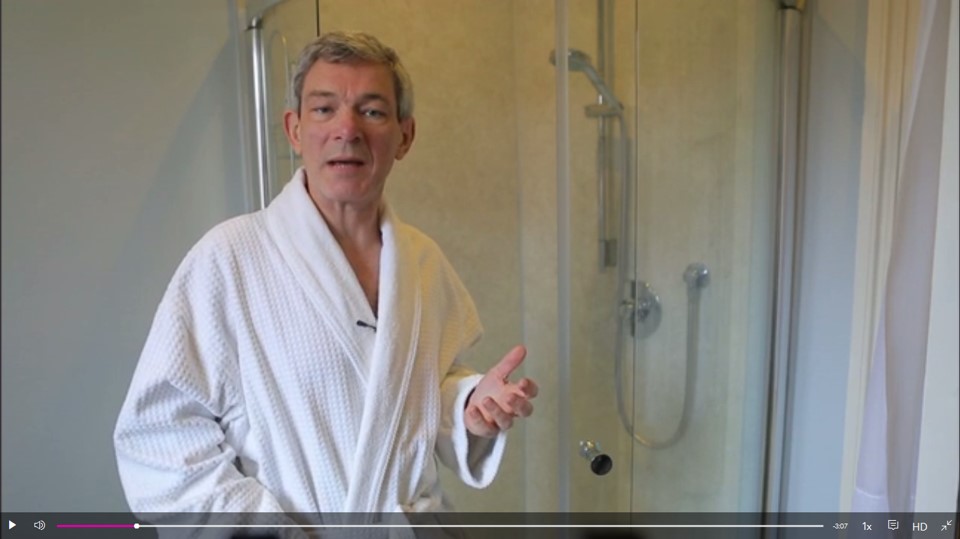
You can illustrate a much wider range of Everyday Engineering Examples on video than is viable in a lecture theatre.  So, for instance, I used my shower to engage the learners and to introduce a little statistical thermodynamics and explain how we can consider the average behaviour of a myriad of atoms.  However, it is not possible to progress through 5Es [see ‘Engage, Explore, Explain, Elaborate and Evaluate’ on August 1st, 2018] in a single step of a MOOC; so, instead I used a step (or sometimes two steps) of the MOOC to address each ‘E’ and cycled around the 5Es about twice per week.  This approach provides an effective structure for the MOOC which appears to have been a significant factor in achieving higher completion rates than in most MOOCs.

In the MOOC, I extended the Everyday Engineering Example concept into experiments set as homework assignments using kitchen equipment.  For instance, in one lab students were asked to measure the efficiency of their kettle.  In another innovation, we developed Clear Screen Technology to allow me to talk to the audience while solving a worked example.  In the photo below, I am calculating the Gibbs energy in the tank of a compressed air powered car in the final week of the MOOC [where we began to transition to more sophisticated examples].

Last academic year, I blended the MOOC on thermodynamics with my traditional first year module by removing half the lectures, the laboratory classes and worked example classes from the module.  They were replaced by the video shorts, homework labs and Clear Screen Technology worked examples respectively from the MOOC.  The results were positive with an increased attendence at lectures and an improved performance in the examination; although some students did not like and did not engage with the on-line material.

Photographs are stills from the MOOC ‘Energy: Thermodynamics in Everyday Life’.

CALE #10 [Creating A Learning Environment: a series of posts based on a workshop given periodically by Pat Campbell and Eann Patterson in the USA supported by NSF and the UK supported by HEA] – although this post is based on recent experience in developing and delivering a MOOC integrated with traditional learning environments.