Tag Archives: education

A reflection on existentialism

Detail from stained glass window by Marc Chagall in Fraumunster Zurich from http://www.fraumuenster.ch

I was in Zürich last weekend.  We visited the Fraumünster with its magnificent stained glass windows by Marc Chagall [see my post entitled ‘I and the village‘ on August 14th, 2013] and by Augusto Giacometti (1877-1947).  The Kunsthaus Zürich has a large collection of sculptures by another Giacometti, Alberto (1901-1966), a Swiss sculptor, who is famous for his slender statues of people which portray individuals alone in the world.  He was part of the existentialist movement in modern art that examined ideas about self-consciousness and our relationship to other people.  For me, this echoed a lecture that I contributed last week to a module on Scientific Impact and Reputation as part of our CPD programme [see my post entitled ‘WOW projects, TED talks and indirect reciprocity‘ on August 31st, 2016.  In the lecture, I talked about our relationship with other professional people and the development of our technical reputation in their eyes as a result of altruistic sharing of knowledge. This involves communicating with others, building relationships and understanding our place in the community.  The post-course assignment is to write a reflective essay on leadership and technical quality; and we know, from past experience, that our delegates will find it difficult to reflect on their experiences and the impact of those experiences on their life and behaviour.  Maybe we should help them by including a viewing of existential art in one of the Liverpool art galleries as part of our CPD programme on Science and Technology Leadership?

Why playing the piano might enhance our intelligence?

By National Institutes of Health [Public domain], via Wikimedia Commons

Students and lecturers leave all sorts of things in lecture theatres, including lecture notes, pens and water bottles, that accumulate around the edges like flotsam on the beach because no one wants to throw away something for which the owner might return.  A few weeks ago, I found the front page of a letter published in Nature which roused my curiosity. Its title was ‘Verbal and non-verbal intelligence changes in the teenage brain’.  My memories of my teenage years are almost uniformly bad; in part because I was unable to reproduce the academic promise that I had shown when I was younger and the pressure to do so was unrelenting.  I suspect that my experience is not uncommon and the research described in this letter offers a potential explanation for my inability to ace examinations regardless of how hard I tried.

The conventional understanding of human intellectual capacity is that it is constant during our life. However, the authors of this article have shown that the statistics, upon which this understanding is based, hide a variation in our teenage years; because some teenagers experience a reduction and some an increase in intellectual capacity, which leaves the population’s average unchanged.

In addition, using structural and functional imaging, they were able to correlate changes in verbal IQ with changes in grey matter density in a region of the brain activated by speech (the left motor cortex), and changes in non-verbal IQ with changes in grey matter density in regions activated by finger movements (the anterior cerebellum).

The timeline of the reported research does not extend far enough to establish whether or not the changes seen in teenagers is temporary; however, my anecdotal evidence suggests that might be the case.  I would conclude that the effort used to apply psychological pressure on teenagers to ace examinations might be better expended on piano lessons and piano practice to enhance sensorimotor skills which are strongly correlated to cognitive intelligence – but I suspect many parents have already worked that one out!

Source:

Ramsden S, Richardson FM, Josse G, Thomas MSC, Ellis C, Shakeshaft C, Seghier ML & Price CJ, Verbal and non-verbal intelligence changes in the teenage brain, Nature, 479:113-116, 2011.

Georgian interior design and efficient radiators

My lecture last week, to first year students studying thermodynamics, was about energy flows and, in particular, heat transfer.  I mentioned that, despite being called radiators, radiation from a typical central heating radiator represents less than a quarter of its heat output with rest arising from convection [see post entitled ‘On the beach‘ on July 24th, 2013 for an explanation of types of heat transfer].  This led one student to ask whether black radiators, with an emissivity of close to one, would be more efficient.  The question arises because the rate of radiative heat transfer is proportionate to the difference in the fourth power of the temperature of the radiator and its surroundings, and to the surface emissivity of the surface of the radiator.  This implies that heat will transfer more quickly from a hot radiator but also more slowly from a white radiator that has an emissivity of 0.05 compared to 1 for black surface.

Thus, a black radiator will radiator heat more quickly than a white one; but does that mean it’s more efficient?  The first law of thermodynamics demands that the nett energy input to a radiator is the same as the energy input required to raise the temperature of the space in which it is located.  Hence, the usual thermodynamic definition of efficiency, i.e. what we want divided by what we must supply, does not apply.  Instead, we usually mean the rate at which a radiator warms up a room or the size of the radiator required to heat the room.  In other words, a radiator that warms a room quickly is considered more efficient and a small radiator that achieves the same as large one is also considered efficient.  So, on this basis a black radiator will be more efficient.

Recent research by a team, at my alma mater, has shown that a rough black wall behind the radiator also increases its efficiency, especially when the radiator is located slightly away from the wall.  Perhaps, it is time for interior designers to develop a retro-Georgian look with dark walls, perhaps with sand mixed into the paint to increase surface roughness.

Sources:

Beck SMB, Grinsted SC, Blakey SG & Worden K, A novel design for panel radiators, Applied Thermal Engineering, 24:1291-1300, 2004.

Shati AKA, Blakey SG & Beck SBM, The effect of surface roughness and emissivity on radiator output, Energy and Buildings, 43:400-406, 2011.

Image details:

Verplank 2 002<br />
Working Title/Artist: Woodwork of a Room from the Colden HouseDepartment: Am. Decorative ArtsCulture/Period/Location: HB/TOA Date Code: Working Date: 1767<br />
Digital Photo File Name: DP210660.tif<br />
Online Publications Edited By Steven Paneccasio for TOAH 1/3/14

https://www.metmuseum.org/toah/works-of-art/40.127/

Getting it wrong

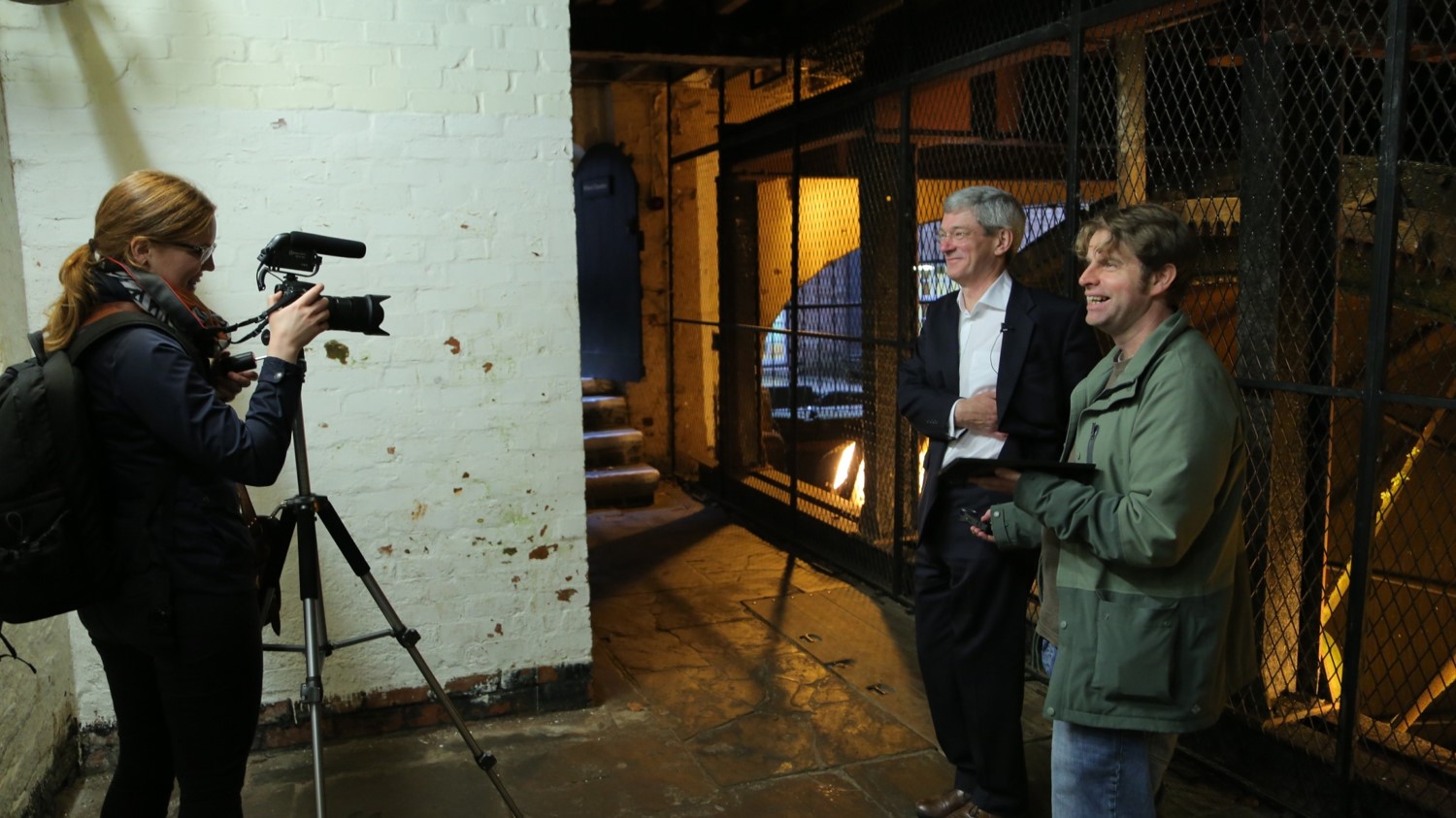
Filming for the MOOC Energy: Thermodynamics in Everyday Life

Last week’s post was stimulated by my realisation that I had made a mistake in a lecture [see ‘Amply sufficiency of solar energy?‘ on October 25th, 2017]. During the lecture, something triggered a doubt about a piece of information that I used in talking about the world as a thermodynamic system. It caused me to do some more research on the topic afterwards which led to the blog post.  The students know this already, because I sent an email to them as the post was published.  It was not an error that impacted on the fundamental understanding of the thermodynamic principles, which is fortunate because we are at a point in the course where students are struggling to understand and apply the principles to problems.  This is a normal process from my perspective but rather challenging and uncomfortable for many students.  They are developing creative problem-solving skills – becoming comfortable with the slow and uncertain process of creating representations and exploring the space of possible solutions [Martin & Schwartz, 2009 & 2014].  This takes extensive practice and most students want a quick fix: usually looking at a worked solution, which might induce the feeling that some thermodynamics has been understood but does nothing for problem-solving skills [see my post on ‘Meta-representational competence‘ on May 13th, 2015].

Engineers don’t like to be wrong [see my post on ‘Engineers are slow, error-prone‘ on April 29th, 2014].  The reliability of our solutions and designs is a critical ingredient in the social trust of engineering [Madhaven, 2016].  So, not getting it wrong is deeply embedded in the psyche of most engineers.  It is difficult to persuade most engineers to appear in front of a camera because we worry, not just about not getting it wrong, but about telling the whole truth.  The whole truth is often inconvenient for those that want to sensationalize issues for their own purposes, such as to sell news or gain votes, and this approach is anathema to many engineers.  The truth is also often complicated and nuanced, which can render an engineer’s explanation cognitively less attractive than a simple myth, or in other words less interesting and boring.  Unfortunately, people mainly pass on information that will cause an emotional response in the recipient, which is perhaps why engineering blogs are not as widely read as many others! [Lewandowsky et al 2012].


This week’s lecture was about energy flows, and heat transfer in particular; so, the following posts from the archive might be interest: ‘On the beach‘ on July 24th, 2013, ‘Noise transfer‘ on April 3rd, 2013, and ‘Stimulating students with caffeine‘ on December 17th, 2014

Sources:

Martin L & Schwartz DL, Prospective adaptation in the use of external representations, Cognition and Instruction, 27(4):370-400, 2009.

Martin L & Schwartz DL, A pragmatic perspective on visual representation and creative thinking, Visual Studies, 29(1):80-93, 2014.

Madhaven G, Think like an engineer, London: One World Publications, 2016.

Lewandowsky S, Ecker UKH, Seifert CM, Schwarz N & Cook J, Misinformation and its correction: continued influence and successful debiasing, Psychological Science in the Public Interest, 13(3):106-131, 2012.