Tag Archives: brain

Intelligent aliens?

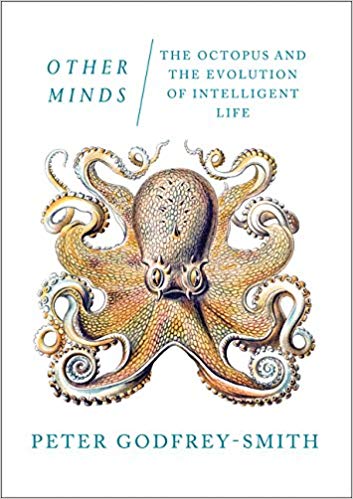
A couple of weeks ago I wrote about cuttlefish [see ‘Wearing your heart on your sleeve‘ on January 16th, 2019]  based on a wonderful book, that I was given for Christmas, called ‘Other Minds: The Octopus and the Evolution of Intelligent Life‘ by Peter Godfrey-Smith.  Cuttlefish and octopuses are cephalopods that Peter Godfrey-Smith describes as ‘an island of mental complexity in the sea of invertebrate animals’.  The most recent common ancestor of cephalopods and humans is so distant and was so simple that cephalopods represent an independent experiment in the evolution of large brains and complex behaviour.  An octopus has about 500 million neurons, which is not as many as humans, we have about 100 billion; but still a large number and connectivity is probably more important than absolute size [see ‘Digital hive mind‘ on November 30th, 2016].  Whereas we have a central nervous system, an octopus has a distributed system with neurons located in its arms which appears to give each arm a high-level of autonomy.  In addition to tactile sensory information from its suckers, each arm receives visual information from its skin which is sensitive to light.  The extent to which information and control is shared between the neurons in the brain and the network of neurons in its body is unknown.  It is difficult for us to imagine our fingers as being able to respond independently to visual as well as tactile stimuli, even more so to think of them as independent problem-solvers.  Peter Godfrey-Smith suggests that cephalopods are the closest that we are likely to come to meeting intelligent aliens – their thought processes and capabilities appear so different to ours that our scientific studies and experiments are unlikely to fully reveal their intelligence or level of consciousness.  A first step would be to stop eating them!

Peter Godfrey-Smith, Other Minds: The Octopus and the Evolution of Intelligent Life, London: William Collins, 2018.

Wearing your heart on your sleeve

Many people are increasingly using their mobile phones as mental prostheses to extend the capacity of their brains [see ‘Science fiction becomes reality‘ on October 12th, 2016].  This does not just include tracking their appointments in a calender app or using a search engine to track down a piece of information that they have temporarily forgotten; but also recording their activities and preferences via social media apps.  Many of us are happy to share our thoughts with those close to us but we take it for granted that we are in complete control of what is shared and with whom.  So, unexpected or unauthorised sharing of our personal information via these mental prostheses can cause shock and embarrassment.  Now, spare a thought for the giant cuttlefish whose neurons are directly connected to about ten million chromatophores in its skin.  Each chromatophore is sack of pigment that can be shrunk or expanded to show its particular colour.  In giant cuttlefish the chromatophores are red, yellow and black/brown.  Beneath the chromatophores is a layer of iridophores, which manipulate the wavelengths of light using layers of plates to produce blues and greens and below these cells are leucophores that reflect light outwards through the iridophores and chromatophores.  In effect, the cuttlefish is wearing an Ultra-High Definition TV screen with about 10 million pixels directly connected to its brain.  Even when resting calmly, a cuttlefish’s skin can be pulsing with complex patterns of colour; perhaps this is similar to the way our minds can be teeming with activity even when we are sitting quietly apparently doing nothing.  Imagine what it would be like if all of those thoughts were displayed on a giant television screen.  It would give a whole new meaning to the phrase ‘to wear your heart on your sleeve’.

Source:

Peter Godfrey-Smith, Other Minds: The Octopus and the Evolution of Intelligent Life, London: William Collins, 2018.

Image: https://splimm.com/2017/01/10/cuttlefish-cabin-fever/

Wading in reflections

I have written before about Daniel Goleman’s analysis of leadership styles [see ‘Clueless on leadership style‘ on June 14th, 2017]; to implement these styles, he identifies, four competencies you require: self-awareness, self-management, social awareness and relationship management.  Once again, I am involved in teaching helping people develop these competencies through our Science & Technology Leadership CPD programme for aspiring leaders in Research & Development [R&D].  As part of the module on Science Leadership and Ethics we have asked our delegates to write a short essay reflecting on the ethics of one or two real events and, either from experience or vicariously, on the leadership associated with them.  Our delegates find this challenging, especially the reflective aspect which is designed to induce them to think about their self, their feelings and their reactions to events.  They are technologists who are used to writing objectively in technical reports and the concept of writing about the inner workings of their mind is alien to them.

Apparently, the author Peter Carey compared writing to ‘wading in the flooded basement of my mind’ and, to stretch the analogy, I suspect that our delegates are worried about getting out of their depth or perhaps they haven’t found the stairs to the basement yet.  We try to help by providing a map in the form of the flowchart in the thumbnail together with the references below.  Nevertheless, this assignment remains an exercise that most undertake by standing at the top of the stairs with a weak flashlight and that few both get their feet wet and tell us what they find in the basement.

References:

A short guide to reflective writing, University of Birmingham, Library Services Academic Skills Centre, https://intranet.birmingham.ac.uk/as/libraryservices/library/skills/asc/documents/public/Short-Guide-Reflective-Writing.pdf

http://www.bbc.co.uk/bitesize/intermediate2/english/folio/personal_reflective_essay/revision/1/

Sources:

Image: https://www.pinterest.co.uk/pin/589901251161855637/

Goleman D, Boyatzis R & McKee A, The new leaders: transforming the art of leadership into the science of results, London: Sphere, 2002.

Dickson A, Books do furnish a lie, FT Weekend, 18/19 August 2018.

Logarithmic view of the world

Politicians and the media are fond of dazzling us with big numbers: $62m, £35bn, $1.1 tn.  All of these are unimaginable sums of money – uncountable and, for most us, unspendable.  They are respectively: the launch cost for SpaceX’s Falcon 9 rocket, the anticipated ‘divorce cost’ to the UK for leaving the EU and the predicted US government annual deficit for next year based on the additional spending approved in the budget bill early this month.  For most of us, winning $62m in a lottery would be a life-changing event that we might dream about but there’s only about a 1 in 14 million chance of it happening – oops, there’s another unimaginable number.

We seem quite happy handling numbers over a limited interval, from perhaps 1 in 100 [1% or 0.01] to maybe 100,000 but beyond this range our perspective ceases to be linear and probably becomes logarithmic (as in the graphic), or something similar.  In other words, we don’t perceive £35bn as being about 500 times larger than $62m, or $1.1tn being about 18 million times larger.  Instead, we concertina our mental picture into something more manageable, such as the image shown in the graphic.  Does this have the side-effect of lessening the impact of large numbers so that we are less alarmed by costs of £35bn or deficits of $1.1tn? Maybe we would take more notice of a cost of £500 per person in the UK or a deficit of $3600 per person per year in the USA?

At the other end of the scale, something similar happens.  Nanotechnology is a popular buzz word at the moment but few people can conceive of something 2.5 nanometres in diameter – that’s the diameter of a strand of DNA.  It doesn’t help much to tell you that a human hair is 40,000 times thicker!

Maybe, all of this only applies to those of us who ‘see’ numbers in pictorial patterns, and to the rest of you it is nonsensical.  See my post on Engineering Synaesthesia on September 21st, 2016.

Sources:

http://time.com/money/5135565/elon-musk-falcon-heavy-rocket-launch-cost/

https://www.theguardian.com/politics/2017/dec/31/tough-2017-what-does-next-year-hold-theresa-may

Financial Times, Weekend 10 February/11 February 2018.