Category Archives: Thermodynamics

Writing backwards

honey&mumfordschematicMy regular readers will know that I am a fan of the 5E instructional method and in particular combining it with Everyday Engineering Examples when teaching introductory engineering courses to undergraduate students. Elsewhere in this blog, there is a catalogue of lesson plans and examples originally published in a series of booklets produced during a couple of projects funded by the US National Science Foundation. Now, I have gone a step further and embedded this pedagogy in a Massive Open Online Course (MOOC) on Energy! Thermodynamics in Everyday Life. If you follow the MOOC, you’ll find some new worked examples that I explain while writing ‘backwards’ on a glass board. My film unit are very proud of the ‘backwards’ writing in these examples, which they tell me is an innovation in education filming-making. Our other major innovation is laboratory exercises that MOOC participants can perform in their kitchens. Two of these are based on everyday experiences for most participants: boiling water and waiting for a hot drink to cool down; the third is less everyday because it involves a plumber’s manometer. In each case, I am attempting to move people around Honey and Mumford’s learning cycle, which is illustrated schematically in the figure, i.e. having an experience, reviewing the experience, concluding from the experience and the planning the next steps. The intention is that students progress around the cycle in the taught component, then again in the experiments.

If you want to have a go at the one of experiments, then the instructions for the first one are available here. Alternatively you could sign up for the MOOC – its not too late!  But if you don’t want to follow the course then you can stil watch some excerpts on the University of Liverpool’s Stream website, including the backwards written examples.

Sources:

Atkin, J.M. and Karplus, R., 1962. Discovery of invention? Science Instructor, 29 (5), 45–47.

Honey P, Mumford A. The Manual of Learning Styles 3rd Ed. Peter Honey Publications Limited, Maidenhead, 1992.

And then we discovered thermodynamics

sunEnergy, matter, space and time came into existence in the Big Bang 13.5 billion years ago. 10 billion years later biological organisms started to appear. 70,000 years ago one of those organisms, man started to organise in structures, called cultures and history began. For most of history if you wanted something moved then you had to do it yourself or persuade someone else to do it. The agricultural revolution began 12,000 years ago and shortly afterwards we realised that if you fed fuel to an animal then it would ‘burn’ it and do work for you. And that’s how it remained for thousands of years – we didn’t know how to convert heat into work or work into heat. The average energy consumption per capita was about 20GJ per year. Then, 200 years ago we discovered how to imitate nature by burning fuel and producing power in the steam engine. We had discovered thermodynamics and our average energy consumption started rising towards 80GJ per year today.

As a consequence, ‘we have now all but destroyed this once salubrious planet as a life-support system in fewer than two hundred years, mainly by making thermodynamic whoopee with fossil fuels’ as Kurt Vonnegut wrote. And that’s because nature starts from solar energy and recycles everything and we haven’t learnt how to do either very effectively. But energy or power engineering has been around for less than a blink of eye relatively speaking and we are just learning how to perform a trick nature has been using for billions of years: convert solar radiation into other energy forms. The sun delivers about 340 Watts per square metre to the Earth so we have plenty energy available.

If you would like to know more about energy engineering or thermodynamics and its potential then join the 5000 people who have signed up for the MOOC that I am teaching for five weeks from next Monday.  Listen to me interview Ken Durose, Director of the Stephenson Institute for Renewable Energy on the prospects for renewable energy.

Sources:

http://ourfiniteworld.com/2012/03/12/world-energy-consumption-since-1820-in-charts/

Yuval Noah Harari, Sapiens: A brief history of mankind. London: Vintage (Penguin, Random House), 2014.

Kurt Vonnegut, A Man without a Country, New York: Seven Stories Press, 2005.

Running away from tigers

rsph graphicToday, the probability that you will have to run away from a tiger is very small, no matter where you live.  Tigers have lost 93% of their historical range that used to stretch from Turkey across Asia to Eastern China and southwards to Indonesia.  Tigers have no problem with the first law of thermodynamics – they instinctively know that if they take in more energy than they expend then the excess energy will be stored as fat and when they become overweight they won’t be able to catch you or whatever else they decided to chase for their next meal.

As a species we seem to have lost that understanding of energy balances.   Obesity is increasing in many parts of the world.  The situation is so serious in the UK, where more than two-thirds of the adult population are overweight or obese, that the Royal Society for Public Health has proposed that food should be labelled with the amount of exercise required to burn-off the calories it contains and they have suggested using the infographic in the thumbnail.  Of course, the Royal Society’s position paper does not mention explicitly thermodynamics (or tigers!) though it does effectively cite the first law by stating ‘the cause of obesity is excess energy consumption relative to energy expenditure‘.  By coincidence, this week I interviewed Professor Graham Kemp, in the Institute of Ageing and Chronic Disease in Liverpool, about energy flows through our bodies for a MOOC on Energy: Thermodynamics in Everyday Life.

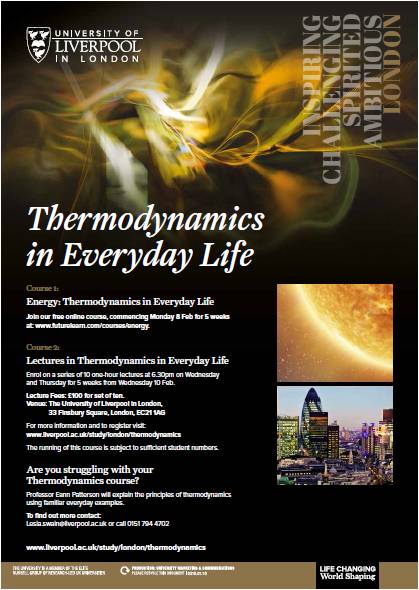
If you wathermolectures posternt to listen to that interview or learn more about the thermodynamics underpinning the energy balances controlling our weight, climate change and your electricity charges, then you need to join the more than 4,500 people who have already enrolled on the MOOC that will run for five weeks from February 8th, 2016.  I will also be giving an accompanying series of lectures in London.

I was astonished to discover that there are fewer tigers in the world than people signed up for our MOOC.  Less than 3,200 tigers exist in the wild mainly because our growing population and prolifigate use of the world’s resources has destroyed their habitat and those of the other species with which we share this planet.


Small is beautiful and economic

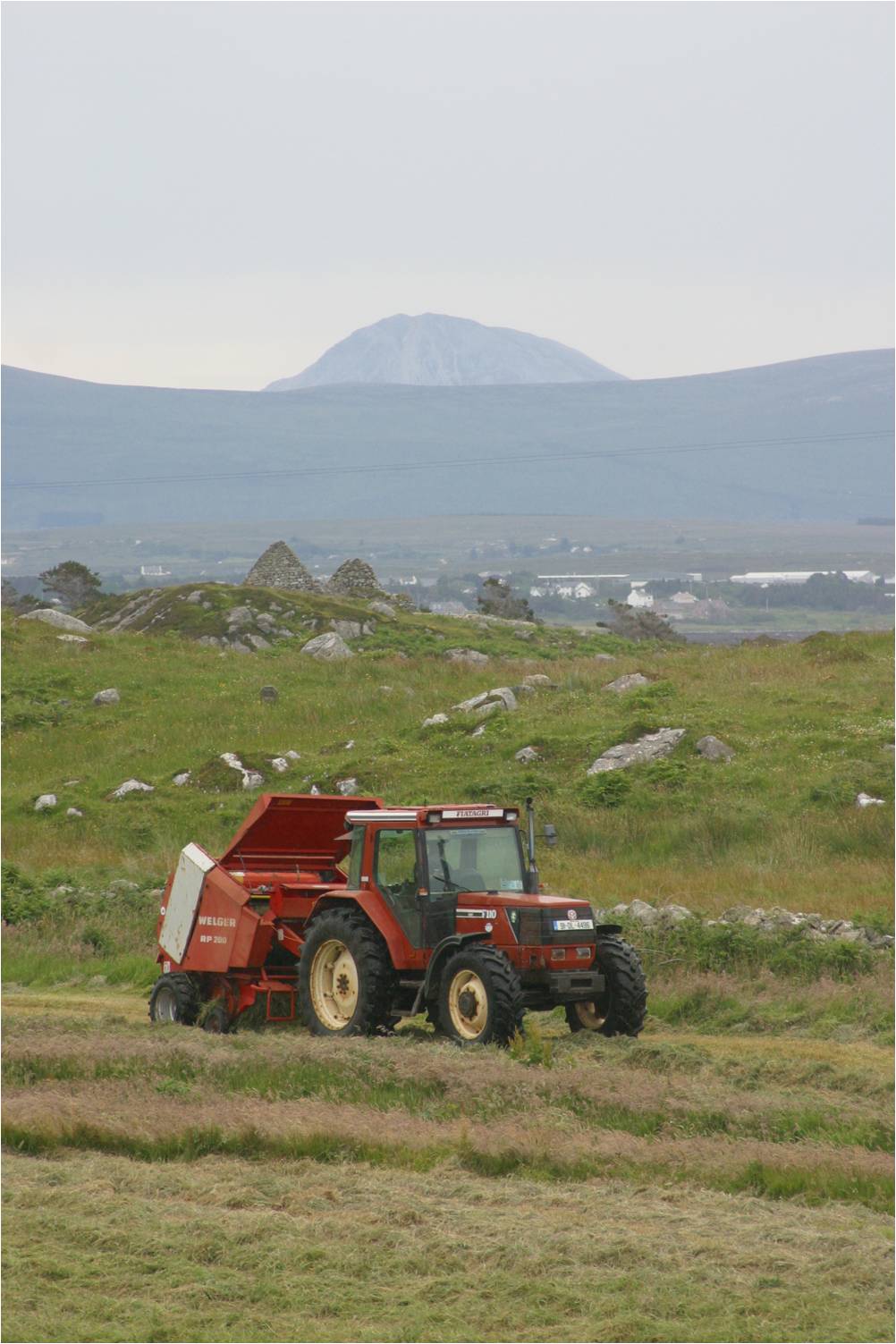
tractorFarm tractors have been growing bigger and bigger, though perhaps not everywhere – the photograph was taken in Donegal, Ireland earlier this year.  The size of tractors is driven by the economics of needing a driver in the cab. The labour costs are high in many places, so that the productivity per tractor driver has to be high too.  Hence, the tractors have to move fast and process a large amount of the field on each pass.  This leads to enormous tractors that weigh a lot and exert a large pressure on the soil, which in turn results in between 1 and 3% of the farm land becoming unproductive because crops won’t grow in the severely compressed soil. But what happens if we eliminate the need for the driver by using autonomous vehicles? Then, we can have smaller vehicles working 24/7 that do less damage and are cheaper, which means that a single machine breakdown doesn’t bring work to halt. We can also contemplate tailoring the farming of each field to the local environmental and soil conditions instead a mono-crop one-size fits all approach. These are not my ideas but were espoused by Peter Cooke of the Queensland University of Technology at a recent meeting at the Royal Society on ‘Robotics and Autonomous Systems’.

It is a similar argument for modular nuclear power stations. Most of the world is intent on building enormous reactors capable of generating several GigaWatts of power (that’s typically 3 with nine zeros after it) at a cost of around £8 billion (that’s 8 with nine zeros) so about 50 pence per Watt. Such a massive amount of power requires a massive infrastructure to deliver the power to where it is need and a shutdown for maintenance or a breakdown potentially cuts power to about a million people. The alternative is small modular reactors built, and later dismantled, in a factory that leave an uncontaminated site at a lower capital cost and which provide a more flexible power feed into the national grid. Some commentators (see for example Editor’s comment in Professsional Engineer, November 2015)believe that a factory could be established and rolling modular reactors off its production line on the same timescale as building a GigaWatt station.

Regular readers will recognise a familiar theme found in Small is beautiful and affordable in nuclear powerstations on January 14th, 2015, Enabling or disruptive technology for nuclear engineering on January 28th, 2015 and Small is beautiful on October 10th, 2012; as well as the agricultural theme in Knowledge-economy on January 1st, 2014.