
 Last week we drove from the south through downtown Detroit on Interstate 75. Approaching from a distance along the shore of Lake Erie and the banks of the Detroit river, the city looks like many others in the US with glass-clad towers clustered together and stretching towards the clear blue sky. Close-up and beyond the glass skyscrapers, Detroit offers a different view of derelict apartment blocks, factory buildings and offices covered in graffiti with weeds growing out of them. These are not isolated buildings but whole city blocks. It is reminiscent of Hadron in Doris Lessing’s book ‘Mara and Dann’, in which twenty-five towers built for city administrators are left abandoned in preference for fine houses in large gardens. The mental picture that our drive brought to mind was from Lessing’s book; however, in searching out the book at home I remembered a similar image drawn by JG Ballard in ‘High Rise’ in which civilised life in a 42-storey degenerates as residents abandon all moral and social conventions and a hunter/gatherer culture of competing gangs developed.
Of course Detroit is infamous for having recently become the largest municipal bankruptcy when it filled for Chapter 9 Bankruptcy on July 18th, 2013. However, not all is doom and gloom in Detroit; it might be suffering from entropic decay but they know how to conserve energy (available energy). At Detroit Metropolitan Airport they are replacing more than 6000 light fixtures with LED (light emitting diodes) lights in the parking structures (multi-storey car parks) as well as adding an extra thousand for a total cost of $6.2 million (£4M). It is anticipated that the resultant reduction in energy consumption will be 7,345,000 kilowatt hours (kWh) worth about $1.2 million per year (£0.77M). According to Ali Dib, Director of Infrastructure & Engineering for Wayne County Airport Authority, the energy saved by the light replacements will be “equivalent to powering 880 U.S. households for one year, and the reduction of 7,000 metric tons of CO2 per year is equal to taking 1,350 passenger vehicles off the road.” Not something they would be very happy about you doing in the ‘Motor Capital of the World’. So the other way of looking at the CO2 production saved is that it is equivalent to 25,400,000 passenger air miles not flown or a thousand round-the-world flights.
Oh, and the LEDs will only need changing every ten years instead of every thirteen months for the current light bulbs.
For ‘Mara and Dann’ see: http://www.dorislessing.org/maraand.html And for reviews: http://www.nytimes.com/books/99/01/10/reviews/990110.10upch.html or http://www.theguardian.com/books/1999/may/29/books.guardianreview27
For ‘High Rise’ see: http://www.jgballard.ca/criticism/highrise.html
Information on changing light fixtures from The Metropolitan dEtroit, August 2013 (p.11) and http://www.themetropolitandetroit.com/
Passenger air miles CO2 production from http://www.transportdirect.info/Web2/JourneyPlanning/JourneyEmissionsCompare.aspx
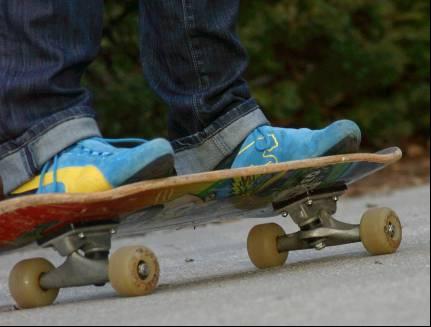 Walking through campus last week I saw a stonemason carving small chamfers every 30cm or so around the edge of plinth being prepared to receive a new sculpture. A few days later there were metal tabs fitted in the chamfers, presumably to discourage skateboarders from using the plinth for acrobatics. These metal tabs are becoming as common in our public places as the skateboarders they are designed to discourage. I can understand old people being worried by fast moving youngsters on skateboards, but the speed and freedom of movement is part of the attraction for young people. As a teacher of engineering, I see the skateboard as another everyday example of engineering with which to liven up the classroom and grab students’ attention. Try riding a board into class to engage attention!


 Realize Engineering