Category Archives: Soapbox

Only the name of the airport changes

The conference that I attended last week was in Reno, Nevada and, on my way to it, I stopped over in Dayton, Ohio and visited the US Air Force Research Laboratory to present the results from our research project supported by their European Office of Aerospace Research & Development (EOARD).  The journey from Liverpool to Dayton, via Manchester and Altanta airports, took 17 hours; however, that was short compared to the journey from Dayton to Reno, via Chicago and San Francisco airports, which took 24 hours door-to-door or rather hotel-to-hotel.  ‘Only the name of the airport changes’ is a quote from Italo Calvino describing the city of Trude in his book ‘Invisible Cities‘; but it also described how I felt looking out from my window seats at successive airports over the four days that I travelled from Liverpool to Reno.

We arrived at Dayton airport at 5am for a 7am flight to be told that it was cancelled and we were re-booked on a flight leaving at 5.18pm.  We tried to re-rent the rental car that we had just returned but were told every car was booked; so, we were stuck in Dayton airport for 12 hours.  Your perspective of time changes in these circumstances.  At 5am with nothing much to do, 12 hours seemed like infinity; but at 5pm when we were about to board our flight, the same 12 hours seemed short – almost as if we had only arrived at the airport an hour or so earlier.  Augustine observed that our consciousness is based on memory and anticipation such that time is entirely present in our minds as memory and as anticipation.  While Aristotle considered time to be the measurement of change.  Hence, since I was anticipating no change during my 12 hours of waiting, my perception of time was of it passing very slowly.  Whereas, when I was boarding my flight 12 hours later, my memory was of having done the same things that I would usually have done while waiting for a flight [reading and editing draft manuscripts from my research group]; and hence my perception of the elapsed 12 hours was compressed into the usual 2-hour period spent at an airport prior to a flight.  The apparent unchanging view out of the plane’s window, both in flight and, to a lesser extent, on the ground also tended to distort my perception of the passage of time.

Sources:

Italo Calvino, Invisible Cities, Penguin Vintage Classics, 1997.

Carlo Rovelli, The Order of Time, Penguin, 2019.
 

Feed your consciousness with sensory experiences

Our senses are bombarded in modern life.  When our ears are plugged with sound from the mobile phone to which our eyes are glues, our brain tends to be overloaded with stimuli and we barely register the signals from our other senses: smell, taste, touch.  Our smart phones can deliver so much data to our brains that there is little time to savour experiences.  Yet, some neuroscientists have suggested that the significant function of consciousness is to provide us with sensory pleasure and a reason to live.  In our busy lives, we need to pay attention to the small things in life, such as the taste of your home-made granola at breakfast and the smell of freshly brewed coffee, or the feel of a shell or pebble that you keep on your desk [‘Pebbles – where are yours?’ on September 27, 2017].  So, tune into all of your senses and give your mind a break from the digital world.  It should make you feel better.

On a similar theme see also: ‘Listening with your eyes shut‘ on 31st May 2017 and ‘Slow down, breathe your own air‘ on December 23rd, 2015.

Sources:

Ken Mogi, The little book of ikigai, London: Quercus Editions Limited, 2018.

Nicholas Humphrey, Soul dust: the magic of consciousness,Princeton NJ: Princeton University Press, 2012.

Knowledge explosions

Photo credit: Tom

When the next cohort of undergraduate students were born, Wikipedia had only just been founded [January 2001] and Google had been in existence for just over a decade [since 1998].  In their lifetime, the number of articles on Wikipedia has grown to nearly 6 million in the English language, which is equivalent to 2,500 print volumes of the Encyclopedia Britannica, and counting all language editions there are 48 million articles.  When Leonardo Da Vinci was born in 1452, Johan Gutenberg had just published his first Bible using moveable type.  By the time Leonardo Da Vinci was 20 years old, about 15 million books had been printed which was more than all of the scribes in Europe had produced in the previous 1500 years.  Are these comparable explosions in the availability of knowledge?  The proportion of the global population that is literate has changed dramatically from about 2%, when Leonardo was alive, to over 80% today which probably makes the arrival of the internet, Wikipedia and other online knowledge bases much more significant than the invention of the printing press.

Today what matters is not what you know but what you can do with the knowledge because access to the internet via your smart phone has made memorisation redundant.

Eternal non-existence

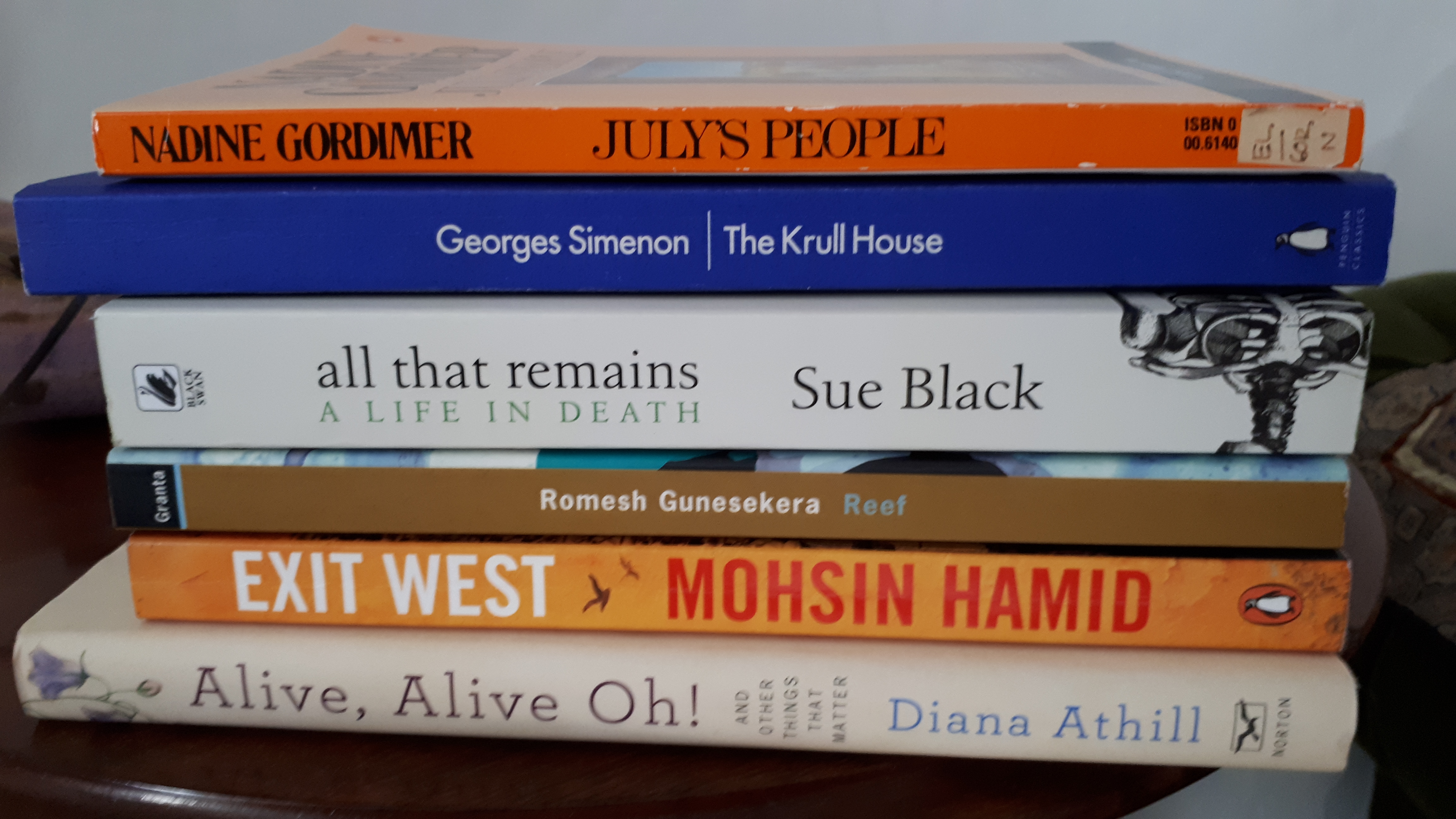
I was on holiday last week in the Lake District.  The weather was beautiful all week and we spent every day walking the hills around the Duddon Valley before sampling a different real ale each evening in the Manor Arms in Broughton-in-Furness.  I also found time to read a small pile of books in which a recurring theme seemed to be death, perhaps because I was sensitised to it by the most substantial book on the pile: ‘All that remains: a life in death‘ by Sue Black, who is a leading professor of anatomy and forensic anthropology. In her brilliant memoir, she identifies three stages: dying, death and being dead.  She worries most about the first stage, dying, which in common with most people, she would like to skip through as quickly as possible.  However, she is intrigued by the threshold that separates dying from being dead and would like to experience it when the time comes; although that sounds like professional curiosity to me and I would be happy to skip through that too.  As she points out, those fears that we might have about the third stage, being dead, depend on our belief in what happens to us after death.  Not many people write books at the age 99, so I was curious to read a collection of essays by Diana Athill who was born in 1917 and published ‘Alive, Alive Oh!‘ in 2016.  The final essay is entitled ‘Dead right’ and is about her recollection of a contribution to a discussion on a television programme about death made by the photographer, Rankin.  The contributor said ‘that not existing for thousands and thousands of years before his birth had never worried him for a moment, so why should going back into non-existence at his death cause him dismay?’.