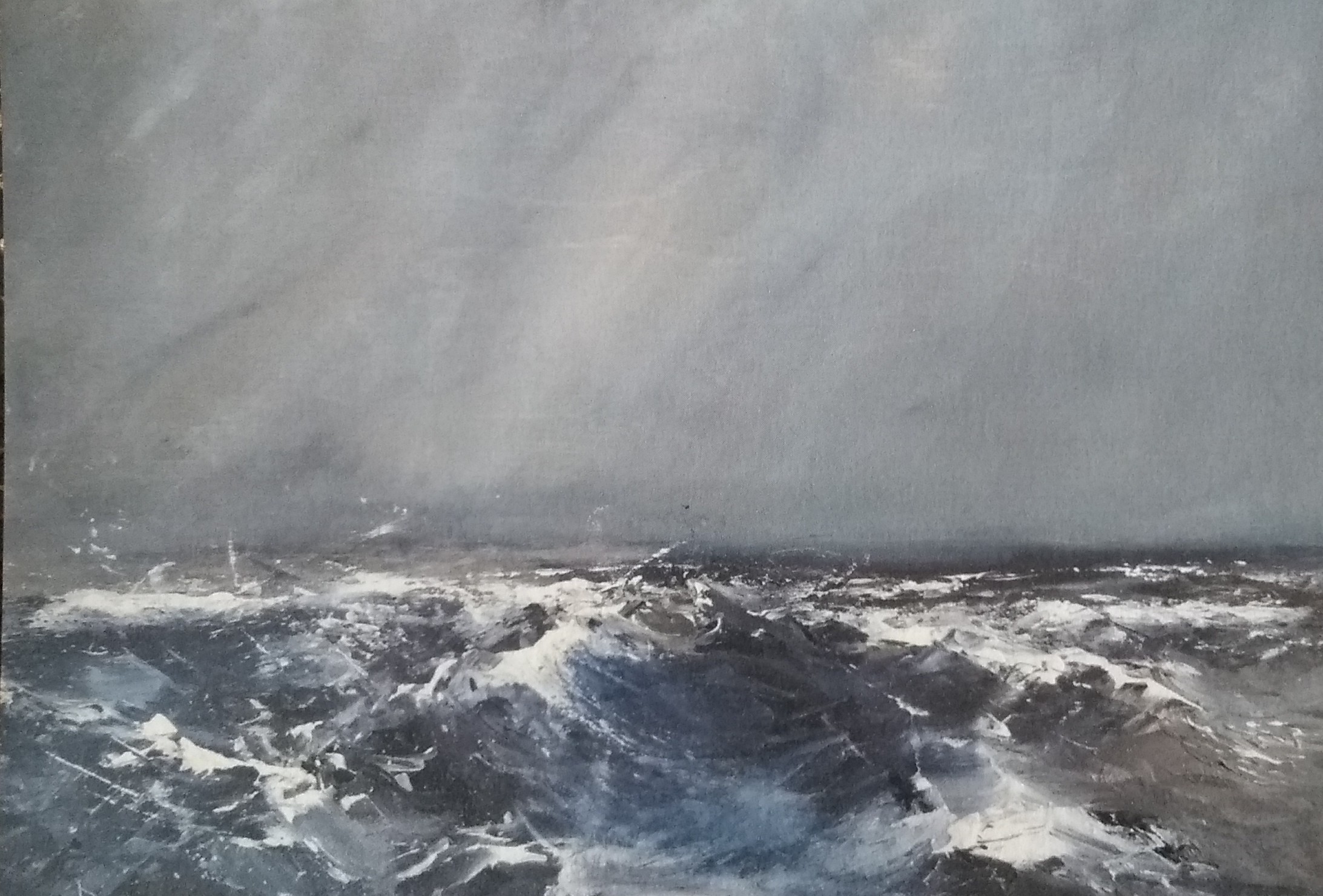
 As part of my undergraduate course on thermodynamics [see ‘Change in focus’ on October 5th, 2022) and in my MOOC on Thermodynamics in Everyday Life [See ‘Engaging learners on-line‘ on May 25th, 2016], I used to ask students to read Chapter 1 ‘The Storm in the Computer’ from Philosophy and Simulation: The Emergence of Synthetic Reason by Manuel Delanda. It is a mind-stretching read and I recommended that students read it at least twice in order to appreciate its messages. To support their learning, I provided them with a précis of the chapter that is reproduced below in a slightly modified form.
At the start of the chapter, the simplest emergent properties, such as the temperature and pressure of a body of water in a container, are discussed [see ‘Emergent properties’ on September 16th, 2015]. These properties are described as emergent because they are not the property of a single component of the system, that is individual water molecules but are features of the system as a whole. They arise from an objective averaging process for the billions of molecules of water in the container. The discussion is extended to two bodies of water, one hot and one cold brought into contact within one another. An average temperature will emerge with a redistribution of molecules to create a less ordered state. The spontaneous flow of energy, as temperature differences cancel themselves, is identified as an important driver or capability, especially when the hot body is continually refreshed by a fire, for instance. Engineers harness energy gradients or differences and the resultant energy flow to do useful work, for instance in turbines.
However, Delanda does not deviate to discuss how engineers exploit energy gradients. Instead he identifies the spontaneous flow of molecules, as they self-organise across an energy gradient, as the driver of circulatory flows in the oceans and atmosphere, known as convection cells. Five to eight convections cells can merge in the atmosphere to form a thunderstorm. In thunderstorms, when the rising water vapour becomes rain, the phase transition from vapour to liquid releases latent heat or energy that helps sustain the storm system. At the same time, gradients in electrical charge between the upper and lower sections of the storm generate lightening.
Delanda highlights that emergent properties can be established by elucidating the mechanisms that produce them at one scale and these emergent properties can become the components of a phenomenon at a much larger scale. This allows scientists and engineers to construct models that take for granted the existence of emergent properties at one scale to explain behaviour at another, which is called ‘mechanism-independence’. For example, it is unnecessary to model molecular movement to predict heat transfer. These ideas allow simulations to replicate behaviour at the system level without the need for high-fidelity representations at all scales. The art of modelling is the ability to decide what changes do, and what changes do not, make a difference, i.e., what to include and exclude.
Source:
Manuel Delanda Philosophy and Simulation: The Emergence of Synthetic Reason, Continuum, London, 2011.
Image: Painting by Sarah Evans owned by the author.


 Realize Engineering