Category Archives: education

Compelling presentations

It used to be that you only had to compete with the view out of the window when you were talking to a group of people.  Now, you have to compete with the view of the world available through people’s mobile devices.  You know when your audience arrives and sets up their laptops that you have a challenge ahead of you.  A few of them might be planning to take notes using their laptop but most will be distracted by the constant flow of information delivered by email and messaging applications.  Of course, you can use the same technology to embellish your presentation and to hold their attention; but often the result is ‘death by Powerpoint’ and the audience retreats into their own worlds – doing their own thing.

There’s a nice quote from an interview with Eric Clapton in the San Diego Union Tribune (September 4th, 2005): ‘It’s very hard, so I try and make it as engaging as it can be. But you have to face the fact that, no matter how good it is, you can only hold their attention for a little while.  So, you have to plan you talk in small steps and to re-engage your audience at the start of each step.  There needs to be a narrative and the same rules apply as when writing [see post entitled ‘Reader, Reader, Reader’ on April 15th, 2015].  Powerpoint is not a requisite nor a substitute but preparation is essential.  As a group of undergraduate students told me during a recent visit to another university, they can easily spot the lecturers who prepare conscientiously and are worth listening to.

I am at a scientific conference this week where a wide range of speaking skills will be on display and I have my mobile devices with me to provide alternative stimulation.  The real value of the conference is the opportunity to interact with other researchers in a community of knowledge and for that we need shorter talks and more time for discussion.  But the mechanics of modern scientific conferences is a separate issue!


Image: view from lecture theatre on London campus where I taught science and technology leadership last year [see post entitled ‘Leadership is like shepherding‘ on May 10th, 2017].

Creating an evolving learning environment

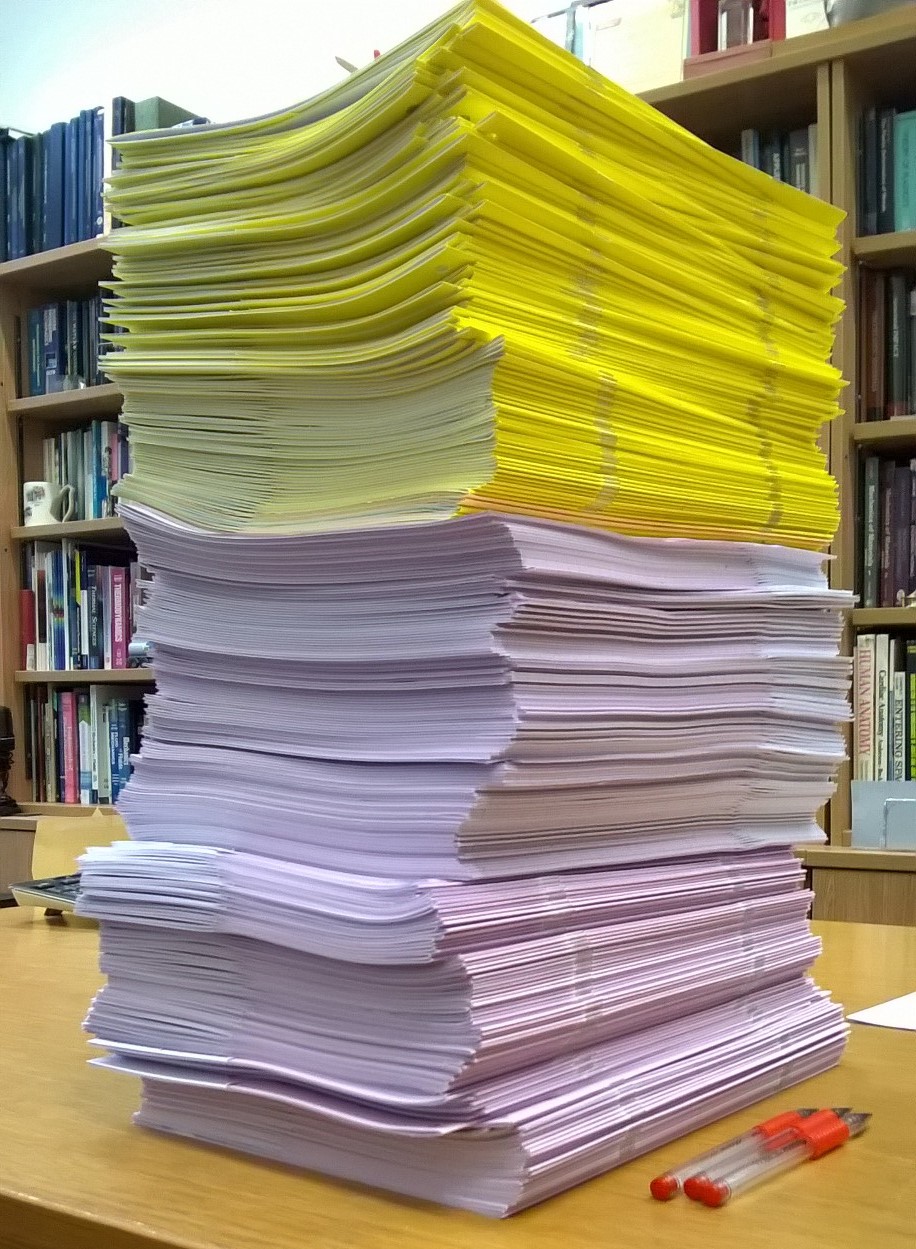
A couple of weeks ago, I wrote about marking examinations and my tendency to focus on the students that I had failed to teach rather than those who excelled in their knowledge of problem-solving with the laws of thermodynamics [see my post ‘Depressed by exams‘ on January 31st, 2018].  One correspondent suggested that I shouldn’t beat myself up because ‘to teach is to show, to learn is to acquire‘; and that I had not failed to show but that some of my students had failed to acquire.  However, Adams and Felder have stated that the ‘educational role of faculty is not to impart knowledge; but to design learning environments that support knowledge acquisition‘.  My despondency arises from my apparent inability to create a learning environment that supports and encourages knowledge acquisition for all of my students.  People arrive in my class with a variety of formative experiences and different ways of learning, which makes it challenging to generate a learning environment that is effective for everyone.   It’s an on-going challenge due to the ever-widening cultural gap between students and their professors, which is large enough to have warranted at least one anthropological study (see My Freshman Year by Rebekah Nathan). So, my focus on the weaker exam scripts has a positive outcome because it causes me to think about evolving the learning environment.

Sources:

Adams RS, Felder RM, Reframing professional development: A systems approach to preparing engineering educators to educate tomorrow’s engineers. J. Engineering Education, 97(3):230-240, 2008.

Nathan R, My freshman year: what a professor learned by becoming a student, Cornell University Press, Ithaca, New York, 2005

Depressed by exams

I am not feeling very creative this week, because I am in middle of marking examination scripts; so, this post is going to be short.  I have 20 days to grade at least 1100 questions and award a maximum of 28,400 marks – that’s a lot of decisions for my neurons to handle without being asked to find new ways to network and generate original thoughts for this blog [see my post on ‘Digital hive mind‘ on November 30th, 2016].

It is a depressing task discovering how little I have managed to teach students about thermodynamics, or maybe I should say, how little they have learned.  However, I suspect these feelings are a consequence of the asymmetry of my brain, which has many more sites capable of attributing blame and only one for assigning praise [see my post entitled ‘Happenstance, not engineering‘ on November 9th, 2016].  So, I tend to focus on the performance of the students at the lower end of the spectrum rather than the stars who spot the elegant solutions to the exam problems.

Sources:

Ngo L, Kelly M, Coutlee CG, Carter RM , Sinnott-Armstrong W & Huettel SA, Two distinct moral mechanisms for ascribing and denying intentionality, Scientific Reports, 5:17390, 2015.

Bruek H, Human brains are wired to blame rather than to praise, Fortune, December 4th 2015.

Formula Ocean

I have had intermittent interactions with motorsport during my engineering career, principally with Formula 1, Formula SAE and Formula Student teams.  The design, construction and competition involved in Formula Student generates tremendous enthusiasm amongst a section of the student community and enormously increases their employability.  As a Department Chair at Michigan State University, I was a proud and enthusiastic sponsor of the MSU Formula SAE team.  However, I find it increasingly difficult to support an activity that is associated with profligate expenditure of energy and resources – this is not the impression of engineering that should be portrayed to our current and future students.  Engineering is about so much more than making a vehicle go around a track as fast as possible.  See my posts on ‘Re-engineering Engineering‘ on August 30th, 2017, ‘Engineering is all about ingenuity‘ on September 14th, 2016 or ‘Life takes engineering‘ on April 22nd, 2015.

There are many other challenges that could taken up by student teams, in competition if that encourages participation, which would benefit human-kind and the planet.  A current hot topic in the UK media is the pollution of oceans by waste plastic [see for example BBC report]; so, engineering undergraduates could be challenged to design, construct and operate an autonomous marine vehicle that collects and processes plastic waste.  It could be powered from the embedded energy in the waste plastic collected in the ocean.  It would need to navigate to avoid collisions with other vessels, coastal features and wildlife, and to locate and identify the waste.  These represent technological changes in chemical, control, electronic, materials and mechanical engineering – and probably some other fields as well.  I have shared this concept with colleagues in Liverpool and there is some enthusiasm for it; maybe some competition from other universities is all that’s needed to get Formula Ocean started.  The machine with the largest positive net impact on the environment wins!