Category Archives: Engineering

Engineering archaeology

Last week I spent a relaxing day painting the old railings in front of our house. Since I am not a painter and decorator by trade the end result is not perfect but they look much better in shiny black than two-tone rust and matt black.   One of the fleurs de lis on our railings had been knocked off when either we moved in or the previous occupiers moved out.  It’s a way of life being an engineer, so the shape of the failure surface on the broken railing was bugging me while I was painting the rest.  You would expect wrought iron railings to be ductile, i.e. to deform significantly prior to fracture, and to have a high tensile strength.  Wrought iron’s properties are derived from its very low carbon content (less than 0.25%) and the presence of fibrous slag impurities (typically about 2%), which almost make it a composite material.  It was historically used for railings and gates.  However, my broken railing had exhibited almost no deformation prior to fracture, i.e. it was a brittle failure, and the fleur de lis had broken in half on impact with the stone flags.  So on one of the rainy days last week, when I couldn’t paint outside, I did a little bit of historical research and discovered that in the late 1790s and early 1800s, which is when our house was built, cast iron started to be used for railings.  Cast iron has a high carbon content, typically 2 to 4%, and also contains silicon at between 1 and 3% by weight.  Cast iron is brittle, i.e. it shows almost no deformation prior to fracture, so the failure surface tends be to flat and smooth just like in my fleur de lis.

This seems like a nice interdisciplinary, if not everyday, engineering example.  It would be vandalism to go around breaking iron railings in front of old buildings.  So, if you want Everyday Engineering Examples of ductile and brittle behaviour, then visit a junk shop and buy an old china dinner plate and a set of cutlery.  The ceramic of the china plate is brittle and will fracture without deformation – have some fun and break one!  The stainless steel of the fork and spoon is ductile and can be easily bent, i.e. it is easy to introduce large deformation, in this case permanent or plastic deformation, prior to failure.  In fact you will probably have to bend the fork back and forth repeatedly before it will snap with each bending action introducing additional damage.

The more curious will be wondering why some materials are ductile and others brittle.  The answer is associated with their microstructures, which in turn is dependent on their constituents, as hinted above.  However, I am not going to venture into material science to explain the details.  I have probably already given materials scientists enough to complain about because my Everyday Engineering Examples are not directly analogous at the microstructural level to wrought iron and cast iron but they are more fun.

Sources: http://www3.westminster.gov.uk/spgs/publications/Railings.pdf

Conflict Resolution

conflict pyramidEngineers need to be experts in resolving conflicts…

Every man-made device that moves required energy to make it and uses energy when it moves. Heavier devices have greater inertia than small ones and hence more energy is needed to set them in motion – think about peddling an old-fashioned steel-framed bike compared to a modern alloy one. So, designing for sustainability requires engineers to minimise the quantity of raw materials and energy used to manufacture a device AND to minimize its weight if the device moves as part of its function.

Now, here comes the conflict.

Sustainability also implies that devices should have a long, maintenance-free service life so that resources used in maintenance and replacement are minimized. Service life is usually limited by fatigue and, or wear and the probability of these failure mechanisms occurring can be reduced by lowering stress levels. However, stress is inversely proportional to cross-section area and so can be reduced by adding material, i.e. increasing the mass of the device which will also increase its inertia, or resistance to motion. The probability of failure can be reduced by using stronger, more sophisticated materials that are lightweight and almost always more expensive, e.g. composites. Customers also want performance and additional expense might be acceptable if it is accompanied by additional performance – some people will pay for a carbon-fibre frame for their bicycle. Elegant engineering design requires resolution of the conflict between cost, safety and reliability, performance and sustainability.

This is why engineers are trained in conflict resolution or as it is more commonly known: problem-solving.

Are electric cars back?

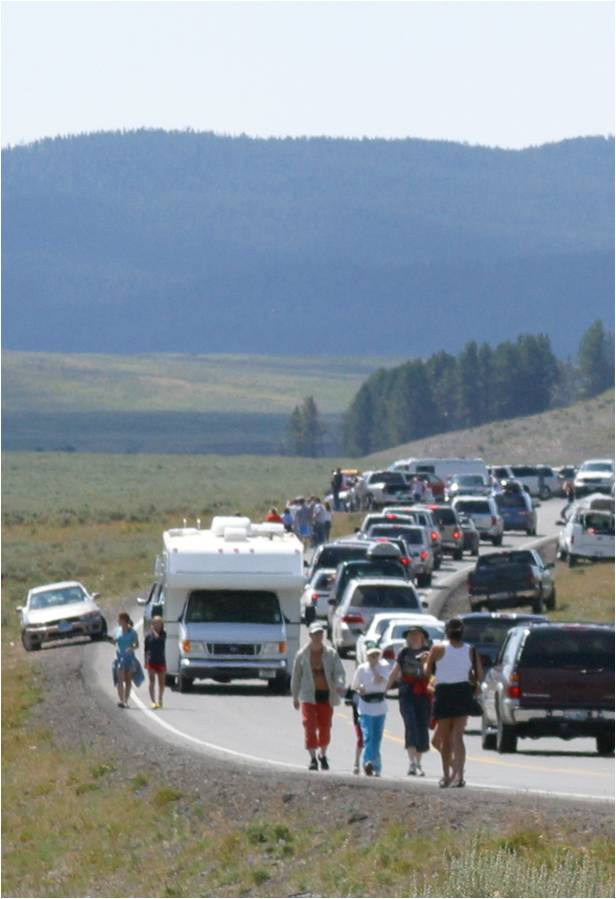
roadchaosDid you know that before Henry Ford developed the Model T Ford motorcar, the nearly 40% of automobiles on US roads were electric vehicles? I think we will be heading back in this direction if we are to have any hope of achieving reductions in carbon dioxide emissions. The implications for the national electricity grid of a major shift to plug-in cars would be very serious and has been the subject of several recent studies including a third year undergraduate dissertation that I have been supervising and from which came the opening factoid.

It is relatively easy, through not without obstacles, to envision a shift to all-electric cars; after all there are several models on the market now. However, an all-electric aircraft seems further in the future, if only because of the weight of the batteries required. Engineers would talk about the energy density, i.e. the amount of energy that can be extracted from a kilogram of kerosene compared to a kilogram battery. However, perhaps the future is not far away because the New Scientist reported earlier in the month [3rd May, 2014] that Airbus had completed the test flight of an electric plane, the E-fan. It is a two-seater plane with a pair of 65 kilogram lithium battery packs driving a pair of 30 kilowatt motors attached to the fans. The E-fan will cruise at 185 kilometres per hour and flies for an hour. Relative to a modern computer jet, this performance is similar to the early plug-in cars relative to their internal-combustion-engined rivals. But, it is an indication of bigger things to come. In the meantime, if you want an E-fan then a new division of Airbus called Voltair will be producing them by 2017.

I mentioned undergraduate dissertations because they have filled a sizeable chunk of my waking hours for a few weeks. This is an annual ritual in the UK during May when final-year undergraduate students are busy submitting and defending their dissertations. I had a pile of twelve dissertations to read and assess. Eight of them belonged to students that I have supervising in weekly one-to-one meetings since last October and the remainder were dissertations for which I was the assessor. All of the students that I supervised were studying either Mechanical or Aerospace Engineering and so the topics of their projects were associated mainly with energy and, or transportation. Some of these projects are provided by engineering companies (those with an asterisk in the list below), which guarantees their topicality and relevance, while others spin-out from my interests and research activities. So many of the topics in the list below will come as no surprise to regular readers of this blog.

Dissertation projects supervised during 2013-14:

Investigation into a redesign of graphite re-entrant seals for a nuclear power station*

Conceptual design for a carbon sequestration system for automobiles

Recommendations for achieving a low carbon airline industry

Strain-based defect analysis of industrial pipe-work*

Investigation of random frequency excitation of an aerospace body panel

Assessment of preload control of threaded fasteners in motorcycle production*

Recommendations for technology-based approaches to reduced ecological footprints

Investigation of low carbon power for plug-in electric vehicles

100 Everyday Engineering Examples

bookletsSTOP PRESS – more than 100 Everyday Engineering Examples published in more than 40 lesson plans on a new webpage.

I have been including 5E lesson plans as part my recent posts.  These lesson plans are primarily for people teaching first-year engineering undergraduates, which is pulling me away from the intended focus of this blog. So, I have decided to publish all of the lesson plans that I have written & edited on a separate page.  There are more than 100 Everyday Engineering Examples in the more than forty lesson plans.  If that is not enough Everyday Engineering Examples then you can find more at ENGAGE

Now back to Realizing Engineering – we live in an almost entirely engineered world. Engineers, as a profession, are so good at their job that most people are unaware of their influence on society.  Look around you. Engineers will have designed the machines and transport infrastructure to supply most of what you can see as well as what you are probably sitting in and on.

The Royal Academy of Engineering has produced an ebook to expand on this theme of ‘Engineering in Society’ for first year engineering undergraduates but I think its suitable for anyone considering a career in Engineering.