Category Archives: Engineering

Caustics

caustic_hole

White light caustic of 4mm diameter hole in 6mm (PMMA) plate subject to 3kN tension

As children many of us have burnt a hole (yes, tenuous link to last week’s post on ‘Holes’) in a piece of paper by focussing the sun’s rays with a magnifying glass. If you move the glass up or down and tilt it slightly then the sun’s rays will not be focussed on a spot and instead you see a complex spiralling pattern of light. This pattern is caused by the rays being bent by their passage through different sections of the curved glass. The same type of pattern, known as a caustic, appears on the bottom of your bath when you let (clean) water run out down the plug-hole if you have spotlights above the bath. This caustic is produced by the light rays from the spotlight being bent by varying degrees depending on where they pass through the vortex formed by the water spinning down the hole.  Caustics can also be produced when light passes through a glass of water or on the bottom of an outdoor swimming pool in bright sunlight.

The top picture shows the caustic formed by light passing through a transparent plate with a hole when the plate is stretched in the vertical direction. The load in the plate has to flow around the hole where it ‘bunches up’ or concentrates (see last week’s post entitled ‘Holes’) which causes high levels of local deformation with the plate thinning non-linearly at the intersection of the hole circumference and horizontal diameter. When the light passes through the deformed region it is deviated by amount dependent on the local thinning and forms the pattern shown.

This is not a totally abstract phenomenon because the same mechanism of thinning occurs at the tip of cracks as a result of the very high stress concentration at the sharp crack tip, as shown schematically in the diagram below. So we can evaluate the stress concentration by measuring the caustic it generates; it is even possible to predict in which direction the crack will grow next.

Schematic diagram of transparent plate with a crack loaded vertically in tension (left), light ray tracings through the cracked region (centre) and caustic formed on a screen (right).

Schematic diagram of transparent plate with a crack loaded vertically in tension (left), light ray tracings through the cracked region (centre) and caustic formed on a screen (right).

For information:
Carazo-Alvarez, J.D., Patterson, E.A., 1999, ‘A general method for automated analysis of caustics’, Optics & Lasers in Engng., 32: 95-110.

http://lgg.epfl.ch/caustics/

Holes

Holes, little circular ones. There are billions of them in engineering machines and structures. There are more than a million in a jumbo jet alone. Some of them are filled with fasteners, such as bolts and rivets, others are empty to allow fluids to flow through a surface. Load passing through a structure has to flow around holes, especially when they are empty, and the contours of stress bunch up around a hole to form a stress concentration. For a small hole in a very large plate, the stress on the circumference of the hole is three times the level found in the absence of the hole. This concentration increases for bigger holes or smaller plates, so that holes are a potential source of failure – that’s why sheets of stamps are perforated with lines of holes.

A hole can also stop a failure. For instance a crack extending under repeated loading will often stop when it grows into a hole because the ‘sharpness’ of the crack tip is blunted by the roundness of the hole. Engineers sometimes deliberately drill a hole at a crack tip to arrest its progress. So, holes can be both an engineer’s friend and foe.

Origami car-planes

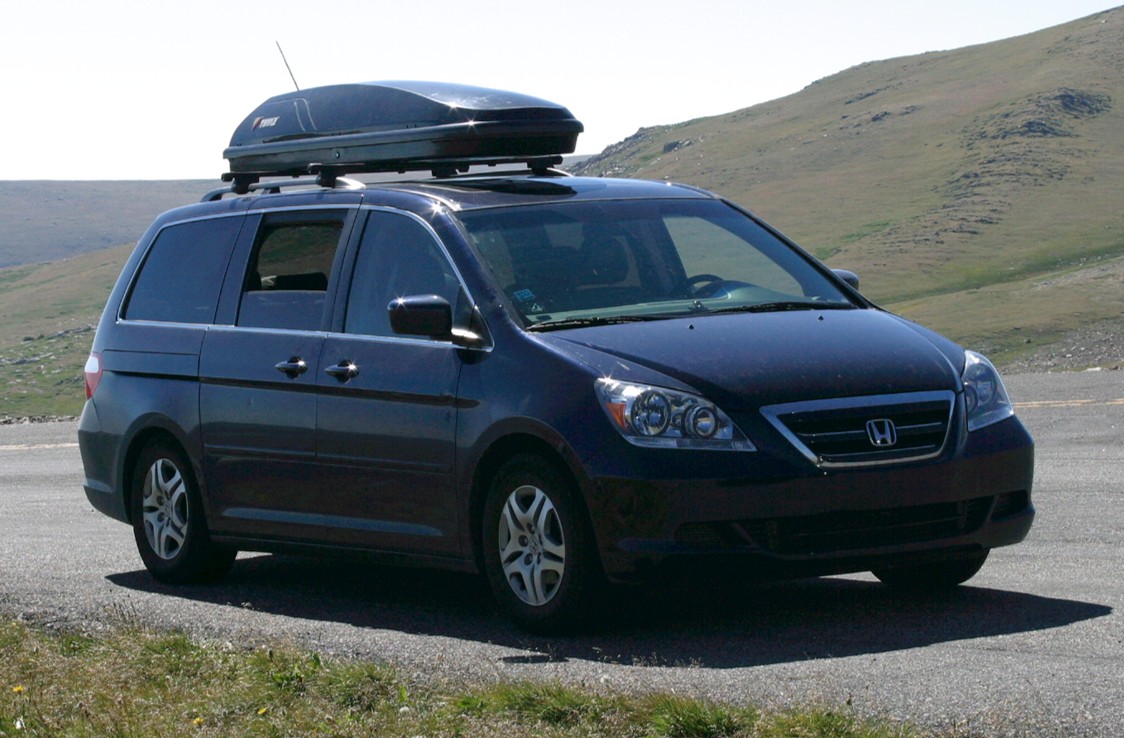
Origami wings in the roof-box?

Origami wings in the roof-box?

A few weeks ago I was fascinated by the competitors’ bikes tessellated on top of the team support cars during the Tour of Britain [see my post entitled ‘Tessallating bikes‘ on September 10th, 2014]. What if instead of tessellating bikes we could use origami to fold away a set of wings? Many people have dreamed of escaping the frustration and congestion of traffic on the road with a convertible. Not the classic convertible but a car that converts to a plane. One small company from Massachusetts, Terrafugiama has already flown a prototype flying car with self-folding wings and is working on an advanced prototype capable of vertical take-off and highway driving. Vertical take-off with wings is difficult so as an alternative a group of universities in Europe is studying the feasibility of a Personal Air Transportation System (PATS) based on a helicopter, known as MyCopter.

These convertibles are difficult to design in practice due to the space constraints for a flying car to take-off and land, the need for two propulsion or at least two transmission systems, the different type of suspension required for comfortable driving compared to landing, the current approach to crashworthiness in cars, and the overwhelming requirement for a light-weight system if there is any hope of getting airborne.   If you add to this list the desire for an environmental-friendly vehicle then perhaps there is no hope, unless we can cross a Tesla with the Airbus prototype electric plane, the E-plane!  [See my post entitled ‘Are electric cars back?‘ on May 28th, 2014]

Sources:

Why we’re not driving the friendly skies‘ by Stuart F. brown in the New York Times on August 22nd, 2014

‘If cars could fly‘ by Nick Bilton in the New York Times on June 30th, 2010

http://www.nytimes.com/2014/08/24/automobiles/pie-in-the-sky-flying-cars-from-the-past.html?action=click&contentCollection=Automobiles&module=RelatedCoverage&region=Marginalia&pgtype=article&_r=0

Sounds of the city

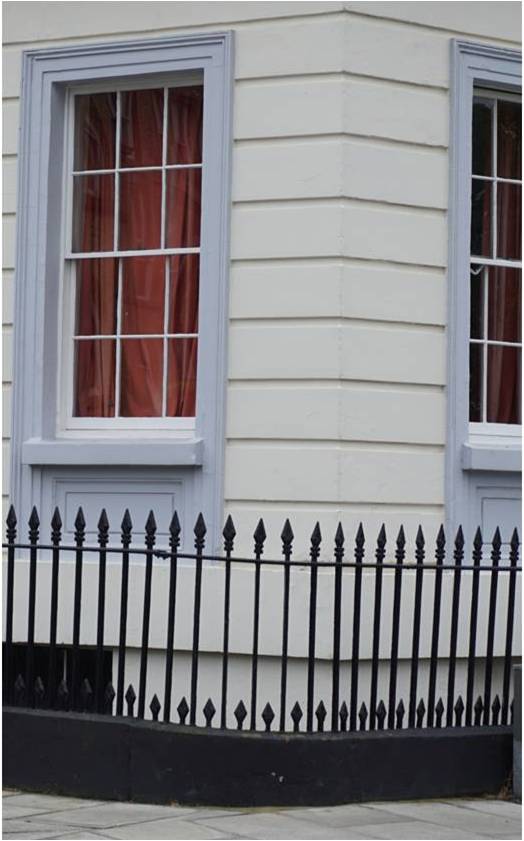
cornerRegular readers of this blog will know that I spent a relaxing day painting railings a few weeks ago [see post entitled ‘Engineering archaeology‘ on July 23rd, 2014].  A day or so later, I went out with my pail of whitewash to paint the walls of the light-well that the railings protect.  ‘The summer world was bright and fresh, and brimming with life’ but unlike Tom Sawyer I was not looking for Jim to do my white-washing for me.  I was looking forward to another therapeutic session painting the walls at the front of our house.  It was an interesting standing in the light-well facing the wall, un-noticed by most passers-by.  We live on a city street close to tourist attractions and there is a constant stream of coaches and taxis stopping to drop-off and pick-up tourists. I have written about the noise insulation in our house before [see Noise Transfer on April 13th, 2013] which means that we don’t notice the constant growl of diesel engines outside but I did while I was painting.  However, there were other sounds in the city.  The voices of pedestrians  deep in conversation as they passed by on the pavement just above my head.  I recognised Chinese, French, Italian and English but there were many different languages that I didn’t recognise.  There were young children asking parents questions as they walked down the street.  For a while I could hear cathedral bells.  When there was a pause in the traffic then it was possible to hear the cooing of pigeons, a neighbour’s radio or television and an ever-present idling diesel engine which I discovered was an ice-cream van dispensing a constant trickle of black soot and an occasional ice-cream.  It is curious that as a society we tolerant high levels of noise pollution at tourist attractions, especially ones that are meant to be places of calm and contemplation. Most tourists are, almost by definition, on holiday seeking relaxation and a lowering of stress levels – how much more pleasant would it be to glide to your destination in a silent electric coach or taxi?

We have the technology to provide such a service [see Are electric cars back? on May 28th, 2014]. Yes, it requires some investment by tour operators and taxi firms in hybrid or electric vehicles and by the city council in re-charging facilities. Induction charging stations at tourist attractions would allow vehicles to recharge while dropping off and picking up passengers. The technology is available and has been used by buses in Genoa and Turin for more than a decade.  So a little bit a regulatory pressure and investment from city councils acting together could create a calmer, quieter and cleaner environment for everyone.

Can we look forward to solar-powered ice-cream vans?

Sources: Thank you to Richard for reminding me about Tom Sawyer.