Tag Archives: Thermodynamics

Energy efficiency

We were sent a summary of our annual gas and electricity consumption recently by our local utility company. The utility quantified our consumption of both gas and electricity in units of kilowatt-hours (kWh). It is usual to be sold electricity in kilowatt-hours but most people are confused by this unit. Perhaps because they learnt at school that the units of energy are Joules in the SI system and the power rating of appliances is usually given in Watts. They might know that a Watt is a Joule of energy per second, so what is a kilowatt-hour? Well it is about 3.6 x 10⁶ Joules or 3.6 MJ, because it is 1000 Joules per second (= Watt) for one hour. So, I think the utility company should be telling me how many MegaJoules (MJ) we have consumed. After all we are used to seeing the energy content of our food quoted in kiloJoules (kJ), as well as calories.

The situation with our gas consumption is rather different because the utility does not supply energy but gas. The amount of energy that I get from it depends on what I do with it. If I burn it under conditions of constant volume, e.g. in a closed rigid container with exactly the correct concentration of oxygen then it will generate more energy in terms of heat than when it is burnt in constant pressure conditions, such as at atmospheric pressure in air. This is because in constant pressure conditions some of the energy released by combustion is used to expand the exhaust gases against the constant pressure, i.e. to do work, and only what is left is released as heat. So the utility should sell the gas by weight. If they sold it by volume then I would be paying more for the same amount of gas (i.e. number of hydrocarbon molecules) when the supply pressure was reduced.

Oil companies don’t sell gasoline or diesel in Joules for the same reason but they can sell by volume because it is always supplied to our cars at atmospheric pressure and the volume of a liquid is essentially constant.

We like to compare the efficiency of cars in terms of miles per gallon, or kilometres per litres. Efficiency can be loosely defined as what you want divided what you have to put in [See my post entitled ‘National Efficiency‘ on May 29th, 2013]. So for a car, what you want is kilometres travelled and what you put in is litres of fuel. However, when we are all driving plug-in electric cars then we will probably talk about how many kilometres per megajoule our car achieves [see my post entitled ‘Are electric car back?‘ on May 28th, 2014] . Unfortunately, while we are in transition with plug-in hybrids, car manufacturers like to quote very attractive kilometres per litre and ignore the electricity supplied via the plug – as if it were free!

Image courtesy KKN Liebstadt NPP from http://www.nucleartourist.com/systems/ct.htm
Watched kettle never boils

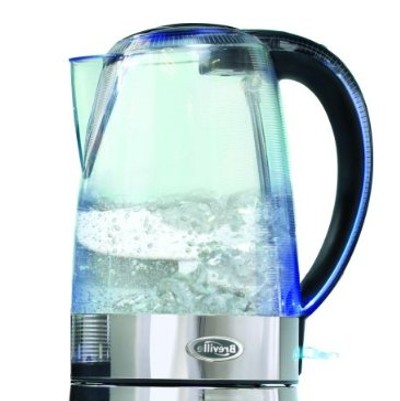
boiling kettleThe phrase ‘a watched kettle never boils’, or a watched pot as Americans might prefer say, is a familiar phrase.  We have probably all stood waiting for water boil thinking it is taking a long time.  This might be in part because the rate of boiling does indeed slow down during the heating process and then speed up towards the end.

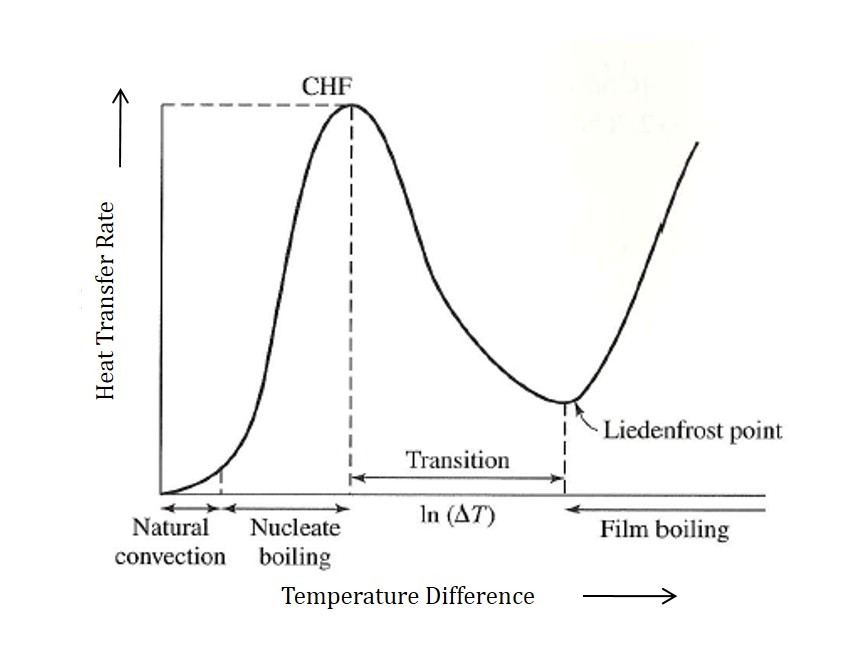
When an electric kettle is first switched on the element in the bottom of the kettle heats up causing heat to be transferred by conduction to the water.  The water adjacent to the element rises in temperature becomes less dense, moves towards the surface and transfers heat by natural convection to the contents of the kettle.  As the temperature of the water rises, tiny bubbles form on the element due to local boiling.  Bubbles are dislodged by new ones forming and float up to the surface giving the appearance that complete boiling is imminent.  However, as the temperature rises further the element becomes completely covered by a film of vapour that insulates the element from the water and slows down heat transfer to the water.  This delays boiling until the element has pumped enough energy (heat) into this film for heat transfer to occur across it from the element to the water. Sections of the film tend to break away and belch onto the surface of the water.  This process of large bubble formation and belching on the surface usually establishes itself fairly quickly once the first one has broken free and we see the familiar violent boiling of the kettle.

So the watched kettle has boiled but only after what might have seem like an interminable delay.  If you have a transparent electric kettle then you can watch this happen, otherwise you could watch a YouTube video – possible the most boring video on YouTube?

The process described above is known as the Liedenfrost effect and is illustrated graphically in the chart below, which is based on Figure 6.16 in ‘The Design and Simulation of Thermal Systems‘ by NV Suryanarayana and Oner Arici published by McGraw-Hill.  There are a number of more comprehensive explanations available, for example by Jearl Walker.  The Leidenfrost effect is also responsible for the way water disperses in liquid droplets across a very hot surface instead of evaporating as steam, see this Youtube clip for more explanation.

boiling graph


Lost at sea

leaving usa

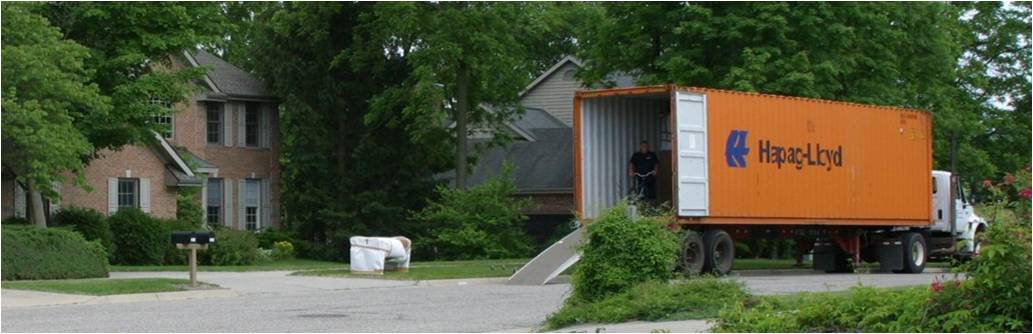
Loading our shipping container to leave USA

Our inability to find flight MH370 was still very prominent in the national media when I was in China last month.  The search for the aircraft and the false alarms caused by floating rubbish at sea has raised awareness about the amount of junk floating around our oceans, for instance 10,000 shipping containers are lost at sea every year,  or more than 1 every hour.  However, there are about 17 million containers in the world, so we only lose about 0.05% per annum which is a negligible amount unless its the one containing all your household goods as you move continents!

I was interested to find a high level of environmental awareness in China.  Alongside the reports on the search for flight MH370 the China Daily had a centre-page spread on Thursday 24th April, 2014 about ‘How pollution affects marine life’ with a focus on the garbage patches in the Pacific and North Atlantic oceans.  The North Atlantic Garbage Patch is more than 100 kilometres in diameter with about 200,000 pieces of debris per square kilometre trapped in the gyre. These are big numbers and if you break it down to small areas then it is one piece of debris per five square metres, which a box 2.24 x 2.24m or 7 x 7 ft.  This doesn’t sound so bad until you consider the impact on wildlife, for instance 86% of all sea turtles are affected by entanglement or ingestion of marine debris and an autopsy on a sperm whale found dead in Spanish waters concluded that the cause of death was ingestion of 24 meters of plastic.  About 300 million tonnes of plastic are produced globally per year of which it is estimated about 6 million tonnes (2%) ends up in the oceans, with 80% being washed into the sea from rivers or blown by the wind from rubbish dumps.

The second law of thermodynamics [see my post on June 5th, 2013 on Impossible Perfection] limits the efficiency of all processes with the result that engineers are used to not worrying about losses of 10% or less so that the losses to the ocean of 0.05% and 2% mentioned above would be considered negligible but the enormous scale of human processes mean that the losses are having a significant impact on the fauna of the planet.  Engineers need to lead society towards a more harmonious and protective relationship with the rest of the planet.

Source: http://www.billiebox.co.uk/facts-about-shipping-containers/

100 Everyday Engineering Examples

bookletsSTOP PRESS – more than 100 Everyday Engineering Examples published in more than 40 lesson plans on a new webpage.

I have been including 5E lesson plans as part my recent posts.  These lesson plans are primarily for people teaching first-year engineering undergraduates, which is pulling me away from the intended focus of this blog. So, I have decided to publish all of the lesson plans that I have written & edited on a separate page.  There are more than 100 Everyday Engineering Examples in the more than forty lesson plans.  If that is not enough Everyday Engineering Examples then you can find more at ENGAGE

Now back to Realizing Engineering – we live in an almost entirely engineered world. Engineers, as a profession, are so good at their job that most people are unaware of their influence on society.  Look around you. Engineers will have designed the machines and transport infrastructure to supply most of what you can see as well as what you are probably sitting in and on.

The Royal Academy of Engineering has produced an ebook to expand on this theme of ‘Engineering in Society’ for first year engineering undergraduates but I think its suitable for anyone considering a career in Engineering.