Tag Archives: sustainability

Limitless energy

neil hunterThe Sun supplies approximately 100,000 TeraWatts (TW) of energy to the Earth continuously. To put this into perspective the entire generating capacity of China is 1TW and the global population as a whole uses 15TW. Plants use about 100TW via photosynthesis. Most our energy consumption is derived from biomass created millions of years ago by photosynthesis and stored as coal, gas or oil when the plant died and was crushed by geological processes.
I am stealing and paraphrasing from Professor Neil Hunter’s presentation at the Royal Society’s Scientific Discussion Meeting on Bio-inspiration for New Technologies. Of course, as Neil pointed out, the energy from the Sun arrives across a range of wavelengths some of which are damaging to our health. So fortunately for us the Earth’s atmosphere filters out a number of wavelengths but nevertheless a broad band of wavelengths still arrives at the Earth’s surface. Photosynthesis only makes use of two relatively narrowbands of light….

Mankind’s efforts to use solar energy look pathetic alongside Nature’s performance and should be humbling to any engineer or scientist. But it is also an inspiration to do better. We need cheap clean energy for everyone. It is being delivered everyday but we don’t know how to use it.

Dream machine

Painting by Katy Gibson

Painting by Katy Gibson

A machine that can do work indefinitely without any external input of energy.  It would solve the world’s energy problems, eliminate global warming and make the inventor very rich.  There have been so many attempts to design such a machine that a classification system has been established.  My machine, that does work indefinitely with no energy input, would be a perpetual motion machine of the first type because energy is not conserved – a contradiction of the first law of thermodynamics.  The second type contravene the second law of thermodynamics, usually by spontaneously converting heat into work, and the third type eliminates friction and, or other dissipative forces.

I said ‘my machine’ in the sense that I have an on-going sporadic correspondence with the inventor of a machine that is claimed to produce ‘power above the primary power that drives it’.  It is an epistemic impossibility, which means that it cannot exist within our current understanding of the real world.  In other words, if a perpetual motion machine was to be proven to exist then the laws of thermodynamics would have to be rewritten.  This would probably lead to an invitation to Stockholm to collect a Nobel prize.

Such arguments make no difference to inventors of perpetual motion machines.  Many appear to start from the premise that the laws of thermodynamics have not been proven and hence they must not be universally applicable, i.e. there is space for their invention.  Whereas the laws of thermodynamics form part of our current understanding of the world because no one has demonstrated their falsity despite many attempts over the last two hundred years.  This is consistent with the philosophical ideas introduced by Karl Popper in the middle of the last century.  He proposed that a hypothesis cannot be proven to be correct using observational evidence but its falsity can be demonstrated.

So, inventors need to build and demonstrate their perpetual motion machines in order to falsify the relevant law of science.  At this stage money as an input usually becomes an issue rather than energy!


The painting by Katy Gibson is from a series made as part from an art and engine collaboration between Okemos High School Art Program and the Department of Mechanical Engineering at Michigan State University.


Enabling or disruptive technology for nuclear engineering?

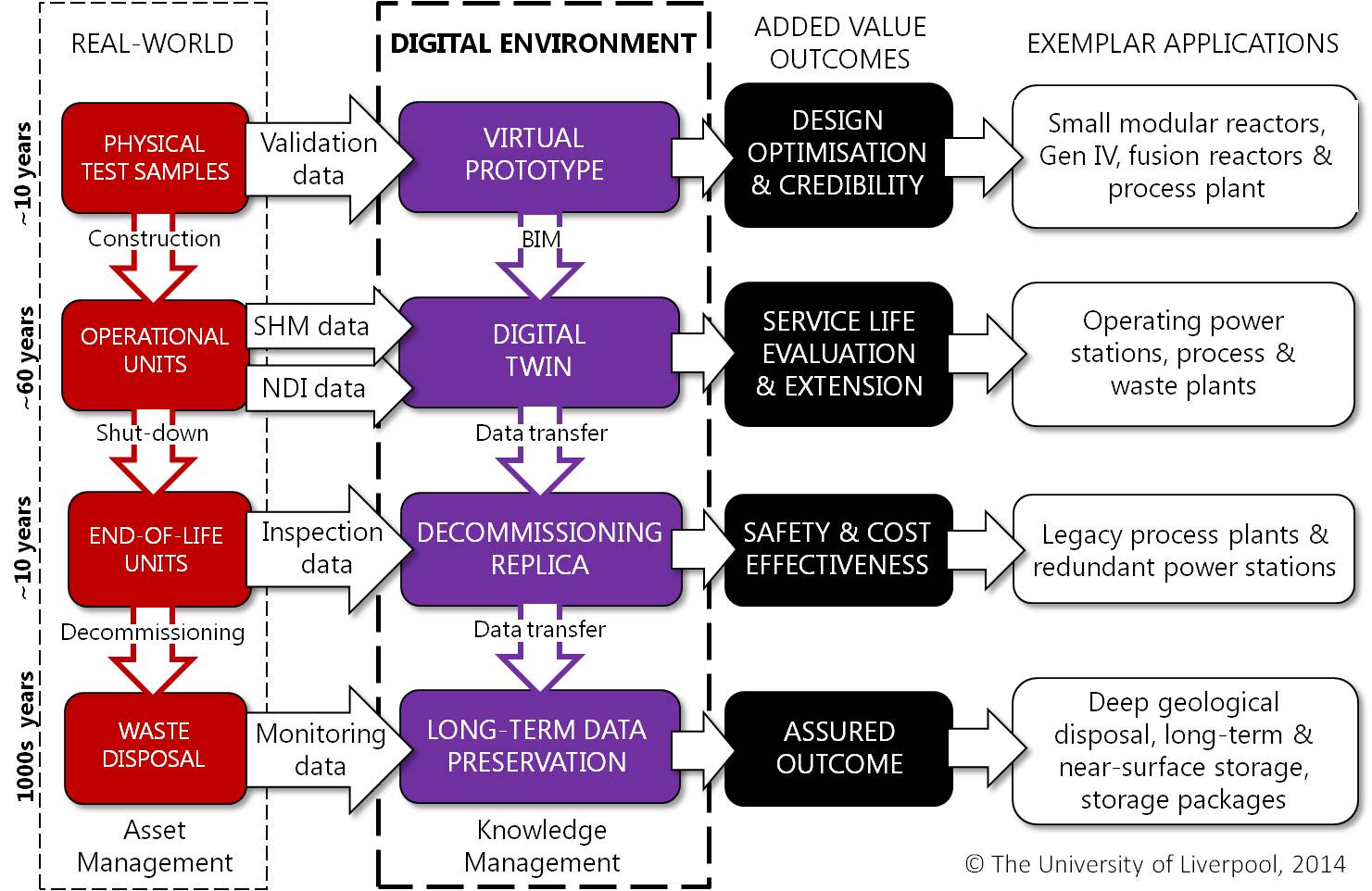
INDEA couple of weeks ago [see ‘Small is beautiful and affordable in nuclear power-stations’  on January 14th, 2015] I ranted about the need to develop small modular reactors whose components can be mass-produced in a similar way to the wings, cockpit, tail-planes, fuselage and engines of an Airbus aeroplane that are manufactured in factories in different countries in Europe prior to final assembly and commissioning in Toulouse, France. The aerospace industry is heavily dependent on computer-aided engineering to design, test, manufacture, operate and maintain aircraft in a series of processes involving a huge number of organisations. The civil engineering and building services industries are following the same model through the introduction of BIM, or Building Information Modelling. I have recently suggested that the nuclear industry needs to adopt the same approach through an Integrated Nuclear Digital Environment (INDE) that has the potential to reduce operating and decommissioning costs and increase reliability and safety for existing and planned power-stations but more importantly would enable a move towards mass-production of modular power-stations.

Recently I presented a paper at a NAFEMS seminar on Modelling and Simulation in the Nuclear Industry held on November 19th 2014 in Manchester, UK.  To judge from the Q&A session afterwards, the paper divided the audience into those who could see the enormous potential (the enablers?) and those who saw only massive problems that rendered it unworkable (the potentially disrupted?). The latter group tends to cite the special circumstances of the nuclear industry associated with its risks and regulatory environment. These are important factors but are not unique to the industry. From my perspective of working with many other industrial sectors, the nuclear industry is unique in its slow progress in exploiting the potential of digital technologies.  Perhaps in the end, as one of my academic colleagues believes, research on solar power will produce such efficient solar cells that even in cold and cloudy England we will be able to meet all of our power needs from solar energy [given incoming solar radiation is about 340 Watts/square meter], in which case perhaps the nuclear power industry will become extinct unless it has evolved.

Schematic diagram showing the digital environment (second column from left in purple), its relationships to the real-world (left column in red) and the potential added value (third column from left) together with exemplar applications (right column). Coloured arrows are processes and coloured boxes represent physical (red) or digital (purple) infrastructure.

Schematic diagram showing the digital environment (second column from left in purple), its relationships to the real-world (left column in red) and the potential added value (third column from left) together with exemplar applications (right column). Coloured arrows are processes and coloured boxes represent physical (red) or digital (purple) infrastructure [from Patterson & Taylor, 2014].

The diagram is an extract from Patterson & Taylor, 2014.  The views expressed in this blog post are those of the author and not necessarily of those of his co-authors on other publications, or their employers.

Small is beautiful and affordable in nuclear power-stations

Most of you will have domestic carbon footprints that are similar to mine, i.e. dominated by energy consumption, probably mainly your car and climate control in your home, and you will struggle to reduce your footprint [see my post entitled ‘New Year Resolution’ on December 31st, 2014]. We live in a fossil fuel economy and so even if you make your home entirely powered by electricity and buy a plug-in car then your utility provider is still very likely to use fossil fuel to generate the electricity supplied to you and your carbon emissions will have been simply moved elsewhere. If you are lucky enough to live in a suitable location then installing geothermal, solar or wind power for your home might be viable; but otherwise the majority of us are dependent on power-stations for our electricity.

I discussed the impossibility, with today’s technology, of providing all of our electrical power needs using renewable sources in my post entitled ‘Energy Blending‘ on May 22nd, 2013. The alternatives are either to reduce our power consumption dramatically, which seems unlikely to happen given that everyone would like to enjoy the lifestyle of typical readers of blogs, or to build a very large number of nuclear power stations.  The scale of the problem facing China was the topic of my post entitled ‘Mass-produced nuclear power plants‘ on November 12th, 2014 and it is many times large on a global scale.

A major obstacle to building nuclear power-stations is their exorbitant capital cost, e.g. £24 billion for the planned Hinckley Point C reactor in the UK. This level of investment is beyond the reach of most companies and the construction of a fleet of such power-stations to provide national needs is beyond the budget of most national governments. Small modular reactors (SMR), whose components could be mass-produced and assembled on-site, have been proposed and both their small size and the manufacturing approach would lead to considerable reductions in unit costs. Although many designs for SMRs are under development, with mature designs in China and India, progress towards implementation and mass-production is slow so that the situation is ripe for a disruptive technology from another industrial sector to transform the nuclear power landscape. One possible candidate is the fusion reactor being developed by Lockheed Martin’s Skunk works [see my post entitled ‘Mass-produced nuclear power plants‘ on November 12th, 2014] or the Travelling Wave Reactor being developed by the spin-out company TerraPower.

We need to think big about small affordable solutions instead of thinking and spending big money on massive projects that tend towards a big unaffordable solution.

Also see Bill Gates on Energy-Miracles