Tag Archives: success

Experiencing success vicariously

Decorative image of a graduation ceremonyThe final PhD student for whom I will act as lead supervisor is scheduled to finish this month.  I have graduated forty PhD students since I was appointed a lecturer in 1985.  I am still in touch with many of them – they are divided between industry and universities with a bias towards industry (about 60%).  For the first twenty years, I was a sole academic supervisor often with an industrial supervisor providing support.  Then I moved to the US where a PhD committee provides supervisory guidance to the student and supervisor.  By the time I returned to the UK, about fifteen years ago, it had become accepted practice to appoint a second supervisor for each PhD student.  So, although I decided a couple of years ago not to accept any new PhD students as lead supervisor, I am acting as second supervisor for five students.  This is a great role since you have less responsibility, but you are engaged with the exciting research.  The topics vary from understanding the nanoscale mechanics of particles interacting with cells (see, for example, ‘Label-free real-time tracking of individual bacterium‘ on January 25, 2023 through to ‘Structural damage assessment using infrared detectors in fusion environments‘ on March 15, 2023), and just starting this year, innovative methods for communicating confidence in computational models.  Although the research is exciting, at a training session for supervisors during the CDT Winter School that I attended in January (see ‘Experiencing success vicariously‘ on January 7, 2026), we discussed our roles as supervisors and in particular that the research project is not the principal outcome of the PhD.  Instead, the development of the PhD student is the principal outcome.  It’s all about nurturing and mentoring people and the reward is experiencing their success vicariously.

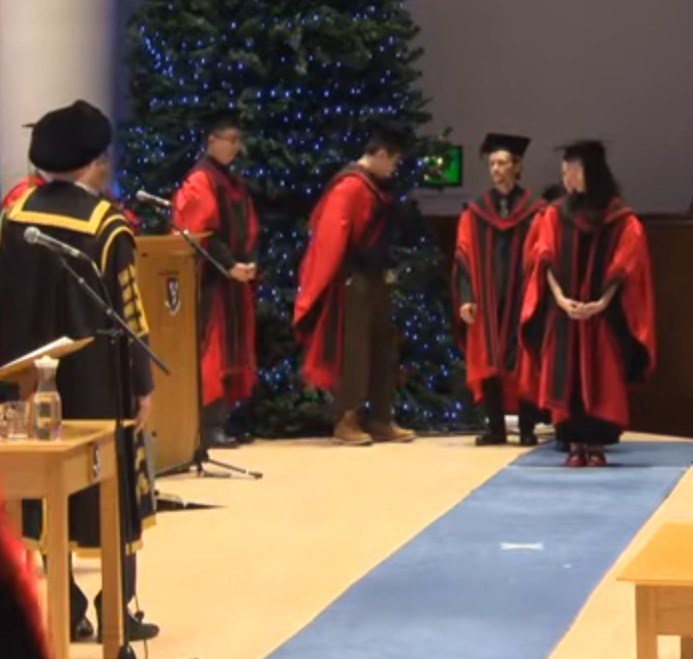
Image: still from a video of a graduation ceremony at the University of Liverpool on December 9, 2025.  As Dean of the School of Engineering, I am at the lectern presenting PhD graduates, but I am hidden behind the Vice-Chancellor who has his back to the camera on the extreme left of the image.  You can watch the video at https://www.liverpool.ac.uk/graduation/the-ceremony/watch-graduation/catch-up/school-of-engineering/9-december-2025-10am/ .


A view from the middle

Red tulips in a window boxI was schooled to compete in the classroom, in examinations and on the sports field in preparation for life in, what Mary Midgley described as, the ‘intense competitiveness of the Western world’.  Many of us are obsessed with winning, believing that life is not worth living unless we are at the top of the hierarchy.  As result, we strive for the top where there are only a limited number of places so most people remain in the middle or bottom no matter how hard they strive.  If they are led to believe that they are despised for their position in the hierarchy then they will be miserable and make those around them, both above and below, miserable too.  It took me some time to realise that happiness was not the exclusive property of those at the top of the hierarchy but can be found anywhere through supporting and valuing others.  As a young naval officer, I was trained to look after those under my command and to gain their respect.  I hope that as a leader in academia I have learned to blend the competitive and compassionate elements of the training I received as a young man to create happy and successful communities in which individuals can thrive.  It is ongoing challenge that requires constant vigilance [see ‘Leadership is like shepherding‘ on May 10th, 2017].

Sources:

Mary Midgley, Beast and Man – the roots of human nature. Abingdon, Oxon. Routledge Classics, 2002.

Success is to have made people wriggle to another tune

Shortly before the pandemic started to have an impact in the UK, I went to our local second-hand bookshop and bought a pile of old paperbacks to read.  One of them was ‘Daisy Miller and Other Stories’ by Henry James (published in 1983 as Penguin Modern Classic).  The title of this post is a quote from one of the ‘other stories’, ‘The Lesson of the Master’, which was first published in 1888.  ‘Success is to have made people wriggle to another tune’ is said by the successful fictional novelist, Henry St George as words of encouragement to the young novelist Paul Ovett.  It struck a chord with me because I think it sums up academic life. Success in teaching is to inspire a new level of insight and way of thinking amongst our students; while, success in research is to change the way in which society, or at least a section of it, thinks or operates, i.e. to have made people wriggle to another tune.

Student success and self-efficacy

Success is a multiplicative function of ability and motivation [Chan et al, 1998 & Pinder 1984] and in turn motivation requires positive ‘situation expectations’ and good ‘achievement striving’, which is the extent to which individuals take their work seriously [Norris & Wright, 2003].  Hence, we can motivate engineering students by setting engineering science in a professional context and connecting it to something familiar according to Sheppard et al [2009].

Self-efficacy is a ‘belief in one’s capabilities’ and is closely related to student success [Marra et al, 2009].  There are four sources of self-efficacy that contribute to success: mastery experiences; social persuasion; psychological state; and vicarious experiences [Bandera, 1997].

Mastery experiences include, for example, the positive experience of completing a course or a project.  Vicarious experiences are those gained via observation of someone else’s engagement and their effect on self-efficacy is dependent on similarity of the observer and observed.

The bottom-line is that self-efficacy is powerful motivational construct relating to choices to engage in class activities and to persist in engineering [Hackett et al, 1992].  So, to create a learning environment that motivates all students to acquire knowledge, it is necessary provide opportunities for all sources of self-efficacy to contribute to student success.  This implies providing opportunities for mastery and vicarious experiences in a supportive environment that avoids any negative stereotyping.

Using a variety of everyday engineering examples provides a level of familiarity that lowers anxiety levels and improves the psychological state of students.  Demonstrating everyday examples in class, as part of the Engage step in the 5Es [see ‘Engage, Explore, Explain, Elaborate and Evaluate’ on August 1st, 2018], allows students to have a vicarious experience as does Elaborating examples for them.  While allowing students to Evaluate their own learning provides the opportunity for mastery experiences.  These factors are probably one reason why using Everyday Engineering Examples embedded in 5E lesson plans leads to a higher level of student engagement and learning.

References:

Bandura A, Self-efficacy: the exercise of control, Freeman & Co, New York, 1997.

Chan D, Schmitt N, Sacco JM; DeShon RP. Understanding pretest and posttest reactions to cognitive ability and personality tests, J. Applied Psychology, 83(3): 471-485, 1998

Hackett G, Betz NE, Casas JM, Rocha-Singa IA, Gender ethinicity and social cognitive factors predicting the academic achievement of students in engineering, J. Counselling Psychology, 39(4):527-538, 1992.

Marra RM, Rodgers KA, Shen D, and Bogue B, Women engineering students and self-efficacy: a multi-year, multi-institution study of women engineering student self-efficacy, J. Engineering Education, 99(1):27-38, 2009.

Norris SA, Wright D. Moderating effects of achievement striving and situational optimism on the relationship between ability and performance outcomes of college students, Research in Higher Education, 44(3):327-346, 2003.

Pinder CC, Work motivation, Scott, Foresman Publishing, Glenview, IL, 1984.

Sheppard S, Macatangay K, Colby A, Sullivan WM, Educating engineers: designing for the future of the field, Jossey-Bass, San Francisco, CA, 2009.


CALE #8 [Creating A Learning Environment: a series of posts based on a workshop given periodically by Pat Campbell and Eann Patterson in the USA supported by NSF and the UK supported by HEA]