Tag Archives: second law

Entropy and junkies

I am on a deep vacation [see ‘Digital detox with a deep vacation‘ on August 10th, 2016] and so my posts for the next few weeks will be ‘reprints’ from my archive of more than 570 posts.  The one below first appeared in January 2013 under the title ‘Unavoidable junk‘.

The laws of thermodynamics are physical laws whose relevance extend beyond the study of engines and heat plants. We can restate the first law of thermodynamics (conservation of energy) as ‘the quantity of matter is constant and finite’. Matter changes both in nature and as it moves through the economic system; and as it does so, its intrinsic properties change rendering it less useful and usable, thus requiring more and more resources to make it useful again. This last sentence is a form of the second law of thermodynamics. Very useful (low entropy) goods, such as iron ore and fossil fuels, eventually produce less useful (high entropy) matter, such as piles of junk cars in scrap-metal yards and greenhouse gases, as they move through the economic system. In our current western life-style, we are all contributing to the generation of vast piles of junk; we are hooked on it; we are all ‘junkies’.

In the paragraph above, I have plagiarised the 2009 report entitled ‘The New Sustainable Frontier’. However, similar ideas were expressed by Handscombe and Patterson in their 2004 book entitled the ‘Entropy Vector’. They paraphrased the first and second laws of thermodynamics as ‘you can’t have something nothing’ and ‘you can’t have it just anyway you like it’.

Delaying cataclysmic events might hasten their advent

detail tl from abstract painting by Zahrah RIn thermodynamics, students are taught to draw a boundary around the system they want to analyse and to decide whether the boundary is open or closed to transfers of mass and energy based on the scenario they want to model.  The next step is to balance the energy flows across the boundary with the change in the energy content of the system.  This is an application of the first law of thermodynamics which is that energy can neither be created nor destroyed.  Rudolf Clausius is credited with discovering entropy when he realised that when energy flowed as heat across a system boundary it became entropy or disordered energy. For instance, when a steam engine does work and discharges heat to the environment. The second law of thermodynamics states that entropy of the universe increases in all real processes.  Thermodynamicists are not the only people who draw boundaries and decide whether they are open or closed.  Politicians and generals draw national boundaries occasionally and more frequently decide whether they are open or closed to people, goods and capital.  After the first world war economists, such as Friedrich Hayek and Ludwig von Mises, proposed that conflict would be less likely if people, goods and capital could flow freely across national boundaries.  These ideas became the principles on which the IMF and World Bank were formed at Bretton Woods in July 1944 in the closing stages of the second world war.  Presidents of the USA, since Ronald Reagan, have taken these ideas a step further by unleashing capitalism through deregulation of markets in the belief that markets know best.  However, ever-growing capital generates an ever-increasing rate of creation of entropy and disorder in the world [see ‘Existential connection between capitalism and entropy‘ on May 4th 2022] and perhaps attempting to reduce conflict by unfettering capital actually accelerates the descent into chaos and disorder because entropy increases in every transaction.

Sources:

Rana Foroohar, When the market fails us, FT Weekend, 23 April/24 April 2022.

Gary Gerstle, The Rise and Fall of the Neoliberal Order: America and the World in Free Market Era, Oxford: OUP, 2022.

The cataclysmic events referred to in the title are those identified by Thomas Piketty as being the only means by which economic inequality is reduced, i.e., wars and revolutions [see ‘Existential connection between capitalism and entropy‘ on May 4th 2022].  The title was inspired by correspondence from Bob Handscombe with whom I wrote a book entitled ‘The Entropy Vector: Connecting Science and Business‘.

Existential connection between capitalism and entropy

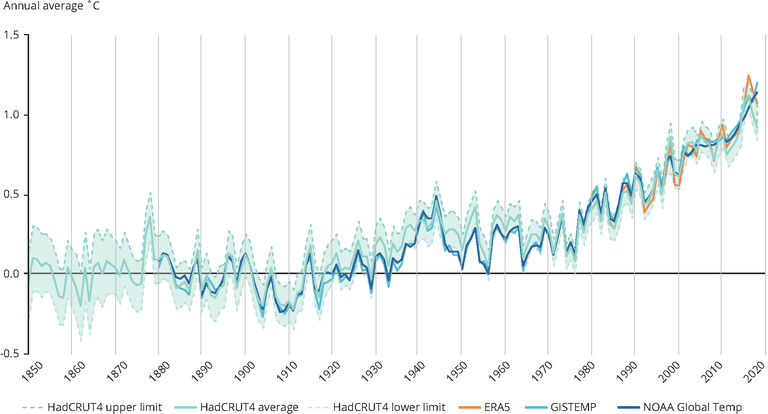
global average temperature with timeAccording to Raj Patel and Jason W Moore, in his treatise ‘Das Kapital’ Karl Marx defined capitalism as combining labour power, machines and raw materials to produce commodities that are sold for profit which is re-invested in yet more labour power, machines and raw materials.  In other words, capitalism involves processes that produce profit from an economic perspective, and from a thermodynamic perspective produce entropy because the second law of thermodynamics demands that all real processes produce entropy.  Thermodynamically, entropy usually takes the form of heat dissipated into the environment which raises the temperature of the environment; however, it can also be interpreted as an increase in the disorder of a system [see ‘Will it all be over soon?’ on November 2nd, 2016].  The ever-expanding cycle of profit being turned into capital implies that the processes of producing commodities must also become ever larger.  The ever-expanding processes of production implies that the rate of generation of entropy also increases with time.  If no profit were reinvested in economic processes then the processes would still increase the entropy in the universe but when profit is re-invested and expands the economic processes then the rate of entropy production increases and the entropy in the universe increases exponentially – that’s why the graphs of atmospheric temperature curve upwards at an increasing rate since the industrial revolution.  As if that is not bad enough, the French social economist, Thomas Piketty has proposed that the rate of return on capital, “r” is always greater than the rate of growth of the economy, “g” in his famous formula “r>g”.  Hence, even with zero economic growth, the rate of return will be above zero and the level of entropy will rise exponentially.  Piketty identified inequality as a principal effect of his formula and suggested that only cataclysmic events, such as world wars or revolutions, can reduce inequality.  The pessimistic thermodynamicist in me would conclude that an existential cataclysmic event might be the only way that this story ends.

Sources

Raj Patel & Jason W. Moore, A history of the world in seven cheap things, London: Verso, 2018.

Thomas Piketty, A brief history of equality, translated by Steven Rendall, Harvard: Belknap, 2022.

Diane Coyle, Piketty the positive, FT Weekend, 16 April/17 April 2022.

Image: Global average near surface temperature since the pre-industrial period from www.eea.europa.eu/data-and-maps/figures/global-average-near-surface-temperature

Bringing an end to thermodynamic whoopee

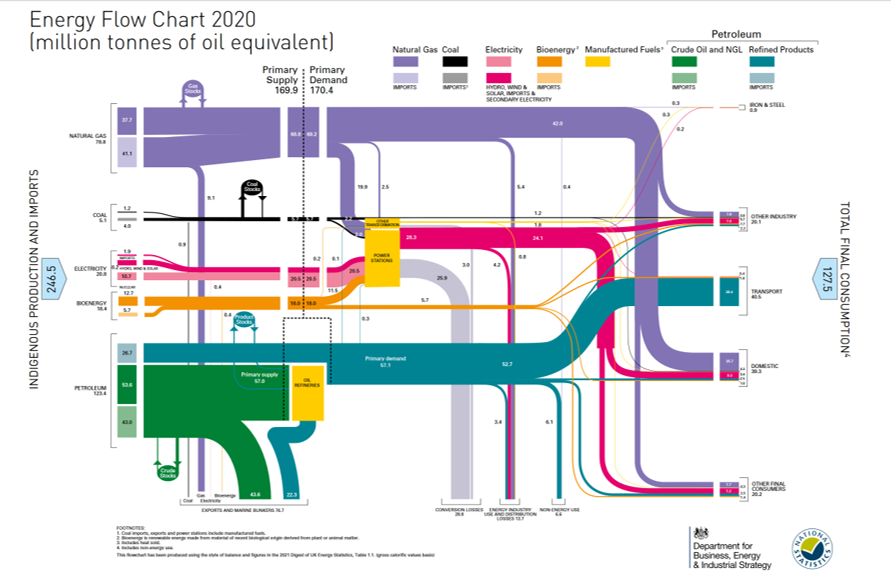
Two weeks ago I used two infographics to illustrate the dominant role of energy use in generating greenhouse gas emissions and the disportionate production of greenhouse gas emission by the rich [see ‘Where we are and what we have‘ on November 24th, 2021].  Energy use is responsible for 73% of global greenhouse gas emissions and 16% of the world’s population are responsible for 38% of global CO2 emissions.  Today’s infographics illustrate the energy flows from source to consumption for the USA (above), UK and Europe (thumbnails below).  In the USA fossil fuels (coal, natural gas and petroleum) are the source of nearly 80% of their energy, in the UK it is a little more than 80% and the chart for Europe is less detailed but the proportion looks similar. COP 26 committed countries to ending ‘support for the international unabated fossil fuel energy sector by the end of 2022’ and recognised ‘investing in unabated fossil-related energy projects increasingly entails both social and economic risks, especially through the form of stranded assets, and has ensuing negative impacts on government revenue, local employment, taxpayers, utility ratepayers and public health.’  However, to reduce our dependency on fossil fuels we need a strategy, a plan of action for a fundamental change in how we power industry, heat our homes and propel our vehicles.  A hydrogen economy requires the production of hydrogen without using fossil fuels, electric cars and electric domestic heating requires our electricity generating capacity to be at least trebled by 2050 in order to hit the net zero target. This scale and speed of  transition to zero-carbon sources is such that it will have to be achieved using an integrated blend of green energy sources, including solar, wind and nuclear energy.  For example, in the UK our current electricity generating capacity is about 76 GW and 1 GW is equivalent to 3.1 million photovoltaic (PV) panels, or 364 utility scale wind turbines [www.energy.gov/eere/articles/how-much-power-1-gigawatt] so trebling capacity from one of these sources alone would imply more than 700 million PV panels, or one wind turbine every square mile.  It is easy to write policies but it is much harder to implement them and make things happen especially when transformational change is required.  We cannot expect things to happen simply because our leaders have signed agreements and made statements.  Now, national plans are required to ween us from our addiction to fossil fuels – it will be difficult but the alternative is that global warming might cause the planet to become uninhabitable for us.  It is time to stop ‘making thermodynamic whoopee with fossil fuels’ to quote Kurt Vonnegut [see ‘And then we discovered thermodynamics‘ on February 3rd, 2016].


Sources:

Kurt Vonnegut, A Man without a Country, New York: Seven Stories Press, 2005.  He wrote ‘we have now all but destroyed this once salubrious planet as a life-support system in fewer than two hundred years, mainly by making thermodynamic whoopee with fossil fuels’.

US Energy flow chart: https://flowcharts.llnl.gov/commodities/energy

EU Energy flow chart: https://ec.europa.eu/eurostat/web/energy/energy-flow-diagrams

UK Energy flow chart: https://www.gov.uk/government/collections/energy-flow-charts#2020