Tag Archives: renewable energy

And then we discovered thermodynamics

sunEnergy, matter, space and time came into existence in the Big Bang 13.5 billion years ago. 10 billion years later biological organisms started to appear. 70,000 years ago one of those organisms, man started to organise in structures, called cultures and history began. For most of history if you wanted something moved then you had to do it yourself or persuade someone else to do it. The agricultural revolution began 12,000 years ago and shortly afterwards we realised that if you fed fuel to an animal then it would ‘burn’ it and do work for you. And that’s how it remained for thousands of years – we didn’t know how to convert heat into work or work into heat. The average energy consumption per capita was about 20GJ per year. Then, 200 years ago we discovered how to imitate nature by burning fuel and producing power in the steam engine. We had discovered thermodynamics and our average energy consumption started rising towards 80GJ per year today.

As a consequence, ‘we have now all but destroyed this once salubrious planet as a life-support system in fewer than two hundred years, mainly by making thermodynamic whoopee with fossil fuels’ as Kurt Vonnegut wrote. And that’s because nature starts from solar energy and recycles everything and we haven’t learnt how to do either very effectively. But energy or power engineering has been around for less than a blink of eye relatively speaking and we are just learning how to perform a trick nature has been using for billions of years: convert solar radiation into other energy forms. The sun delivers about 340 Watts per square metre to the Earth so we have plenty energy available.

If you would like to know more about energy engineering or thermodynamics and its potential then join the 5000 people who have signed up for the MOOC that I am teaching for five weeks from next Monday.  Listen to me interview Ken Durose, Director of the Stephenson Institute for Renewable Energy on the prospects for renewable energy.

Sources:

http://ourfiniteworld.com/2012/03/12/world-energy-consumption-since-1820-in-charts/

Yuval Noah Harari, Sapiens: A brief history of mankind. London: Vintage (Penguin, Random House), 2014.

Kurt Vonnegut, A Man without a Country, New York: Seven Stories Press, 2005.
Small is beautiful and economic

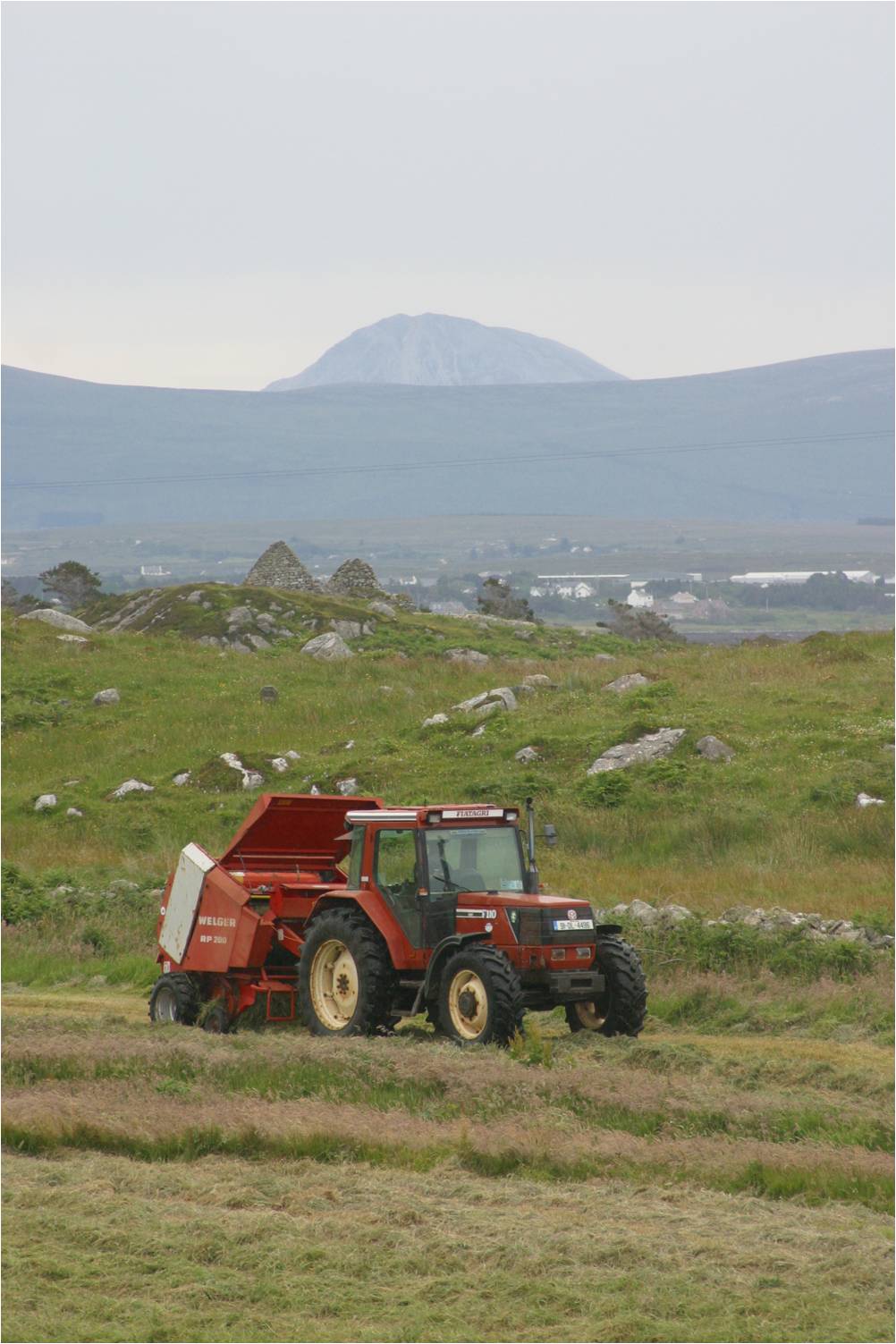
tractorFarm tractors have been growing bigger and bigger, though perhaps not everywhere – the photograph was taken in Donegal, Ireland earlier this year.  The size of tractors is driven by the economics of needing a driver in the cab. The labour costs are high in many places, so that the productivity per tractor driver has to be high too.  Hence, the tractors have to move fast and process a large amount of the field on each pass.  This leads to enormous tractors that weigh a lot and exert a large pressure on the soil, which in turn results in between 1 and 3% of the farm land becoming unproductive because crops won’t grow in the severely compressed soil. But what happens if we eliminate the need for the driver by using autonomous vehicles? Then, we can have smaller vehicles working 24/7 that do less damage and are cheaper, which means that a single machine breakdown doesn’t bring work to halt. We can also contemplate tailoring the farming of each field to the local environmental and soil conditions instead a mono-crop one-size fits all approach. These are not my ideas but were espoused by Peter Cooke of the Queensland University of Technology at a recent meeting at the Royal Society on ‘Robotics and Autonomous Systems’.

It is a similar argument for modular nuclear power stations. Most of the world is intent on building enormous reactors capable of generating several GigaWatts of power (that’s typically 3 with nine zeros after it) at a cost of around £8 billion (that’s 8 with nine zeros) so about 50 pence per Watt. Such a massive amount of power requires a massive infrastructure to deliver the power to where it is need and a shutdown for maintenance or a breakdown potentially cuts power to about a million people. The alternative is small modular reactors built, and later dismantled, in a factory that leave an uncontaminated site at a lower capital cost and which provide a more flexible power feed into the national grid. Some commentators (see for example Editor’s comment in Professsional Engineer, November 2015)believe that a factory could be established and rolling modular reactors off its production line on the same timescale as building a GigaWatt station.

Regular readers will recognise a familiar theme found in Small is beautiful and affordable in nuclear powerstations on January 14th, 2015, Enabling or disruptive technology for nuclear engineering on January 28th, 2015 and Small is beautiful on October 10th, 2012; as well as the agricultural theme in Knowledge-economy on January 1st, 2014.

Free: Energy! Thermodynamics in Everyday Life

sunTalking to camera is difficult…

For the last few weeks I have been spending a considerable proportion of my working hours in front of a camera shooting video clips for a MOOC, a Massive Online Open Course. The first results of this effort and those of my colleagues Matt O’Rourke and Rob Lindsay in the University’s Centre for Lifelong Learning are now available as a trailer. The initial reviews were ‘cool’ and ‘awesome’, so go ahead and watch it!

Innovation to support learning

Some people have commented on the lack of pedagogical foundation in many MOOCs. However, I think we are being quite innovative in the following ways:

  • we are using an established pedagogy, 5Es (see the next paragraph for more explanation),
  • we have designed three do-it-at-home laboratory exercises,
  • the five-week MOOC will run in parallel with the delivery of the traditional course to first year undergraduates in Liverpool and,
  • the traditional lectures will be repeated at the university’s campus in London two evenings each week.

The lectures in London will allow students living around London to meet each other and me, as well as, of course, experience the energy of the live delivery of the course.

For students worldwide (and in London)

If you are a student who has or is struggling with elementary Thermodynamics then register for the free MOOC which will start in February 2016. I will cover the curriculum content of most ‘A’ level modules and introductory undergraduate courses in Thermodynamics. If you are in London and would like to attend the lectures then contact me and I will send you more details.

For teachers/instructors anywhere

If you are a teacher, tutor or lecturer then consider bringing it to the attention of your students. I will be taking a different approach to the traditional way of teaching classical thermodynamics based on my experience teaching at the University of Liverpool using the Everyday Engineering examples featured on this blog together with the 5Es approach to lecture or lesson plans. If you would like to use it in parallel with your own lectures then get in touch with me so that we can talk about synchronization.

5Es

The 5Es are Engage (the students), Explore (the topic), Explain (the principles underpinning the topic), Elaborate (using the principles to analyse the topic) and Evaluate (ask the students to evaluate their learning by performing some analysis). The course has been well-received by students and nearly a thousand have taken it over last four years. This year we are making into a five-week MOOC so that thousands more can learn using it.

Sources:

Real life thermodynamics

Bybee RW, Taylor JA, Gardner A, van Scotter P, Powell JC, Westbrook A & Landes N, The BSCS 5E Instructional model: origins, effectiveness and applications, BSCS Colorado Srings, 2006.

Sian Bayne & Jen Ross, The pedagogy of the MOOC: the UK view,  Higher Education Academy, 2014

Paul Stacy, The pedagogy of MOOCs, http://edtechfrontier.com/2013/05/11/the-pedagogy-of-moocs/

Limitless energy

neil hunterThe Sun supplies approximately 100,000 TeraWatts (TW) of energy to the Earth continuously. To put this into perspective the entire generating capacity of China is 1TW and the global population as a whole uses 15TW. Plants use about 100TW via photosynthesis. Most our energy consumption is derived from biomass created millions of years ago by photosynthesis and stored as coal, gas or oil when the plant died and was crushed by geological processes.

I am stealing and paraphrasing from Professor Neil Hunter’s presentation at the Royal Society’s Scientific Discussion Meeting on Bio-inspiration for New Technologies. Of course, as Neil pointed out, the energy from the Sun arrives across a range of wavelengths some of which are damaging to our health. So fortunately for us the Earth’s atmosphere filters out a number of wavelengths but nevertheless a broad band of wavelengths still arrives at the Earth’s surface. Photosynthesis only makes use of two relatively narrowbands of light….

Mankind’s efforts to use solar energy look pathetic alongside Nature’s performance and should be humbling to any engineer or scientist. But it is also an inspiration to do better. We need cheap clean energy for everyone. It is being delivered everyday but we don’t know how to use it.