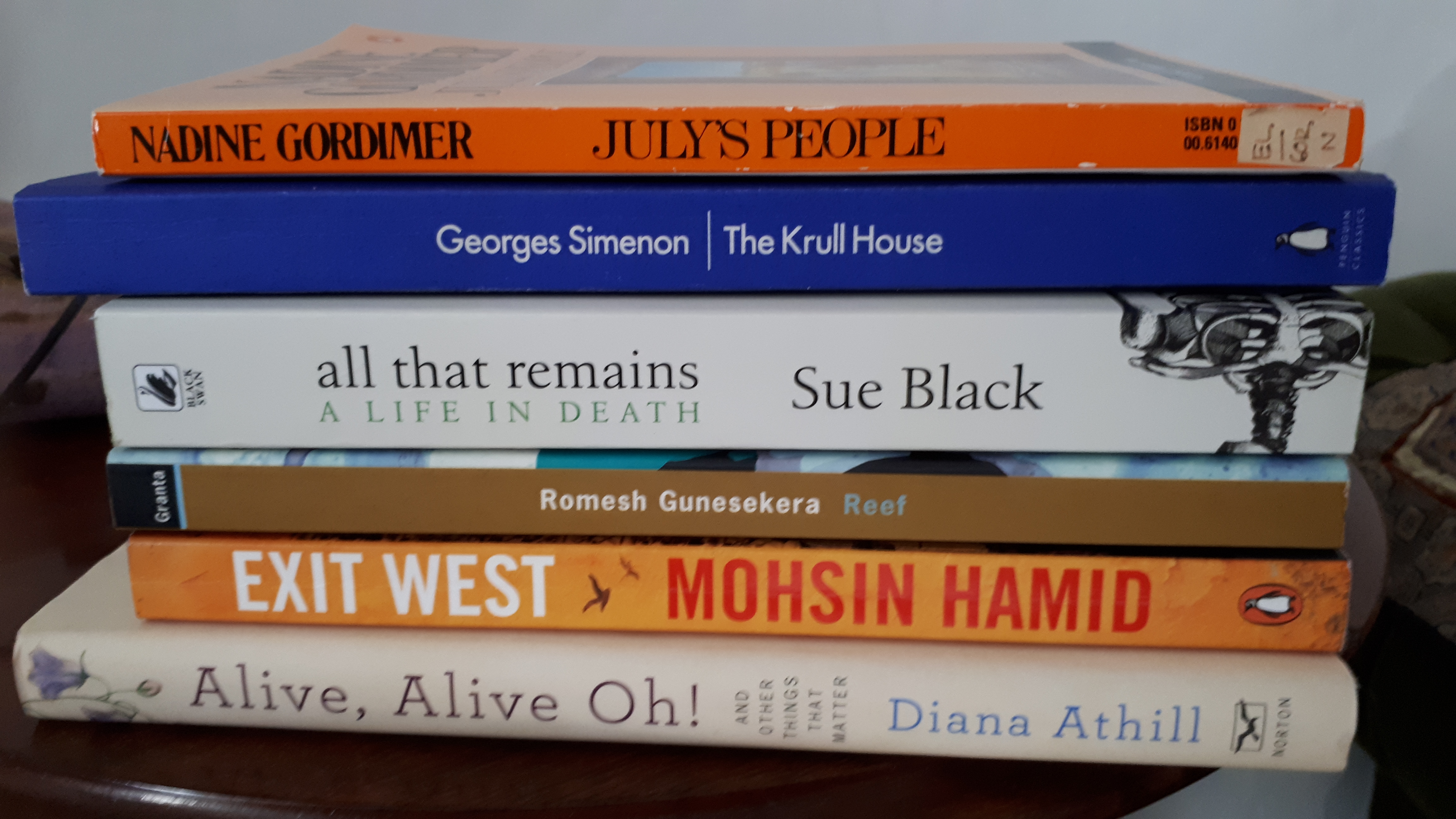
I was on holiday last week in the Lake District. The weather was beautiful all week and we spent every day walking the hills around the Duddon Valley before sampling a different real ale each evening in the Manor Arms in Broughton-in-Furness. I also found time to read a small pile of books in which a recurring theme seemed to be death, perhaps because I was sensitised to it by the most substantial book on the pile: ‘All that remains: a life in death‘ by Sue Black, who is a leading professor of anatomy and forensic anthropology. In her brilliant memoir, she identifies three stages: dying, death and being dead. She worries most about the first stage, dying, which in common with most people, she would like to skip through as quickly as possible. However, she is intrigued by the threshold that separates dying from being dead and would like to experience it when the time comes; although that sounds like professional curiosity to me and I would be happy to skip through that too. As she points out, those fears that we might have about the third stage, being dead, depend on our belief in what happens to us after death. Not many people write books at the age 99, so I was curious to read a collection of essays by Diana Athill who was born in 1917 and published ‘Alive, Alive Oh!‘ in 2016. The final essay is entitled ‘Dead right’ and is about her recollection of a contribution to a discussion on a television programme about death made by the photographer, Rankin. The contributor said ‘that not existing for thousands and thousands of years before his birth had never worried him for a moment, so why should going back into non-existence at his death cause him dismay?’.
Tag Archives: reading
Female writers from Sappho to today
A couple of weeks ago, after reviewing one of my posts, my editor commented that I was repeating myself because I had already written on the same topic in an earlier post. I feel that is inevitable in a weekly blog which has an archive of more than three hundred posts – I am just not sufficiently creative to produce something original every week. Besides, maybe that’s not necessary. Anyhow, today I am returning to a theme that I have written about previously: the Treasury at the Weston Library in Oxford. It is a small museum with a rotating collection of treasures from the Bodleian Library, which until the end of February 2019 is on the topic of ‘Sappho to Suffrage: women who dared‘. As you might expect from the title, the oldest treasure in the exhibition are fragments of a copy from the 2nd century AD of one of Sappho’s poems. Sappho, who lived on the Greek island of Lesbos between 630 and 580 BC, is the first female writer known to Western civilisation. Her work was almost lost – the fragments of papyrus on display were found on an ancient Eygptian rubbish dump. Perhaps this is a good representation of men’s attitude to women’s writing because probably since Sappho, female writers have been neglected by publishers and male readers. As Nilanjana Roy has reported, publishing houses submit more books by male writers for literary prizes and book reviews tend to highlight more books by men than by women. In books written by women the gender of characters in evenly divided, whereas in those written by men, women only occupy between a quarter and third of the character-space and men tend to read books written by men. Perhaps it is unsurprising that many men are lacking in understanding and social awareness of half the population. Encouraged by my wife and daughters, this imbalance in my reading habits is being addressed by reading the books shortlisted for the Women’s Prize for Fiction each year during our summer holidays. I can recommend the 2018 winner ‘Home Fire’ by Kamila Shamsie – it’s very topical, will make you think and pulls you along to its dramatic final page. However, you should also read ‘When I hit you’ by Meena Kandasamy – it was both enlightening and shocking to me, and I was left wondering about the line between fiction and non-fiction. I also really enjoyed last year’s winner: ‘The Power’ by Naomi Alderman.
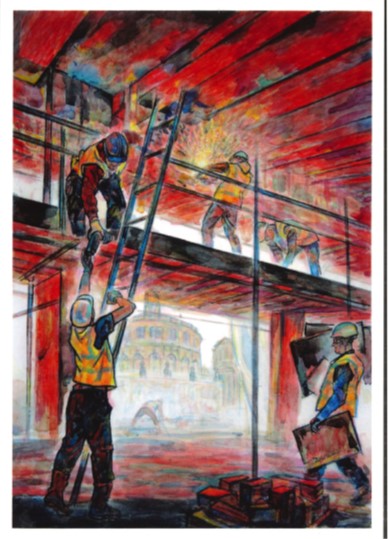
BTW – the thumbnail is a scan of postcard bought in the Weston Library showing a painting by their artist in residence, Dr Weimen He, who captured moments in time during the refurbishment of the library.
Source: Gender and genre: reading the world by Nilanjana Roy in the FT Weekend, Saturday 22 September 2018.
Previous posts featuring the Weston Library Treasury: ‘Pope and Austen‘ on September 9th, 2015, ‘Red Crane‘ on July 26th, 2017 and ‘Ramblings on equality‘ on October 11th, 2017.
Nauseous blogging?
In his novel ‘Nausea’, Jean-Paul Sartre suggests that at around forty, experienced professionals ‘christen their small obstinacies and a few proverbs with the name of experience, they begin to simulate slot machines: put in a coin in the left hand slot and you get tales wrapped in silver paper, put a coin in the slot on the right and you get precious bits of advice that stick to your teeth like caramels’. When I first read this passage a few weeks ago, it seemed like an apt description of a not-so-young professor writing a weekly blog.
I am on vacation combining the positive effects of reading [see ‘Reading offline‘ on March 19th, 2014] and walking [see ‘Gone walking‘ on April 19th, 2017] with a digital detox [see ‘In digital detox‘ on July 19th, 2017]; but, through the scheduling facilities provided by WordPress, I am still able to dispense my slot machine homily. I will leave you to decide which posts are from the left and right slots.
Source:
Jean-Paul Sartre, Nausea, translated by Lloyd Alexander, New York: New Directions Pub. Co., 2013.
La Nausée was first published in 1938 by Librairie Gallimard, Paris.
A short scramble in the Hindu Kush
I have been resolving an extreme case of Tsundoku [see ‘Tsundoki‘ on May 24th, 2017] over the last few weeks by reading ‘A short walk in the Hindu Kush‘ by Eric Newby which I bought nearly forty years ago but never read, despite taking it on holiday a couple of years ago. Although it was first published in 1958, it is still in print and on its 50th edition; so, it has become something of classic piece of travel writing. It is funny, understated and very English, or least early to mid 20th century English.
It felt quite nostalgic for me because about thirty years ago I took a short walk in Gilgit Baltistan. Gilgit Baltistan is in northern Pakistan on the border with China and to the west of Nuristan in Afghanistan where Eric Newby and Hugh Carless took their not-so short walk. I went for a scramble up a small peak to get a better view of the mountains in the Hindu Kush after a drive of several days up the Karakorum Highway. We were driven from Islamabad to about a mile short of the border with China on the Khunjerab pass at 4730 m [compared to Mont Blanc at 4810 m].
I was there because the Pakistani Government supplied a small group of lecturers with a mini-bus and driver to take us up the Karakorum Highway [and back!] in exchange for a course of CPD [Continuing Professional Development] lectures on structural integrity. This we delivered in Islamabad to an audience of academics and industrialists during the week before the trip up the Karakoram Highway. So, Eric Newby’s description of whole villages turning out to greet them and of seeing apricots drying in the sun on the flat roofs of the houses brought back memories for me.