Last week I spoke at the annual conference of the Associazione Italiana per ‘Analisi dell Sollecitazioni in Vicenza, Italy on the role of experimental mechanics in the validation of computational models used in engineering simulations. We discussed the conflict between reducing cost and energy consumption and increasing performance and reliability of engineering machines and vehicles. Generally, the former implies using less material more efficiently, while the latter tends to require the use of more material. Engineers resolve this conflict by using computational models when optimising designs to simulate engineering behaviour. The development of elegant and successful designs requires a high level of credibility in the models. This credibility can be established by comparing the results from models with those from specially-conducted experiments; a process that is known as ‘validation’.
Tag Archives: mechanics
Perfect engines
We can’t build perfect engines and even if we could they would not be 100% efficient. A heat engine generates power [or does work] by absorbing heat from a source into a working fluid, often water,
using the hot fluid to create motion, e.g. via a turbine, then discharging waste heat to a heat sink before pumping the fluid back to the heat source. This is the operating cycle of most power stations. The heat source might be a fossil fuel furnace, a nuclear reactor or a solar concentrator; and the heat sink is often the environment.
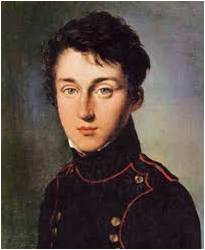
A Frenchman, Nicolas Leonard Sadi Carnot [1796-1832], deduced that the best efficiency achievable by a heat engine was given by one minus the ratio of the temperatures [in Kelvin] of its heat sink to heat source.
A perfect heat engine operating with a heat source at about 350°C [623K] and a heat sink at 20°C [293K] would have a Carnot efficiency of about 45%. We can only hope to increase this efficiency by finding a naturally occurring very cold heat sink or by increasing the temperature of the heat source, which is why we are interested in strain measurement in very hot components (see post on ‘hot stuff’) – we don’t want our super-efficient engines to break!
Hot stuff

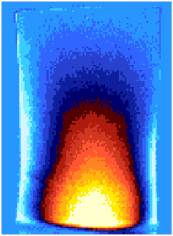
Amplitude of temperature fluctuations in a turbine blade from a jet engine during a vibration test at 700Hz
There have been no postings for a while because I have been away. Last week I organised a workshop in Glasgow for engineers in industry and academic on [how we can make] ‘Strain Measurements in Extreme Environments’. Although this included making measurements on large and fast engineering components, half of the workshop was focussed on evaluating strain at high temperatures, 1000°C to 2000°C, which is hot by most standards. This is beyond the operating range of most sensors and most materials that remain solid at these temperatures glow, which makes optical measurements challenging.
So why are we interested? For hypersonic flight including applications such as delivering satellites into orbit. And, because engines become more efficient when operating at high temperatures.
Can we do it? Not in the real-world but in a laboratory environment some research groups have been successfully using digital image correlation with ceramic particles creating a textured pattern on the hot surface that can be tracked as the hot stuff deforms.
Two Earths
An enormous amount of time and money are expended on developing engineering simulations and establishing their credibility using information from experiments. You could ask: why? After all for structural reliability we could just use more or stronger material to avoid unexpected failures. One answer is that more or stronger material either costs more and, or weigh more. The additional weight requires the use of more resources, including more energy for manufacturing and operation of engineering machines, structures and systems. Engineers have a responsibility to support a shift by society to use less resources while achieving the same standard of living, because to provide the same standard of living enjoyed by the average European (North American) citizen to everyone on this planet would require the resources of two (four) more earths using our current technology*. The latest pictures from the Curiosity Rover on Mars suggest that our nearest neighbour isn’t going to be of much use to us.
*Based on average ecological footprint of 2.5 acres per person in the developing world, 13.5 acres per person in the UK and 24 acres per person in the USA. For more on this theme see Edward O. Wilson, ‘The Future of Life’, The 2001 John H. Chafee Memorial Lecture.
[Picture Credit: NASA Goddard Space Flight Center Image by Reto Stöckli (land surface, shallow water, clouds). Enhancements by Robert Simmon (ocean color, compositing, 3D globes, animation). Data and technical support: MODIS Land Group; MODIS Science Data Support Team; MODIS Atmosphere Group; MODIS Ocean Group Additional data: USGS EROS Data Center (topography); USGS Terrestrial Remote Sensing Flagstaff Field Center (Antarctica); Defense Meteorological Satellite Program (city lights).]