Tag Archives: innovation

Robots with a delicate touch

whitesgroup demoCan a robot pick up an egg or a baby cactus without damaging either? If it is a conventional ‘hard’ robot then the answer is almost certainly ‘no’. But if it is a ‘soft’ robot then the answer is definitely ‘yes’. They can pick ripe tomatoes from the plant, too. And play the piano with a light touch.

These are all examples used by Professor George Whitesides to illustrate the capability of soft robots during a lecture that I attended last week. The occasion was a scientific discussion meeting on Bio-inspiration of New Technologies which was held to celebrate 350 years to publishing the Philosophical Transactions of the Royal Society. While I was in London listening live to Prof Whitesides and the other eight speakers, other people were listening via video links to Bangalore, India and Sao Paulo, Brazil.

Professor Whitesides’ ingenious robots have ‘fingers’ built from the same soft rubber that is used in implants. They are constructed with a solid layer on one face that is curled around the object being picked up by the inflation of compartments on the reverse face. The inflation of the compartments on the reverse face cause the face to lengthen and the ‘finger’ bends to accommodate the change in length. Careful design of the inflated compartments allows the fingers to conform to the shape being picked up and the use of microfluidics ensures it is not damaged.

Professor Whiteside identified star fish as the source of inspiration for the design of his soft robots. I don’t feel that this short piece has done justice to his work. If, nevertheless, you feel inspired to work for him then there’s probably a queue and since he is professor at Harvard it is almost certainly a long one. His research group has also spun out a company, Soft Robotics Inc. so you could buy some soft robots and explore their capabilities…

Engineers are slow, error-prone…

Professor Kristina Shea speaking in Munich

Professor Kristina Shea speaking in Munich

‘Engineers are slow, error-prone, biased, limited in experience and conditioned by education; and so we want to automate to increase reliability.’  This my paraphrasing of  Professor Kristina Shea speaking at a workshop in Munich last year.  At first glance it appears insulting to my profession but actually it is just classifying us with the rest of the human race.  Everybody has these attributes, at least when compared to computers.  And they are major impediments to engineers trying to design and manufacture systems that have the high reliability and low cost expected by the general public.

Professor Shea is Head of the Engineering Design and Computing Laboratory at ETH Zurich.  Her research focuses on developing computational tools that enable the design of complex engineered systems and products.  An underlying theme of her work, which she was talking about at the workshop, is automating design and fabrication processes to eliminate the limitations caused by engineers.

Actually, I quite like these limitations and perhaps they are essential because they represent the entropy or chaos that the second law of thermodynamics tells us must be created in every process.  Many people have expressed concern about the development of Artificial Intelligence (AI) capable of designing machines smarter than humans, which would quickly design even smarter machines that we could neither understand nor control.  Chaos would follow, possibly with apocalyptic consequences for human society.  To quote the British mathematician, IJ Good (1916-2009), “There would then unquestionably be an ‘intelligence explosion’, and the intelligence of man would be left far behind. Thus the first ultra-intelligent machine is the last invention that man need ever make.”  Stephen Cave in his essay ‘Rise of machines’ in the FT on March 20th, 2015, citing James Barrat  suggested that “artificial intelligence could become super-intelligence in a matter of days, as it fixes its own bugs, rewriting its software and drawing on the wealth of information now available online”.

The decisions that we make are influenced, or even constrained, by a set of core values, unstated assumptions and what we call common sense which are very difficult to express in prose never mind computer code.  So it seems likely that an ultra-intelligent machine would lack some or all of these boundary conditions with the consequences that while  ‘To err is human, to really foul things up you need a computer.’  To quote Paul R. Ehrlich.

Hence, I would like to think that there is still room for engineers to provide the creativity.  Perhaps Professor Shea is simply proposing a more sophisticated version of the out-of-skull thinking I wrote about in my post on March 18th, 2015.

Sources:

Follow the link to Kristina Shea’s slides from the workshop on International Workshop on Validation of Computational Mechanics Models.

Stephen Cave, Rise of the machines, Essay in the Financial Times on 21/22 March, 2015.

James Barrat, ‘Our Final Invention: Artificial Intelligence and the End of the Human Era‘, St Martins Griffin, 2015

Life takes engineering

changingconversationTeachers change lives.  Doctors cure, nurses care. Firefighters are heroic.  What do engineers do?  Engineers shape the future.

Most of the things that engineers do are taken for granted.  I would like to think that we are so good at it that people don’t notice anymore.  Occasionally things go wrong and we get the blame but almost everything you do in life from the moment you are born is shaped by engineering.  A structural engineer designed the structure in which you were born, a team of mechanical engineers designed the vehicle you made your first journey in, if you needed medication a team of chemical engineers designed the factory that produced them and so on through life.  You can repeat the process for an average day – who designed the production system that made the bed you slept on, the alarm clock that woke you, runs the utilities that provided hot water to wash in, designed the supply chain that delivered food to your breakfast table and so on through the day?  Yes, engineers.

Maybe engineering is so ubiquitous that it is difficult to grasp its essence.  The engineering community spends hundreds of millions of dollars annually to promote public understanding of engineering with little measurable impact on young people, according to the US National Academy of Engineering.  Their report called ‘Changing the Conversation‘ recommends using four tag-lines to promote engineering:

1. Engineers make a world of difference.

2. Engineers are creative problem solvers.

3. Engineers help shape the future.

4. Engineering is essential to our health, happiness and safety.

About 40% of their survey groups found these tag-lines ‘very appealing’.  So perhaps none of them really resonated.  Oh, but now I am being an engineer and analysing the data in order to make a very rational, reasoned decision when instead I should be employing my creative, imaginative side.  Maybe we are back to poetaster engineers [see my posting on ‘Poetasting engineers‘ on March 4th, 2015].  As a profession we are not good with words [see last week’s posting entitled ‘Reader, Reader, Reader] and cannot dream up a catchy memorable tag-line.

What do you think?

Where there is muck there is an engineer

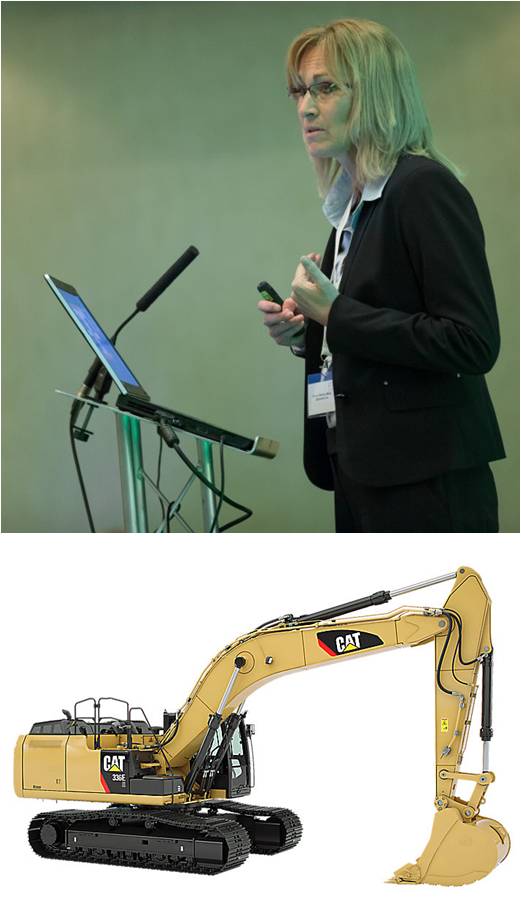
Dr Lou Balmer-Millar at the FPC 2015 & the CAT 366E

Dr Lou Balmer-Millar at the FPC 2015 & the CAT 366E

Here’s a second post on what engineers do [see my post entitled ‘Press button for exciting ride‘ on March 25th, 2015].

Dr Lou Balmer-Millar leads a team that develops new technology for off-road vehicles.  She is Director of Research and Advanced Engineering at Caterpillar Inc. and she gave a keynote talk at the  Future Powertrains Conference, which I wrote about a couple of weeks ago.  She talked about the innovations that Caterpillar are developing to increase the efficiency of their vehicles.  This includes driverless giant trucks.  If you are worried about driverless cars then what about driverless 226 tonnes trucks?  It is already a reality –   watch the Caterpillar video.

However, what stuck in my mind from her presentation was not the enormous mining trucks but the way in which Caterpillar measure the efficiency of their diggers, such as the CAT 366E Hybrid.  They are not so much interested in miles per gallon as tonnes of dirt (or muck) shifted per gallon.  Efficiency is defined as what you want out of a machine divided by what you have to put in to a machine, or work done for energy supplied [see post entitled ‘Energy efficiency‘ on June 18th, 2014].  So for a passenger car, miles travelled divided by energy used is a reasonable measure of efficiency.  But for digger, tonnes of earth moved is what you are want done, so tonnes moved per gallon is the right measure of efficiency.   The machine in the picture does not look like anything special but Caterpillar claim it is 30% more efficient than its competitors.

So there is money to be made in shifting earth more efficiently than your competitors.  If you enjoy watching machines move earth the watch this video.

Photo credit: Joshua Tucker http://www.apcuk.co.uk/2015/03/future-powertrain-conference-2015-report/