Tag Archives: heat transfer

Ample sufficiency of solar energy?

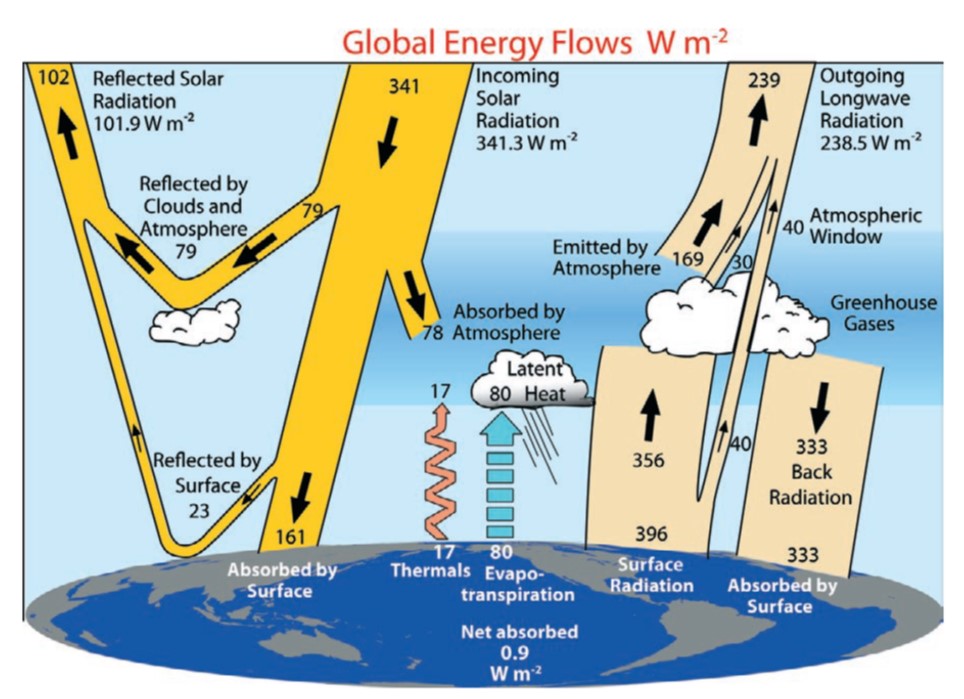
Global energy budget from Trenberth et al 2009

I have written several times about whether or not the Earth is a closed system [see for example: ‘Is Earth a closed system? Does it matter‘ on December 10th, 2014] & ‘Revisiting closed systems in Nature‘ on October 5th, 2016).  The Earth is not a closed thermodynamic system because there is energy transfer between the Earth and its surroundings as illustrated by the schematic diagram. Although, the total incoming solar radiation (341 Watts/sq. metre (W/m²)) is balanced by the sum of the reflected solar radiation (102 W/m²) and the outgoing longwave radiation (239 W/m²); so, there appears to be no net inflow or outflow of energy.  To put these values into perspective, the world energy use per capita in 2014 was 1919 kilograms oil equivalent, or 2550 Watts (according to World Bank data); hence, in crude terms we each require 16 m² of the Earth’s surface to generate our energy needs from the solar energy reaching the ground (161 W/m²), assuming that we have 100% efficient solar cells available. That’s a big assumption because the best efficiencies achieved in research labs are around 48% and for production solar cells it’s about 26%.

There are 7.6 billion of us, so at 16 m² each, we need  120,000 square kilometres of 100% efficient solar cells – that’s about the land area of Greece, or about 500,000 square kilometres with current solar cells, which is equivalent to the land area of Spain.  I picked these countries because, compared to Liverpool, the sun always shines there; but of course it doesn’t, and we would need more than this half million square kilometres of solar cells distributed around the world to allow the hours of darkness and cloudy days.

At the moment, China has the most generating capacity from photovoltaic (PV) cells at 78.07 GigaWatts or about 25% of global PV capacity and Germany is leading in terms of per capita generating capacity at 511 Watts per capita, or 7% of their electricity demand.  Photovoltaic cells have their own ecological footprint in terms of the energy and material required for their production but this is considerably lower than most of our current sources of energy [see, for example Emissions from photovoltaic life cycles by Fthenakis et al, 2008].

Sources:

Trenberth KE, Fasullo JT & Kiehl J, Earth’s global energy budget, Bulletin of  the American Meteorological Society, March 2009, 311-324, https://doi.org/10.1175/2008BAMS2634.1.

World Bank Databank: https://data.worldbank.org/indicator/EG.USE.PCAP.KG.OE

Nield D, Scientists have broken the efficiency record for mass-produced solar panels, Science Alert, 24th March 2017.

2016 Snapshot of Global Photovoltaic Markets, International Energy Agency Report IEA PVPS T1-31:2017.

Fthenakis VM, Kim HC & Alsema E, Emissions from photovoltaic life cycles, Environmental Science Technology, 42:2168-2174, 2008.

Did cubism inspire engineering analysis?

Bottle and Fishes c.1910-2 Georges Braque 1882-1963 Purchased 1961 http://www.tate.org.uk/art/work/T00445

Bottle and Fishes c.1910-2 Georges Braque 1882-1963 Purchased 1961 http://www.tate.org.uk/art/work/T00445

A few weeks ago we went to the Tate Liverpool with some friends who were visiting from out of town. It was my second visit to the gallery in as many months and I was reminded that on the previous visit I had thought about writing a post on a painting called ‘Bottle and Fishes’ by the French artist, Georges Braque.  It’s an early cubist painting – the style was developed by Picasso and Braque at the beginning of the last century.  The art critic, Louis Vauxcelles coined the term ‘cubism’ on seeing some of Braque’s paintings in 1908 and describing them as reducing everything to ‘geometric outlines, to cubes’.  It set me thinking about how long it took the engineering world to catch on to the idea of reducing objects, or components and structures, to geometric outlines and then into cubes.  This is the basis of finite element analysis, which was not invented until about fifty years after cubism, but is now ubiquitous in engineering design as the principal method of calculating deformation and stresses in components and structures.  An engineer can calculate the stresses in a simple cube with a pencil and paper, so dividing a structure into a myriad of cubes renders its analysis relatively straightforward but very tedious.  Of course, a computer removes the tedium and allows us to analyse complex structures relatively quickly and reliably.

So, why did it take engineers fifty years to apply cubism?  Well, we needed computers sufficiently powerful to make it worthwhile and they only became available after the Second War World due to the efforts of Turing and his peers.  At least, that’s our excuse!  Nowadays the application of finite element analysis extends beyond stress fields to many field variables, including heat, fluid flow and magnetic fields.

Consensus is just a coffee break

milk in coffee‘Consensus is just a coffee break’ to quote Caputo. He argued that if consensus was the ultimate aim then eventually we would all stop talking. The goal of conversation would be silence and as he wrote that would be a strange outcome for a species defined by its ability to speak. It is differences that drive everything: innovation, progress and the processes of life.

In thermodynamics, William Thomson (Lord Kelvin) observed that heat flows into the random motion of molecules and is never recovered, so that eventually a universe of uniform temperature will be created. When heat flows between matter at different temperatures we can extract work, for instance, using a heat engine. No work could be extracted from a universe of uniform temperature and so nothing would happen. Life would cease and there would be cosmic death [see my posts entitled ‘Will it all be over soon‘ on November 2nd, 2016 and ‘Cosmic Heat Death‘ on February 18th, 2015].

In the Hitchhiker’s Guide to the Galaxy, the crew of the Heart of Gold contemplated whether relationships between people were susceptible to the same laws that governed the relationships between atoms and molecules. The answer would appear to be affirmative in terms of dissonance being necessary for action.

So, we should celebrate and respect the differences in our communities. They are essential for a functioning, vibrant and successful society – without them life would not just consist of silent conversations but would cease completely.

Sources:

Caputo JD, Truth: Philosophy in Transit, London: Penguin 2013

Douglas Adams, The Hitchhiker’s Guide to the Galaxy, London: Picador, 2002.

Will it all be over soon?

milkywayNASAAs you may have gathered from last week’s post [Man, the Rubbish-Maker on October 26th, 2016], I have been reading Italo Calvino’s Complete Cosmicomics.  In one story, ‘World Memory’ the director of a project to document the entire world memory in the ‘expectation of the imminent disappearance of life on Earth’ is explaining to his successor that ‘we have all been aware for some time that the Sun is halfway through its lifespan: however well things went, in four or five billion years everything would be over’.  The latter is one of the scientific conclusions around which Calvino weaves these short stories and this one put into perspective the concerns expressed by some of my students on both my undergraduate course and MOOC in thermodynamics the prospect of a cosmic heat death resulting from the inevitable consequences of the second law of thermodynamics [see my post ‘Cosmic Heat Death‘ on February 18th, 2015].  The second law requires ‘entropy of the universe to increase in all spontaneous processes’.   Entropy was defined by Rudolf Clausius about 160 years ago as the heat dissipated in a process divided by the temperature of the process.  The dissipated heat flows into random motion of molecules from which it is never recovered.  So, as William Thomson observed, this must eventually create a universe of uniform temperature – an equilibrium state corresponding to maximum entropy where nothing happens and life cannot exist.   Entropy has been increasing since the Big Bang about 13.5 billion years ago.  And as Calvino writes, the sun is about halfway through its life – it is expected to collapse into a white dwarf in 4 to 5 billion years when its supply of hydrogen runs out.  These are enormous timescales: the first human cultures appeared about 70,000 years ago [see my post ‘And then we discovered thermodynamics‘ on February 3rd, 2016]  and history would suggest that our civilization will disappear long before the sun expires or cosmic heat death occurs.  A more immediate existential threat is that our local production of entropy on Earth destroys the delicate balance of conditions that allows us to thrive on Earth.  See my post on Free Riders on April 6th, 2016 for thoughts on avoiding this threat.

Sources:

Italo Calvino, The Complete Cosmicomics, London: Penguin Books, 2002.