Tag Archives: fossil fuel

Difficult or inconvenient data about electric vehicles

photograph of a MDI Airpod 2.0The embodied carbon (i.e. the greenhouse gas emissions produced by its manufacture and assembly) of a typical small (compact) battery electric vehicle (BEV) is about 14 tonnes CO2 compared to about 7 tonnes CO2 in a compact internal combustion engine vehicle (ICEV) [see brusselblog.co.uk for overview of estimates from several sources].  This is mainly a result of the embodied carbon in the batteries.  My compact ICEV does about 50 mpg and we drive about 8,000 per year so we burn 160 gallons per year and one gallon generates about 9 kg CO2; thus, the carbon emissions from my ICEV are about 1.4 tonnes CO2/year. Hence, with our driving habits, building and using a compact ICEV car for five years is equivalent, in carbon emissions (= 7 + (1.4 x 5)), to just building a small electric car.  This does not account for the carbon footprint of electricity generation for the electric car which will not be zero and be dependent on how the electricity is generated; nor is recycling of your old vehicle included.  If you already have a ICEV car then your additional emissions resulting from its continued use will take about a decade to be more than buying a new electric car though by buying an electric vehicle you will move the pollution away from where you live and work.  If you buy an electric SUV, as about 45% of new car purchasers do worldwide [see IEA data], then many more years will be required to acheive a net reduction in carbon emission because the embodied carbon in an electric SUV can be five to ten times more than a compact ICEV.  The challenge for engineers is to develop vehicles that have both zero emissions in use and also zero embodied carbon.  Meanwhile, the bottom line is to use public transport whenever possible but if you need a car then have a small one and keep an electric one for much longer than an internal combustion engine vehicle – neither helps achieve net zero.

Image: the MDI Airpod that runs on compressed air [see ‘Hot air is good for balloons but cold air is better for cars‘ on May 19th , 2021.

Is it time to change priorities on climate change?

It seems unlikely that global warming will be limited to only 1.5 degrees Centigrade above pre-industrial levels in the light of recent trends in temperature data [see ‘It was hot in June and its getting hotter’ on July 12th, 2023 ]. It is probable global warming will lead to average surface temperatures on the planet rising by 4 or 5 degrees, perhaps within a matter of decades.  A global average temperature rise of only 2 degrees would make the Earth as warm as it was 3 million years ago when sea levels were 25 to 35 m (80 to 130 ft) high (Blockstein & Wiegman, 2010).  While it is still important to aim for zero carbon emissions in order to limit global warming and avoid global temperatures reaching a tipping point, it seems improbable that politicians worldwide will be able to agree and implement effective actions to achieve the goal in part because of the massive, vested interests in industrialised economies based on fossil fuels [see ‘Are we all free-riders?’ On April 6th, 2016].  Hence, we need to start planning for potentially existential changes in the climate and environment that will force us to adapt the way we live and work.  In addition to rises in sea levels, a world that is 4 degrees hotter is likely to have an equatorial belt with high humidity causing heat stress across tropical regions that make them uninhabitable for most of the year. To the north and south of this equatorial belt will be mid-latitude belts of inhospitable deserts extending as far north as a line through Liverpool, Manchester, Hamburg, the straits north of Sapporo in Japan, Prince Rupert in British Columbia and Waskaganish on the Hudson Bay.  The habitable zones for humans are likely to be north of this line and in the south in Antarctica, Patagonia, Tasmania and the south island of New Zealand.  Agriculture will probably be viable in these polar regions but will compete with a very dense population [see ‘Belts of habitability in a 4° world’ in Nomad Century by Gaia Vince].  In other words, there will likely be mass migrations that will force a re-organisation of society and a restructuring of our economies.  Some estimates suggest that there could be as many as 1.2 billion environmental migrants by 2050 (Bellizzi et al, 2023).  We need to start adapting now, the world around us is already adapting [see ‘Collaboration and competition’ on June 8th, 2022].

Planning to give up fossil fuels

Decorative image from video mentioned in postAt the start of last month, I wrote about the need for national plans to ween us from our addiction to fossil fuels [see ‘Bringing an end to thermodynamic whoopee‘ on December 8th, 2021].  If we are to reduce carbon emissions to the levels agreed in Paris at COP 21 then the majority of the population as well as organisations in a country will need to engage with and support the national plan which implies that it must transcend party politics.  This level of engagement will likely require us to have a well-informed public debate in which we listen to diverse perspectives and consider multifarious solutions that address all of the issues, including the interests of a fossil fuel industry that employs tens of millions of people worldwide [see EU JRC Science for Policy report on Employment in the Energy Sector] and makes annual profits measured in hundreds of billions of dollars [see article in Guardian newspaper about $174 billion profit of 24 largest oil companies].  Perhaps, learned societies nationally and universities regionally could collate and corroborate evidence, host public debates, and develop plans.  This process is starting to happen organically [for example, see Climate Futures: Developing Net Zero Solutions Using Research and Innovation]; however, the urgency is such that a larger, more focussed and coordinated effort is required if we are to bring about the changes required to avoid the existential threat [see ‘Disruptive change required to avoid existential threats‘ on December 1st, 2021].

Bringing an end to thermodynamic whoopee

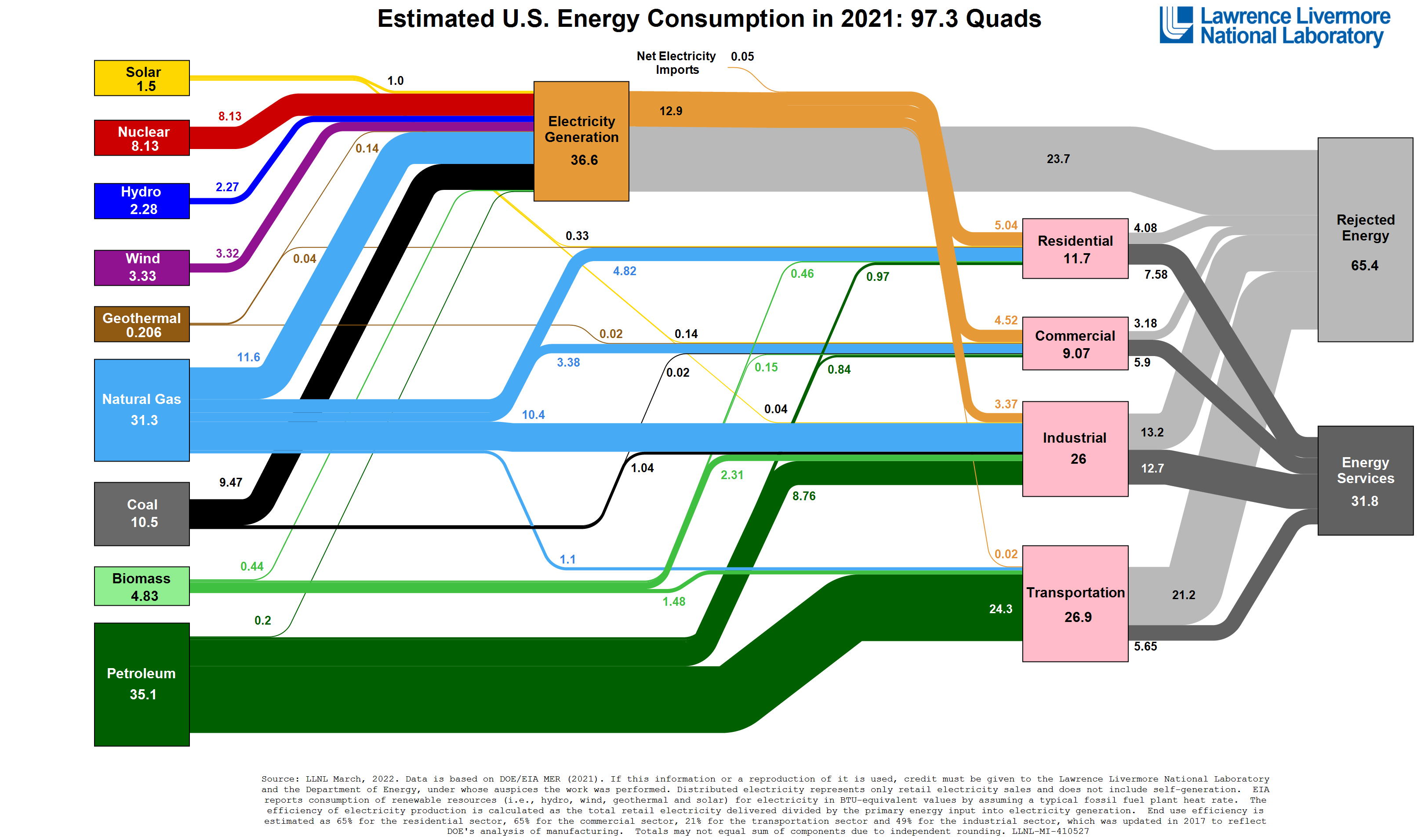
Two weeks ago I used two infographics to illustrate the dominant role of energy use in generating greenhouse gas emissions and the disportionate production of greenhouse gas emission by the rich [see ‘Where we are and what we have‘ on November 24th, 2021].  Energy use is responsible for 73% of global greenhouse gas emissions and 16% of the world’s population are responsible for 38% of global CO2 emissions.  Today’s infographics illustrate the energy flows from source to consumption for the USA (above), UK and Europe (thumbnails below).  In the USA fossil fuels (coal, natural gas and petroleum) are the source of nearly 80% of their energy, in the UK it is a little more than 80% and the chart for Europe is less detailed but the proportion looks similar. COP 26 committed countries to ending ‘support for the international unabated fossil fuel energy sector by the end of 2022’ and recognised ‘investing in unabated fossil-related energy projects increasingly entails both social and economic risks, especially through the form of stranded assets, and has ensuing negative impacts on government revenue, local employment, taxpayers, utility ratepayers and public health.’  However, to reduce our dependency on fossil fuels we need a strategy, a plan of action for a fundamental change in how we power industry, heat our homes and propel our vehicles.  A hydrogen economy requires the production of hydrogen without using fossil fuels, electric cars and electric domestic heating requires our electricity generating capacity to be at least trebled by 2050 in order to hit the net zero target. This scale and speed of  transition to zero-carbon sources is such that it will have to be achieved using an integrated blend of green energy sources, including solar, wind and nuclear energy.  For example, in the UK our current electricity generating capacity is about 76 GW and 1 GW is equivalent to 3.1 million photovoltaic (PV) panels, or 364 utility scale wind turbines [www.energy.gov/eere/articles/how-much-power-1-gigawatt] so trebling capacity from one of these sources alone would imply more than 700 million PV panels, or one wind turbine every square mile.  It is easy to write policies but it is much harder to implement them and make things happen especially when transformational change is required.  We cannot expect things to happen simply because our leaders have signed agreements and made statements.  Now, national plans are required to ween us from our addiction to fossil fuels – it will be difficult but the alternative is that global warming might cause the planet to become uninhabitable for us.  It is time to stop ‘making thermodynamic whoopee with fossil fuels’ to quote Kurt Vonnegut [see ‘And then we discovered thermodynamics‘ on February 3rd, 2016].


Sources:

Kurt Vonnegut, A Man without a Country, New York: Seven Stories Press, 2005.  He wrote ‘we have now all but destroyed this once salubrious planet as a life-support system in fewer than two hundred years, mainly by making thermodynamic whoopee with fossil fuels’.

US Energy flow chart: https://flowcharts.llnl.gov/commodities/energy

EU Energy flow chart: https://ec.europa.eu/eurostat/web/energy/energy-flow-diagrams

UK Energy flow chart: https://www.gov.uk/government/collections/energy-flow-charts#2020