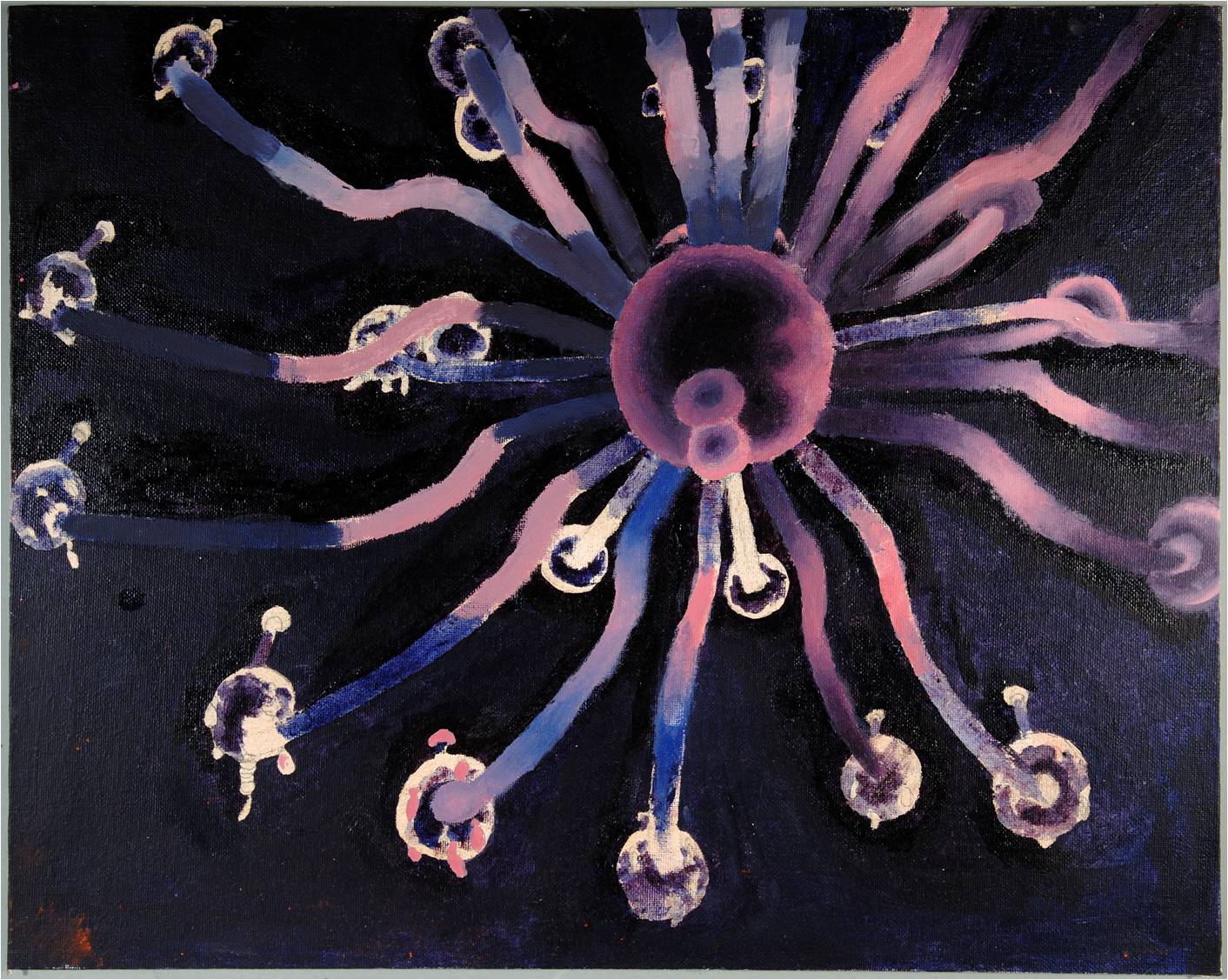
I have a new print in my office. It’s called ‘Small Science Fiction Self-Portrait’ and is by Maria Lassnig (1919-2014) [see: http://www.painters-table.com/link/contemporary-art-daily/maria-lassnig]. I am disappointed to admit that I had never heard of her until I went to a special exhibition at the Tate Liverpool a few weeks ago, which featured her work and that of Francis Bacon. I was expecting the works by Bacon to be the main attraction but instead I thought Lassnig ‘stole the show’. Nearly all of her paintings in the exhibition were self-portraits in which she attempts to represent on canvas her ‘body sensation’ or ‘body awareness’. This seems to echo the synaesthesia pursued by Georgia O’Keeffe when she represented her feelings from various senses in her paintings [see my post entitled ‘Engineering Synaesthesia‘ on September 21st, 2016]. Two of Lassnig’s paintings resonanted with me: one, which was on the front of the programme, called Lady with Brain was painted in 1991 and shows the head of a lady with a proportion of her brain outside of her skull – not in a damaged way but as if it had grown there. This reminded me of the ideas on our increasing use of out-of-skull memory and processing power in our mobile devices that I wrote about under the heading ‘Thinking out of Skull’ [see my post of that title on March 18th, 2015]. The second is the print in my office, painted in 1995, that shows the artist wearing a virtual reality headset that looks almost identical to those we use in our Virtual Engineering Centre. I was amazed by Lassnig’s vision.
Tag Archives: creativity
Art and engineering
![Windows of the Soul II [3D video art installation: http://www.haigallery.com/sonia-falcone/]](https://realizeengineering.blog/wp-content/uploads/2016/09/windows-of-soul-11.jpg?w=625)
Windows of the Soul II [3D video art installation: http://www.haigallery.com/sonia-falcone/%5D
On the other hand, when we visit art galleries we can buy prints and postcards that are copies of the artworks displayed in the gallery. Is the mass-produced, but iconic, engineering artifact equivalent to an art print? Perhaps the original has to be rather less transitory than the latest model of phone or car. The advent of computer-aided engineering and rapid prototyping means that the original often only exists in virtual space, which is more equivalent to the video installations that are becoming more commonplace in galleries, such as Sonia Falcone’s ‘Best Video Installation Art at the Biennale in Santa Cruz Bolivia‘.
Engineering synaesthesia
One of the most memorable places we visited when we lived in the United States was Sante Fe, New Mexico. We rented a house on a hillside that was walking distance from downtown. The landscape is stark, vast and vivid all at the same time. Georgia O’Keeffe captured it beautifully in her paintings. In our house in Liverpool, we have a number of prints from her paintings that we bought during a visit to the Georgia O’Keeffe Museum in Sante Fe about ten years ago. So it was a nostalgic experience to visit the O’Keeffe exhibition at the Tate Modern in London a few weeks ago and reacquaint ourselves with familiar originals as well as enjoy paintings we had not seen before. ‘Red and Yellow Cliffs‘ (1940) was one of my favourites in the exhibition which was reminiscent of many of the landscapes in New Mexico. I also enjoyed the room entitled ‘Abstraction and the Senses’ that contained a series of paintings in which O’Keeffe took inspiration from sensory stimulation and expressed in her paintings the feelings induced by ‘signals’ from senses other than sight, such as hearing music. This is known as synaesthesia: ‘the production of a sense impression relating to one sense or part of the body by stimulation of another sense or part of the body’, according the Oxford Online Dictionary. Some people suffer from synaesthesia and hearing particular sounds might trigger a sensation of taste, or letters might be associated with colours, for instance ‘A’ with red. It can be very useful, for instance I ‘see’ numbers laid out in patterns and so can perform mental arithmetic pictorially.
Engineers make use of similar phenomena to visualize patterns of variables that are invisible. For instance, moiré interferometry uses the interference between regular arrays of lines to magnify tiny differences in the arrays and generate visible fringe patterns – this is useful in comparing the dimensions of two objects to which the arrays are attached. In photoelasticity, polarised light is used to generate colour fringe patterns that are contours of stress in transparent components or models of components [see my post entitled ‘Art and Experimental Mechanics‘ on July 12th, 2012]. Unfortunately this elegant, but analogue, technique has been almost completely usurped by digital analysis using computers. Many of these computers have a touch screen that convert your thoughts, conveyed by the tap or swipe of your fingers, into text or commands for devices attached physically or wirelessly to the computer. And, virtual reality goggles, head sets and haptic devices allow the computer to reverse the process by transmitting signals to our senses, which often confuse us as they become intermingled in a new form of synaesthesia. Georgia O’Keeffe died in 1986 at the age of 98 and so missed out on this aspect of the digital revolution but it might have generated a whole series of beautiful paintings.
Sources:
http://www.nhs.uk/conditions/synaesthesia/Pages/Introduction.aspx
Engineering is all about ingenuity
Who was the first engineer? It’s a tricky question to answer. Some sources cite Ailnolth, who lived in the second half of the twelfth century and worked on the Tower of London, as one of the first to be called an ‘ingeniator’. The word comes from the Latin and the Roman writer, Vitruvius, describes master builders as being ingenious or possessing ‘ingenium’. Leonardo da Vinci (1452 – 1519) was perhaps the first person to be appointed as an engineer. The Duke of Milan appointed him ‘Ingenarius Ducalis’ or Master of Ingenious Devices.
So it would appear that an engineer is ‘a skilful contriver or originator of something’, which is the third definition in the on-line Oxford Dictionary after ‘a person who designs, builds, or maintains engines, machines or structures’ and ‘a person who controls an engine especially on an aircraft or ship’. This type of engine, which uses heat to do work, is a relatively recent invention probably by Thomas Savery and Thomas Newcomen in the early eighteenth century. Engineers have been contriving, designing and inventing ‘works of public utility’ [quote from my older hard copy Oxford English Dictionary] for many centuries before the heat engine hijacked the terminology.
Why does this matter? Well, many people have a misconception that engineering is all about engines, the heat kind; and yes, some of us do design, build and maintain engines but very many more engineers contrive, design and invent works of public utility – in the broadest sense of the words, i.e. just about everything ‘invented’ in the world. In other words, engineering is using human ingenuity to produce something useful; preferably something that improves the quality of life – oh, but now we are moving into ethics and I will leave that for another day!
Sources:
Blockley D, Engineering: A Very Short Introduction, Oxford: Oxford University Press, 2012.
Auyang SY, Engineering – an endless frontier, Cambridge MA: Harvard University Press, 2004.
Little W, Fowler HW & Coulson J, The Shorter Oxford English Dictionary, C.T. Onions (editor), London: Guild Publishing, 1983.