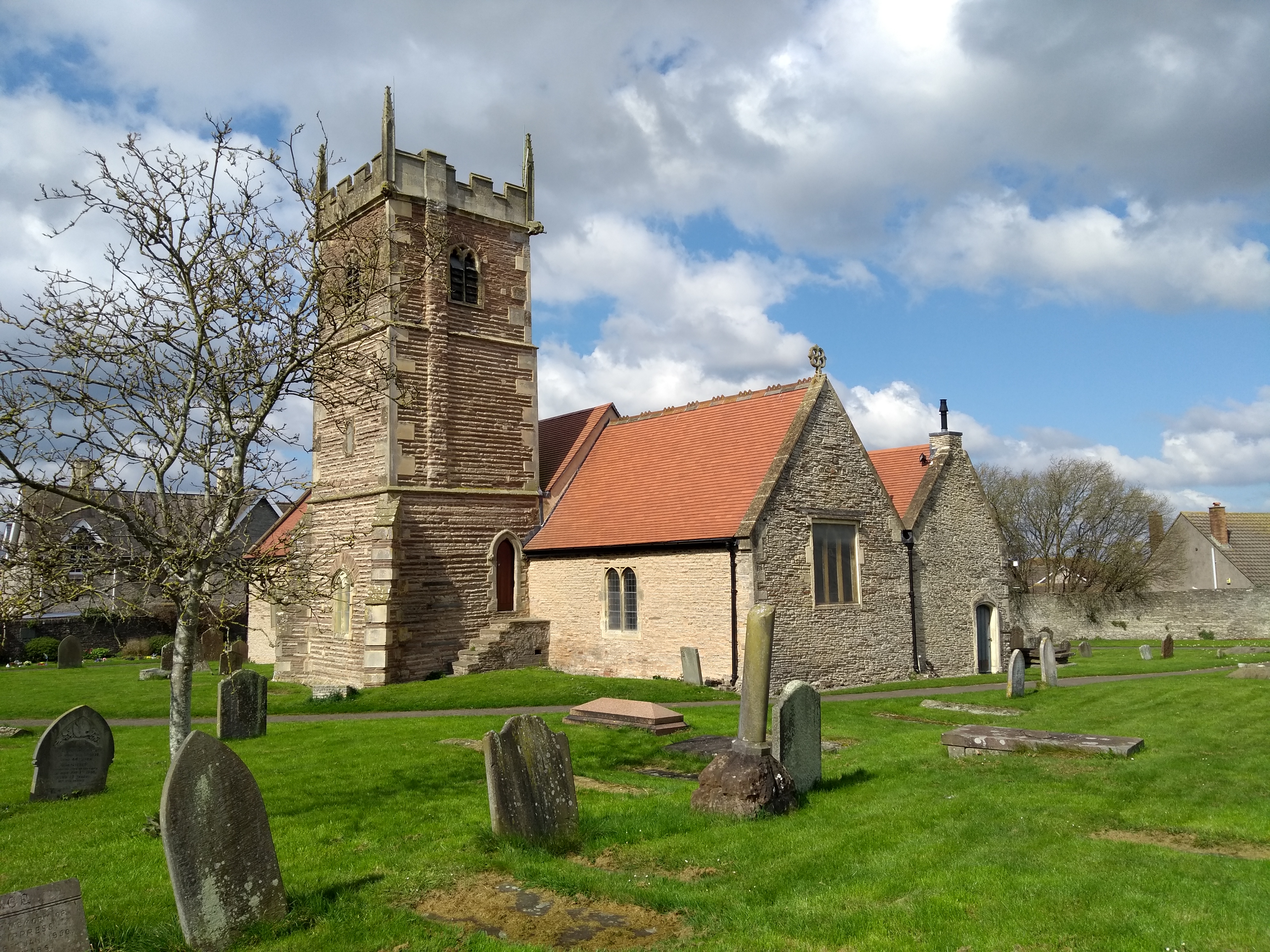
St Michael’s Church, Stoke Gifford
I have been visiting the Airbus site at Filton near Bristol since the mid-1990s. It is where the wings for new designs of aircraft are developed and tested. My involvement has been in the developing of techniques for measuring strain in aircraft structures during static and fatigue tests. At the moment, we are working on methods to integrate fields of measurements with computational predictions of stress and strain [see ‘Jigsaw puzzling without a picture‘ on October 27th, 2021]. I frequently travel by train to Bristol Parkway Station and walk past the church in the photograph without even noticing it despite it being next to the station. To be fair, the view of it from the station entrance is obscured by a billboard. However, last week as I walked back to the station with a half-hour to spare, I noticed a gate leading into a churchyard. I slipped through the gate thinking that perhaps there might be an interesting old church to explore but it was locked and I had to be satisfied with a stroll around the churchyard. I was slightly shocked to realise the church, and the village green beyond it, had been hidden in full view for more than thirty years of walking within a few tens of metres of it perhaps once a month. I had always been too focussed on the research that I was heading to Airbus to discuss, or too tired at the end of a day, to notice the things around me. Our senses flood our brains with information most of which is ignored by our conscious minds that are busy time traveling through past memories or looking into the future [see ‘Time travel and writing history‘ on March 23rd, 2022]. However, there is pleasure to be gained by dwelling in the present and exploring the sensory experience flooding into our brains. As Amy Liptrot commented in her book ‘The Outrun‘, “the more I take the time to look at things, the more rewards and complexity I find”.
Sources:
Enuma Okoro, The Pleasure Principle, FT Weekend, 19 February/20 February 2022.
Mia Levitan, Descent into digital distraction, FT Weekend, 5 March/6 March 2022.
 Term has started, and our students are preparing for end-of-semester examinations; so, I suspect that they would welcome the opportunity to deploy the sleeping-learning that Aldous Huxley envisaged in his ‘Brave New World’ of 2540. In the brave new world of digital engineering, some engineers are attempting to conceive of a world in which experiments have become obsolete because we can rely on computational modelling to simulate engineering systems. This ambitious goal is a driver for the MOTIVATE project [see my post entitled ‘
 Realize Engineering