 Today, the probability that you will have to run away from a tiger is very small, no matter where you live. Tigers have lost 93% of their historical range that used to stretch from Turkey across Asia to Eastern China and southwards to Indonesia. Tigers have no problem with the first law of thermodynamics – they instinctively know that if they take in more energy than they expend then the excess energy will be stored as fat and when they become overweight they won’t be able to catch you or whatever else they decided to chase for their next meal.
As a species we seem to have lost that understanding of energy balances. Obesity is increasing in many parts of the world. The situation is so serious in the UK, where more than two-thirds of the adult population are overweight or obese, that the Royal Society for Public Health has proposed that food should be labelled with the amount of exercise required to burn-off the calories it contains and they have suggested using the infographic in the thumbnail. Of course, the Royal Society’s position paper does not mention explicitly thermodynamics (or tigers!) though it does effectively cite the first law by stating ‘the cause of obesity is excess energy consumption relative to energy expenditure‘. By coincidence, this week I interviewed Professor Graham Kemp, in the Institute of Ageing and Chronic Disease in Liverpool, about energy flows through our bodies for a MOOC on Energy: Thermodynamics in Everyday Life.
If you wa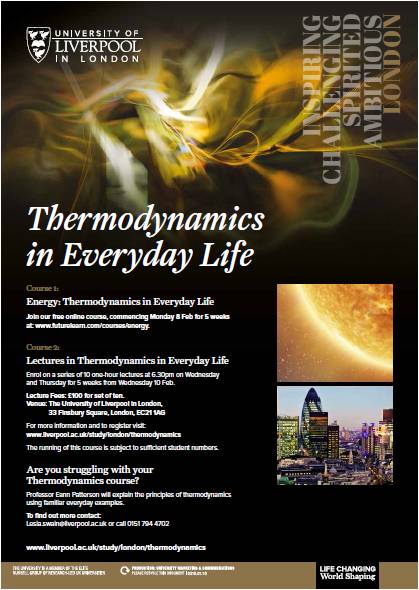 nt to listen to that interview or learn more about the thermodynamics underpinning the energy balances controlling our weight, climate change and your electricity charges, then you need to join the more than 4,500 people who have already enrolled on the MOOC that will run for five weeks from February 8th, 2016. I will also be giving an accompanying series of lectures in London.
I was astonished to discover that there are fewer tigers in the world than people signed up for our MOOC. Less than 3,200 tigers exist in the wild mainly because our growing population and prolifigate use of the world’s resources has destroyed their habitat and those of the other species with which we share this planet.


 Realize Engineering