Category Archives: Uncategorized

Press button for an exciting ride

Painting by Katy Gibson

Artist: Katy Gibson

Someone has suggested that I should write more about what engineers do.  So here is the first in a series of posts in that vein.

A few weeks ago, I went to the ‘Future Powertrains Conference‘ held at the National Motorcycle Museum near Birmingham, UK.  A ‘powertrain’ is the system that creates and delivers power to the wheels of vehicles.  It is at the heart of a motorcycle but they were not discussed at the conference and instead the discussion was about cars and commercial vehicles.  There was a big focus on achieving the EU commitment under the Kyoto Protocol to reduce greenhouse gas emissions (GHG) to below 18% of 1990 levels.

Electric powertrains figured strongly and would certainly improve the air quality in our urban environment but they shift the GHG emissions problem to our powerstations [see my post on ‘Energy Blending‘ on May 22nd, 2013 and on ‘Small is beautiful and affordable in nuclear powerstations‘ on January 14th, 2015]. Even so, the high energy density of fossil fuels means that they remain a very attractive option.  The question that engineers are trying to answer is whether their GHG emissions can be reduced to below 18% of their 1990 levels.
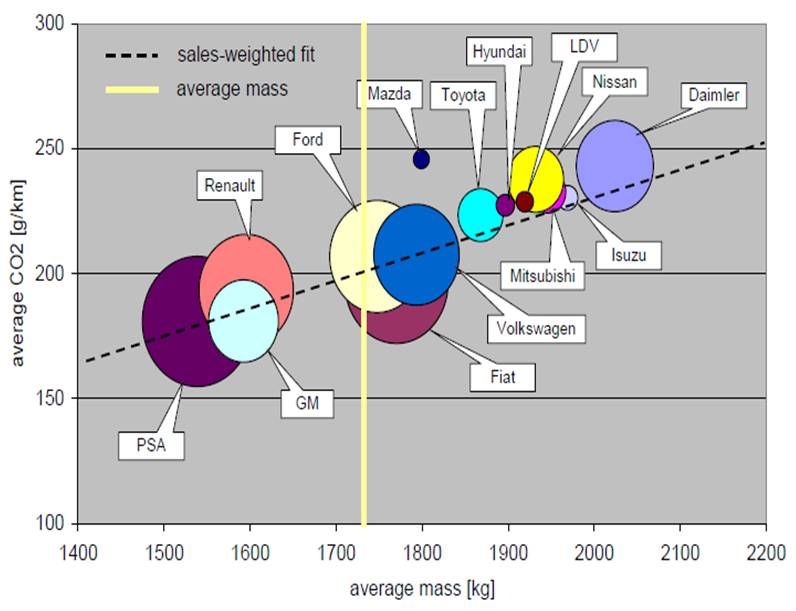
CO2 emissions vs mass of light commercial vehicles (see source below)

CO2 emissions vs mass of light commercial vehicles

When you plot CO2 emissions as a function of kerb weight for all passenger cars the graph reveals that the best in class achieve about 0.1 grams CO2 emitted per kilogram of kerb weight.  Kerb weight is the term used for the weight of a car without passengers or luggage but with a full fuel tank.  Of course, this means the simple answer is that we should all drive lighter cars!

The EU has assumed that most of us will not opt for lighter cars and has introduced legislation which is forcing manufacturers towards 0.02 grams CO2 per kg, which is a huge challenge that is being tackled at the moment by engineers, such as Paul Freeman at Mahle Powertrain Ltd who spoke at the conference.  To help meet this challenge, the UK Automotive Council has produced a series of technology roadmaps such as the one shown below and discussed by Dr Martin Davy from Oxford University during the conference.

As an alternative, we could move more quickly towards driverless cars which would both use the powertrain more efficiently and reduce the risk of accidents to almost zero.  A very small risk of accidents would allow lighter cars to be designed without a heavy crash-resistant cage.  But, as one conference delegate commented on ‘driving’ a driverless car “where would be the fun in that!”  Perhaps that shows a lack of imagination. After all, we can create exciting and safe fairground rides in which you have no control over the ‘vehicle’ into which you are strapped.  So why shouldn’t there be an ‘extra excitement’ button in a driverless car in just the same way that some modern cars have a ‘sport’ button.

passenger_vehicle_roadmap

Source:

Top graphic: http://ec.europa.eu/clima/events/docs/0019/final_report_lcv_co2_250209_en.pdf

Bottom graphic: http://www.automotivecouncil.co.uk/wp-content/uploads/2013/09/Automotive-Council-Roadmaps.pdf


Thinking out-of-the-skull

bustLast year after the relaxation of our annual vacation, I wrote about the benefits of ‘Mind wandering‘ [see my post on September 3rd, 2014].  Our brains work in two modes known as central executive mode, for those tasks requiring focussed attention, and mind-wandering mode that involves day-dreaming and surfing from one idea to another leading to the emergence of new ideas.  We tend to feel tired and stressed when we try to switch between the two modes repeatedly.  At the moment, I struggle to set aside time for mind-wandering and indeed writing a weekly blog can induce a headache!

Perhaps this is because our brains are of finite size; and sometimes it feels as if we have reached their limitations.  I wrote about our attention capacity in my post entitled ‘Silence is golden‘ on January 14th, 2014.  More recently, Antonio Macaro and Julian Baggini have written that ‘savants who remember everything often understand very little’.  Probably this is because if you fill your brain with information there is less capacity for processing ideas to create understanding.  I would like to think that maintaining space for understanding is why I can’t remember anything whereas in fact it is probably just the impact of growing old!  However, Macaro and Baggini also suggest that we should use our smart phones and tablet computers as mental prosthetics to extend the capacity of our brains.  In other words, we should let these mental prostheses handle all of the routine processing of information associated with central executive mode tasks and keep the mental processes in our skulls for the creative thinking associated with mind-wandering.

Traditionally, engineers have followed Leonardo di Vinci‘s example by writing and drawing in a series of notebooks;  perhaps in the hope of emulating his creativity but also to extend the capacity of our minds by recording and ordering thoughts.  However, the processing capacity of modern devices creates the opportunity to go even further.  So that thinking out-of-the-skull could lead to more thinking out-of-the-box!

Source: Macaro, A. & Baggini, J., ‘Do we need props?’ in Financial Times magazine, January 10/11, 2015.

Photo credit: Tom

Ada Lovelace astride two cultures

Ada LovelaceRegular readers will have noticed my recent predilection for poetry.  I am going to deviate from the theme, but only slightly, by highlighting the work of Ada Lovelace who has been described as writing about differential calculus with the same passion that her father, Lord Byron wrote about forbidden love.  As I observed last week, we need more people who can write with passion about engineering and science; so it is appropriate following International Women’s Day on Sunday to highlight the work of Ada Lovelace who worked on programs for Babbage’s analytical engine. She could be described as the world’s first computer programmer.  However, she was much more than that because in her writings she foresaw a world in which computers would be aesthetic tools capable of creating language and art.  She was at least hundred years ahead of her time.  Perhaps growing up surrounded by poetry gave her the skills to express her passion for technology and the vision to see its potential.  If that is the case then we should encourage prospective engineers to read English literature and not books on engineering as implied in my post entitled ‘Good reads for budding engineers‘ on February 25th, 2015.  We need engineers to stand astride the boundary between the ‘Two Cultures‘ [see post of the same title on March 5th, 2013].

For more on modern female scientists and the gender imbalance in science watch the short film from the Royal Society entitled ‘A Chemical Imbalance‘  [see my post on of the same title on October 2nd, 2013]

Sources: Steven Johnson, A glitch in time, Financial Times, 18/19 October 2014.

‘Culture eats strategy for breakfast’

130-3071_IMGMy title is unashamedly borrowed from Richard Plepler, CEO of the premium US cable network, HBO.  He was quoted in an interview reported in the Financial Times on January 11th, 2015 [Lunch with the FT by Matthew Garrahan].  It was said in the context of discussing how a company can encourage creativity.  I like it because it sums up my own approach to nurturing an environment in which high-quality innovative research can flourish.  The role of the leader is to establish and maintain that environment in which everyone must feel able to express their opinions and then once the decision is made be prepared to unite in achieving the goal.  This requires a level of transparency that many leaders find hard to implement and ability to listen to dissenting views that most leaders find difficult or impossible to tolerate. Good leaders create a culture in which people feel safe expressing their views.  To quote Richard Plepler again “Someone once said to me, ‘You made the room safe to talk.’ And I said. ‘If you want to win, what other way is there to be?'”.

Engineering is a creative profession in which we need to worry more about culture and less about strategy.  Of course, bringing about culture change is much harder than writing a new strategy!