Category Archives: energy science

No closed systems in nature

WP_20150722_008 (2)While I was away on vacation last month, WordPress sent an email congratulating me on the third anniversary of the start of this blog.  This stimulated me to look at the statistics on the most frequently read, or at least viewed, of the approximately 160 postings that I have written.  Top of the list is an early posting which asks the question ‘Are there any closed systems in nature?’ (see post entitled ‘Closed systems in Nature?’ on December 21st, 2012).  Since this question has generated more interest than any of my subsequent postings, it seems appropriate, after 30 months, to attempt an answer.

Alexander Bogdanov (1873-1928), and independently Karl Ludwig von Bertalanffy (1901-1972), recognized that all living systems are open systems in the thermodynamic sense, which operate far-from equilibrium and require a continual flux of matter and energy to sustain life.  By contrast, closed thermodynamic systems tend to settle into a state of equilibrium, i.e. with no differences in energy, no chemical reactions in progress and no unbalanced forces.

The cybernetist, William Ross Ashby (1903-1972) suggested that living systems are energetically open but operationally closed, i.e. closed to information and control.  In other words, a cell, or any other living organism, needs no information from the environment to be itself. All the information for a bee to be a bee is contained inside a bee (for more on the bee theme see ‘Entropy management for bees and flights‘ on November 5th, 2014 and ‘Fields of flowers’ on July 8th, 2015).  These concepts, of being energetically open and operationally closed, form the essence of the characteristics of biological life as described by Capra and Luisi, whom I have loosely quoted in the previous sentence.

So, to answer my original question, there are no closed living systems in nature.  We can take this a step further: in 1927  Charles Elton defined an ecosystem in terms of the flow of energy and matter from one organism to another. Consequently, the only waste generated by an ecosystem as a whole is the entropy associated with respiration, which allows the system to satisfy the second law of thermodynamics, and the waste is replaced with energy from the sun through photosynthesis.  The sum of all ecosystems is the biosphere.  So, it can be construed that everything on Earth is part of one giant open system – this is essentially the Gaia hypothesis.

Sources:

Gorelik, G., Principal ideas of Bogdanov’s tektology: the universal science of organisation, General Systems, 20:3-13, 1975.

Bertalanffy, L. von, General Systems Theory, New York: Braziller, 1968.

Ashby, W.R., Design for a Brain, New York: Wiley, 1952.

Capra, F., Luisi, P.L., The Systems View of Life – A unifying vision, Cambridge: Cambridge University Press, 2014.

Elton, C.S, Animal Ecology, London: Sidgwick & Jackson, 1927 (reprinted 2001, University of Chicago Press).

Lovelock, J., Gaia, Oxford: Oxford University Press, 1979.


Limitless energy

neil hunterThe Sun supplies approximately 100,000 TeraWatts (TW) of energy to the Earth continuously. To put this into perspective the entire generating capacity of China is 1TW and the global population as a whole uses 15TW. Plants use about 100TW via photosynthesis. Most our energy consumption is derived from biomass created millions of years ago by photosynthesis and stored as coal, gas or oil when the plant died and was crushed by geological processes.

I am stealing and paraphrasing from Professor Neil Hunter’s presentation at the Royal Society’s Scientific Discussion Meeting on Bio-inspiration for New Technologies. Of course, as Neil pointed out, the energy from the Sun arrives across a range of wavelengths some of which are damaging to our health. So fortunately for us the Earth’s atmosphere filters out a number of wavelengths but nevertheless a broad band of wavelengths still arrives at the Earth’s surface. Photosynthesis only makes use of two relatively narrowbands of light….

Mankind’s efforts to use solar energy look pathetic alongside Nature’s performance and should be humbling to any engineer or scientist. But it is also an inspiration to do better. We need cheap clean energy for everyone. It is being delivered everyday but we don’t know how to use it.

Problem-solving in thermodynamics

Painting from Okemos High School Art Collection at MSUDuring November and December I was handing out a sheet of problems every week in my first-year undergraduate thermodynamics class so that students could evaluate and refine their understanding and problem-solving skills as the course progressed. Of course, most students will not have done this and those problem sheets will have been part of their list of good intentions, which have now become part of their revision schedule. Well, perhaps?  Anyway, to help them is attached ‘Professor Patterson’s Patented Problem-solving Procedure (PPPPP)’ for entry-level thermodynamics problems.

PPPPP is written in the context of thermodynamics but actually it is what engineers tend to do when faced with analysis problems, i.e. draw a sketch including all the known information, identify some simplifying assumptions then apply and solve the relevant physical laws. There is plenty of research that shows most of us are visual problem-solvers [e.g. Martin & Schwartz, 2014] but it is remarkably difficult to persuade people to summarize a problem pictorially.  It takes practice and that’s why we give students lots of problems on which to hone their skills.

See my post entitled ‘Love an engineer‘ on September 24th, 2014 for about creative problem-solving engineers.  Or ‘Mind wandering‘ on September 3rd, 2014.

Sources:

Martin, L., & Schwartz, D.,  2014, ‘A pragmatic perspective on visual representation and creative thinking’, Visual Studies, 29(1):80-93.

Painting from Okemos High School Art Collection at MSU

Where there is muck there is an engineer

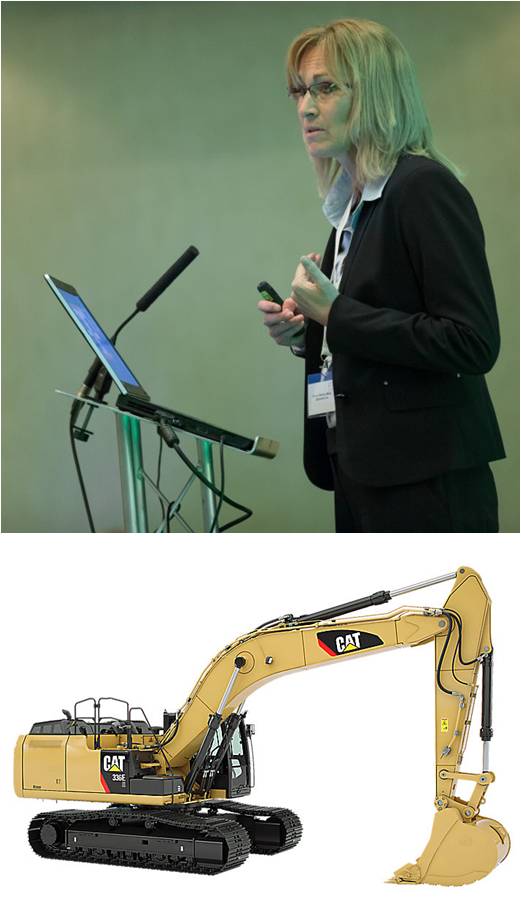
Dr Lou Balmer-Millar at the FPC 2015 & the CAT 366E

Dr Lou Balmer-Millar at the FPC 2015 & the CAT 366E

Here’s a second post on what engineers do [see my post entitled ‘Press button for exciting ride‘ on March 25th, 2015].

Dr Lou Balmer-Millar leads a team that develops new technology for off-road vehicles.  She is Director of Research and Advanced Engineering at Caterpillar Inc. and she gave a keynote talk at the  Future Powertrains Conference, which I wrote about a couple of weeks ago.  She talked about the innovations that Caterpillar are developing to increase the efficiency of their vehicles.  This includes driverless giant trucks.  If you are worried about driverless cars then what about driverless 226 tonnes trucks?  It is already a reality –   watch the Caterpillar video.

However, what stuck in my mind from her presentation was not the enormous mining trucks but the way in which Caterpillar measure the efficiency of their diggers, such as the CAT 366E Hybrid.  They are not so much interested in miles per gallon as tonnes of dirt (or muck) shifted per gallon.  Efficiency is defined as what you want out of a machine divided by what you have to put in to a machine, or work done for energy supplied [see post entitled ‘Energy efficiency‘ on June 18th, 2014].  So for a passenger car, miles travelled divided by energy used is a reasonable measure of efficiency.  But for digger, tonnes of earth moved is what you are want done, so tonnes moved per gallon is the right measure of efficiency.   The machine in the picture does not look like anything special but Caterpillar claim it is 30% more efficient than its competitors.

So there is money to be made in shifting earth more efficiently than your competitors.  If you enjoy watching machines move earth the watch this video.

Photo credit: Joshua Tucker http://www.apcuk.co.uk/2015/03/future-powertrain-conference-2015-report/