Category Archives: Soapbox

An expanding universe

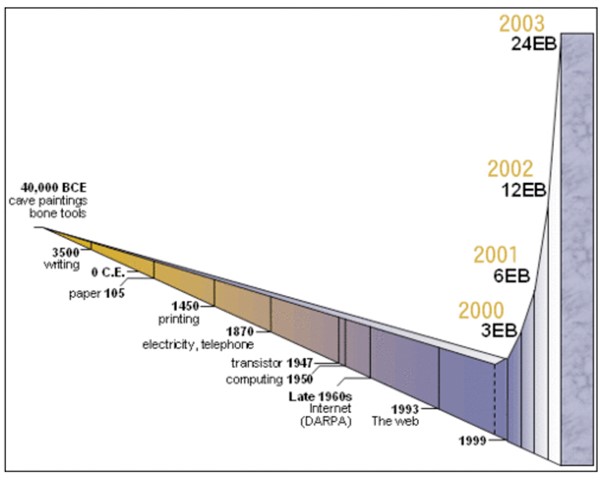
I attended a workshop last month at which one of the speakers showed us this graphic.  It illustrates that the volume of information available to us has been approximately doubling every year.  In 2005, the digital universe was 130 Exabytes (billions of gigabytes) and by 2020 it is expected to have grown to about 40,000 Exabytes.  The second law of thermodynamics tells us that entropy or disorder of the physical universe is always increasing; so, is this also true for the digital universe?  Claude Shannon proposed that information is negentropy, which implies that an increasing growth in information represents a decrease in entropy and this seems to contradict the second law [see my post ‘Entropy on the brain‘ on November 29th, 2017].  Perhaps the issue is the definition of information – the word comes from the Latin: informare, which means to inform or to give someone knowledge.  I suspect that much of what we view on our digital screens does not inform and is data rather than information.  Our digital screens are akin to telescopes used to view the physical universe – they let us see what’s out there, but we have to do some processing of the data in order to convert it into knowledge.  It’s that last bit that can be stressful if we don’t have some control mechanisms available to limit the amount of disorder that we ask our brains to cope with – we are back to Gadget Stress [see my post on April 9th, 2014] and Digital Detox [see my post on August 10th, 2016].

Source: Atsufumi Hirohata, Department of Electronics, University of York www-users.york.ac.uk/~ah566/lectures/adv01_introduction.pps

Image: http://japan.digitaldj.network.com/articles/9538.html


Formula Ocean

I have had intermittent interactions with motorsport during my engineering career, principally with Formula 1, Formula SAE and Formula Student teams.  The design, construction and competition involved in Formula Student generates tremendous enthusiasm amongst a section of the student community and enormously increases their employability.  As a Department Chair at Michigan State University, I was a proud and enthusiastic sponsor of the MSU Formula SAE team.  However, I find it increasingly difficult to support an activity that is associated with profligate expenditure of energy and resources – this is not the impression of engineering that should be portrayed to our current and future students.  Engineering is about so much more than making a vehicle go around a track as fast as possible.  See my posts on ‘Re-engineering Engineering‘ on August 30th, 2017, ‘Engineering is all about ingenuity‘ on September 14th, 2016 or ‘Life takes engineering‘ on April 22nd, 2015.

There are many other challenges that could taken up by student teams, in competition if that encourages participation, which would benefit human-kind and the planet.  A current hot topic in the UK media is the pollution of oceans by waste plastic [see for example BBC report]; so, engineering undergraduates could be challenged to design, construct and operate an autonomous marine vehicle that collects and processes plastic waste.  It could be powered from the embedded energy in the waste plastic collected in the ocean.  It would need to navigate to avoid collisions with other vessels, coastal features and wildlife, and to locate and identify the waste.  These represent technological changes in chemical, control, electronic, materials and mechanical engineering – and probably some other fields as well.  I have shared this concept with colleagues in Liverpool and there is some enthusiasm for it; maybe some competition from other universities is all that’s needed to get Formula Ocean started.  The machine with the largest positive net impact on the environment wins!


A reflection on existentialism

Detail from stained glass window by Marc Chagall in Fraumunster Zurich from http://www.fraumuenster.ch

I was in Zürich last weekend.  We visited the Fraumünster with its magnificent stained glass windows by Marc Chagall [see my post entitled ‘I and the village‘ on August 14th, 2013] and by Augusto Giacometti (1877-1947).  The Kunsthaus Zürich has a large collection of sculptures by another Giacometti, Alberto (1901-1966), a Swiss sculptor, who is famous for his slender statues of people which portray individuals alone in the world.  He was part of the existentialist movement in modern art that examined ideas about self-consciousness and our relationship to other people.  For me, this echoed a lecture that I contributed last week to a module on Scientific Impact and Reputation as part of our CPD programme [see my post entitled ‘WOW projects, TED talks and indirect reciprocity‘ on August 31st, 2016.  In the lecture, I talked about our relationship with other professional people and the development of our technical reputation in their eyes as a result of altruistic sharing of knowledge. This involves communicating with others, building relationships and understanding our place in the community.  The post-course assignment is to write a reflective essay on leadership and technical quality; and we know, from past experience, that our delegates will find it difficult to reflect on their experiences and the impact of those experiences on their life and behaviour.  Maybe we should help them by including a viewing of existential art in one of the Liverpool art galleries as part of our CPD programme on Science and Technology Leadership?

Why playing the piano might enhance our intelligence?

By National Institutes of Health [Public domain], via Wikimedia Commons

Students and lecturers leave all sorts of things in lecture theatres, including lecture notes, pens and water bottles, that accumulate around the edges like flotsam on the beach because no one wants to throw away something for which the owner might return.  A few weeks ago, I found the front page of a letter published in Nature which roused my curiosity. Its title was ‘Verbal and non-verbal intelligence changes in the teenage brain’.  My memories of my teenage years are almost uniformly bad; in part because I was unable to reproduce the academic promise that I had shown when I was younger and the pressure to do so was unrelenting.  I suspect that my experience is not uncommon and the research described in this letter offers a potential explanation for my inability to ace examinations regardless of how hard I tried.

The conventional understanding of human intellectual capacity is that it is constant during our life. However, the authors of this article have shown that the statistics, upon which this understanding is based, hide a variation in our teenage years; because some teenagers experience a reduction and some an increase in intellectual capacity, which leaves the population’s average unchanged.

In addition, using structural and functional imaging, they were able to correlate changes in verbal IQ with changes in grey matter density in a region of the brain activated by speech (the left motor cortex), and changes in non-verbal IQ with changes in grey matter density in regions activated by finger movements (the anterior cerebellum).

The timeline of the reported research does not extend far enough to establish whether or not the changes seen in teenagers is temporary; however, my anecdotal evidence suggests that might be the case.  I would conclude that the effort used to apply psychological pressure on teenagers to ace examinations might be better expended on piano lessons and piano practice to enhance sensorimotor skills which are strongly correlated to cognitive intelligence – but I suspect many parents have already worked that one out!

Source:

Ramsden S, Richardson FM, Josse G, Thomas MSC, Ellis C, Shakeshaft C, Seghier ML & Price CJ, Verbal and non-verbal intelligence changes in the teenage brain, Nature, 479:113-116, 2011.