Category Archives: fluid mechanics

Holes in fluids

Out-of-focus image from optical microscope of 10 micron diameter polystrene spheres in water

Out-of-focus image from optical microscope of 10 micron diameter polystyrene spheres in water

The holes that I wrote about last week and the week before (post entitled ‘Holes‘ on October 8th)were essentially air-filled holes in a solid plate.  When an in-plane load is applied to the plate it deforms and its surface around the hole becomes curved due to the concentration of stress and light passing through the curved surfaces is deviated to form the caustic.  If you didn’t follow that quick recap on last week then you might want flip back to last week’s post before pressing on!

The reverse situation is a solid in a fluid.  It is difficult to induce stress in a fluid so instead we can use a three-dimensional hole, i.e. a sphere, to generate the curve surface for light to pass through and be deviated.  This is quite an easy experiment to do in an optical microscope with some polystyrene spheres floating in distilled water with the microscope slightly out of focus you get bright caustics.  And if you take a series of photographs (the x-y plane) with the microscope objective lens at different heights (z-value) it is possible to reconstruct the three-dimensional shape of the caustic by taking the intensity or greyscale values along the centre line of each image and using them all to create new image of the x-z and, or y-z plane, as shown in the picture.

Well done if you have got this far and are still with me!  I hope you can at least enjoy the pictures.  By the way the particle in the images is about the same diameter as a human hair.
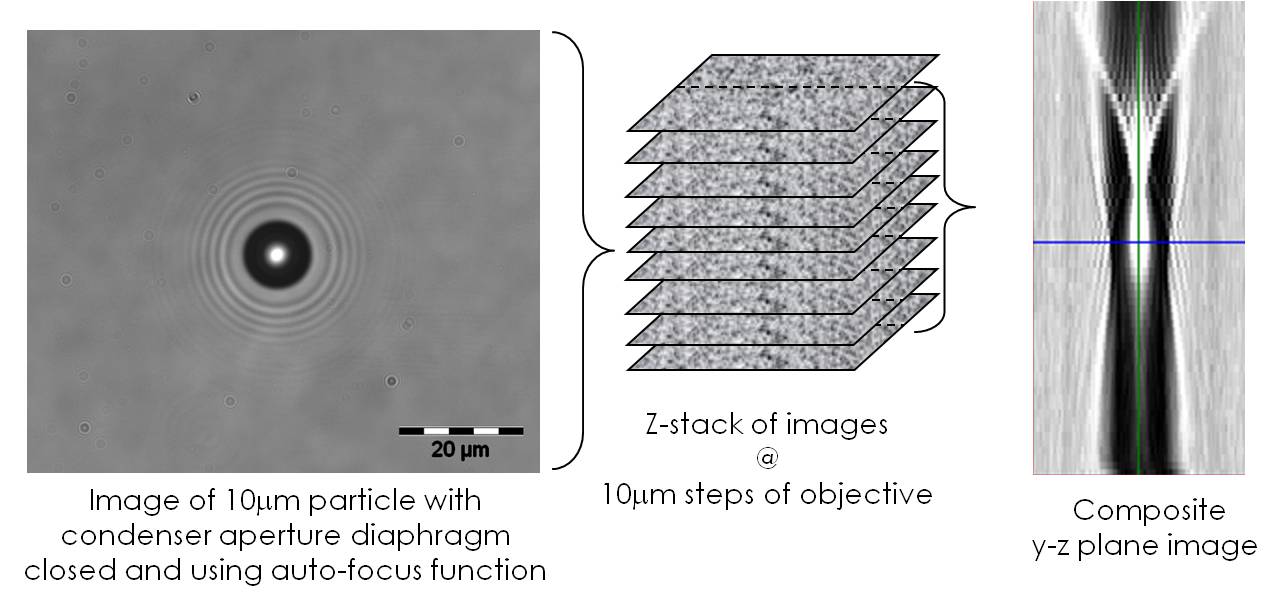
Image in optical microscope of polystrene particle in water (left), series of images at different positions of microscope objective (centre) and artificial image created from greyscale data along centre-lines of image series (right).

Image in optical microscope of polystyrene particle in water (left), series of images at different positions of microscope objective (centre) and artificial image created from greyscale data along centre-lines of image series (right).

Source:

Patterson, E.A., & Whelan, M.P., Tracking nanoparticles in an optical microscope using caustics, Nanotechnology, 19(10): 105502, 2008.

100 Everyday Engineering Examples

bookletsSTOP PRESS – more than 100 Everyday Engineering Examples published in more than 40 lesson plans on a new webpage.

I have been including 5E lesson plans as part my recent posts.  These lesson plans are primarily for people teaching first-year engineering undergraduates, which is pulling me away from the intended focus of this blog. So, I have decided to publish all of the lesson plans that I have written & edited on a separate page.  There are more than 100 Everyday Engineering Examples in the more than forty lesson plans.  If that is not enough Everyday Engineering Examples then you can find more at ENGAGE

Now back to Realizing Engineering – we live in an almost entirely engineered world. Engineers, as a profession, are so good at their job that most people are unaware of their influence on society.  Look around you. Engineers will have designed the machines and transport infrastructure to supply most of what you can see as well as what you are probably sitting in and on.

The Royal Academy of Engineering has produced an ebook to expand on this theme of ‘Engineering in Society’ for first year engineering undergraduates but I think its suitable for anyone considering a career in Engineering.

Singing in the rain

Followers of this blog might have deduced that I live within sight of the sea, which means that it is nearly always windy.  After a rain storm the streets of the city are usually littered with broken umbrellas.  I suspect that most of these belong to the many tourists that visit Liverpool, because local residents know that the wind will wreck any umbrella that you are brave enough or foolish enough to put up.

It is relatively straightforward to estimate the forces involved in holding an umbrella up in a gale by using control volume analysis.  The lesson plan below includes this Everyday Engineering Example together with two more control volume analyses.

Momentum 5EplanNoF5_momentum

The title of the posting is pretty tenuous this week: Gene Kelly sings ‘Singin’ in the rain’ without an umbrella in the film of the same name, see www.youtube.com/watch?v=D1ZYhVpdXbQ – well its difficult to be creative all of the time, or even some of the time!

See also the Everyday Engineering Examples page on this blog for more lesson plans and more background on Everyday Engineering Examples.

Reducing tension

bubbleHave you ever tried to float a paperclip in a bowl of water?  It is quite difficult but possible if you put the paperclip on a piece of tissue paper and carefully place the tissue paper with the paperclip onto the surface of the water; then, using a pencil slowly push the tissue underwater and, with a little bit of luck and practice, the paperclip will be left floating on the surface of the water.  The surface tension of the water counteracts the gravitational force on the paperclip.  This is the same mechanism that allows some insects to ‘skate’ across the surface of ponds.

Detergent is a surfactant which reduces the surface tension of the water.  So, if you drop a little bit into your bowl of water the paperclip will sink because the surface tension is no longer sufficient to support it.

This is not an experiment to demonstrate in class because it is too delicate and too small for students to see but students can do it for themselves at home.  An alternative for demonstrating surface tension effects is to blow bubbles using a detergent solution.  These two ‘Everyday Engineering Examples’ are described in the lesson plan below and you can watch a video clip about it at www.youtube.com/watch?v=BRyQvGEQUt0

5EplanNoF1_fluids&their_properties

See also the Everyday Engineering Examples page on this blog for more lesson plans and more background on Everyday Examples.