Author Archives: Eann Patterson

Is Earth a closed system? Does it matter?

 Earth's annual global mean energy budget,  from Kiehl and Trenberth 1997

Earth’s annual global mean energy budget, from Kiehl and Trenberth 1997

The dictionary definition of a system is ‘a set of things working together as parts of a mechanism or an interconnecting network; a complex whole’. So it is easy to see why ‘systems engineering’ has become ubiquitous: because it is difficult to design anything in engineering that is not some kind of system.  Perhaps the earliest concept of a system in post-industrial revolution engineering is the thermodynamic system, which is a well-defined quantity of matter that can exchange energy with its environment.

Engineers define thermodynamic systems by drawing arbitrary boundaries around ‘quantities of matter’ that are of interest, for instance the contents of a refrigerator or the inside of the cylinder of a diesel engine [see my post entitled ‘Drawing Boundaries‘ on December 19th, 2012].  These boundaries can be permeable to matter in which case the system is described as an ‘open system’, as in the case of an diesel engine cylinder into which fuel is injected and exhaust gases ejected. Conversely, the boundary of a ‘closed system’ is impermeable to matter, i.e. the refrigerator with the door closed.  The analysis of a closed system is usually much simpler than for an open one.  In his Gaia theory, James Lovelock proposed that the Earth was a self-regulated complex system.  Is it also a closed thermodynamic system?  It is clear that energy exchange occurs between the Earth and its surroundings as a consequence of solar radiation incident on the Earth (about 342 Watts/square meter) and radiation from the Earth as a consequence of reflection of solar radiation (about 107 Watts/square meter) and its temperature (235 Watts/square meter).  This implies that we can consider the Earth as a thermodynamic system.  The Earth’s gravitation field ensures that nothing much leaves; at the same time the vast of emptiness of space means that collisions with matter happen only very occasionally, so the inward flow of matter to Earth is negligible.  So, perhaps we could approximate Earth as a closed thermodynamic system.

Does it matter?  Yes, I believe so, because it influences how we think about our complex life support system, or spaceship Earth that sustains and protects us, as Max Tegmark describes it in his book ‘Our Mathematical Universe’.  In a closed system there is finite amount of matter that cannot be replenished, which implies that the Earth’s resources are finite.  However, our current western lifestyle is focused on consumption which is incompatible with a sustainable society in a closed system.  Even the Earth’s energy balance appears to be in equilibrium based on the data in the figure and so we should be careful about massive schemes for renewable energy that might disturb the Gaia.

Sources:

Kiehl, J.T., and Trenberth, K.E., 1997, Earth’s annual global mean energy budget, Bulletin – American Meteorological Society, 78(2):197-208.

Thess, A., The Entropy Principle – Thermodynamics for the Unsatisfied, Springer-Verlag, Berlin, 2011.

Tegmark, M., Our Mathematical Universe, Penguin Books Ltd, 2014.
All things being equal

firstsixbooksofe00eucl_0007Some of the greatest insights and inventions are obvious once they have been pointed out to you and you wonder how you could not have spotted them yourself. Is it luck or genius that allows someone to be the first to have a great idea? The quest for more efficient engines to power the industrial revolution led the likes of Sadi Carnot, Rudolf Clausius, William Rankine, William Thomson and James Watt to experiment and think deeply about thermodynamics or what might be called energy science or energy engineering. They established the First Law of thermodynamics (energy is always conserved) and Second Law of thermodynamics (entropy increases in all processes) of thermodynamics but initially missed the more fundamental, and arguably simpler, Zeroth Law (two systems in thermal equilibrium with a third must also be in thermal equilibrium each other). Rankine, working around 1850, is often attributed with identifying the Zeroth Law but probably the credit should go to Euclid (380-260 BC) who appears to have got there first in the fifth of his series of six books, ‘Elements’ [see my post entitled ‘Lincoln on equality‘ on February 6th, 2013).

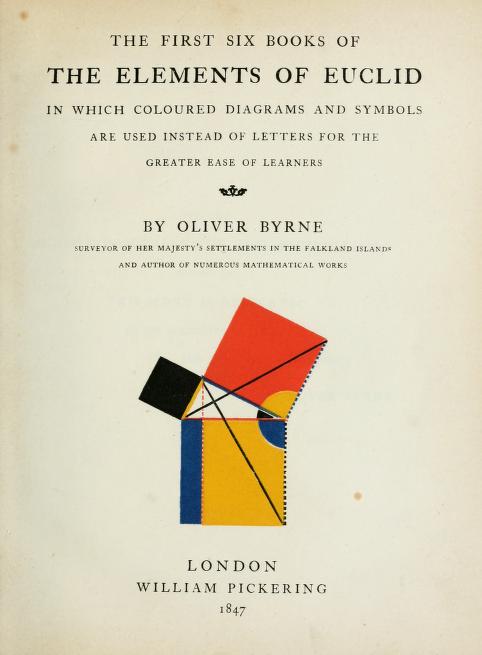
The first English translation of ‘Elements’ is believed to have been by Sir Henry Billingsley in 1570.  A later version by Oliver Byrne was published in 1847 and you can read it on-line.  Go to page 173 to find a version of the Zeroth Law which can be paraphrased as ‘Things that are equal to the same things are equal to each other’.

Oliver Byrne, was Surveyor of Her Majesty’s Settlements in the Falkland Islands which presumably left him plenty of time to be the ‘author of numerous mathematical works’ as the title page to his book states.  The title page also tells us that ‘coloured diagrams and symbols are used instead of letters for the greater ease of learners’.  The bold primary colours and straight lines remind me of the paintings in the recent Mondrian exhibition at the Tate Liverpool. Maybe Piet Mondrian (1872 – 1944) was inspired by Oliver Byrne’s beautiful book, which was an early example of innovative graphic design and as well as an attempt to make mathematical concepts more accessible – something many writers of modern textbooks make little serious effort to do!

Thermodynamic Whoopee

man without a countryThe success of our students in the MyCopter project inspired me a couple of weeks ago to write about the prospect for flying cars [see post on October 2nd, 2014 entitled ‘Origami car-planes‘], which are not good essentially because we don’t know how to manipulate gravity. Everything in the universe is controlled by four forces, i.e. electromagnetic, gravitational, weak nuclear and strong nuclear. Adam Frank, described our understanding and control of electromagnetic forces as god-like because we can manipulate photons, electrons and atoms with enormous precision in flat screen TVs, mobile phones, microwave ovens and much more.

Strong nuclear forces hold protons and neutrons together in the nucleus of atoms and weak nuclear forces control the fusion process in stars. We have managed to take a few tottering steps to control nuclear forces in nuclear power stations but we are blundering apprentices compared to our skills with electromagnetism. However, with gravitational forces we are like toddlers trying to feed ourselves – we have some idea about what we are supposed to be doing but we waste an enormous amount in trying to hit the target. So we use our expertise in electromagnetism to combust fuel in an engine which drives an aerofoil through air faster enough to generate lift. This usually involves burning vast amount of fossil fuel and it gets worse when you want to hover with rotating blades or a vertical jet. Kurt Vonnegut in a ‘A Man without a Country‘ has described our reckless use of fossil fuel as making ‘thermodynamic whoopee’ but if we want fly long distances with significant payloads we don’t have much choice at the moment.

If physicists could work out how to manipulate gravitational forces it would not take engineers long to design and build flying cars that would be as advanced relative to today’s private jet as your tablet computer is relative to an abaqus.

Source:

I was promised flying cars‘ by Adam Frank in the New York Times on June 6th, 2014

‘Crash’ in Taipei: an engineer’s travelogue

taipei101

Taipeo 101

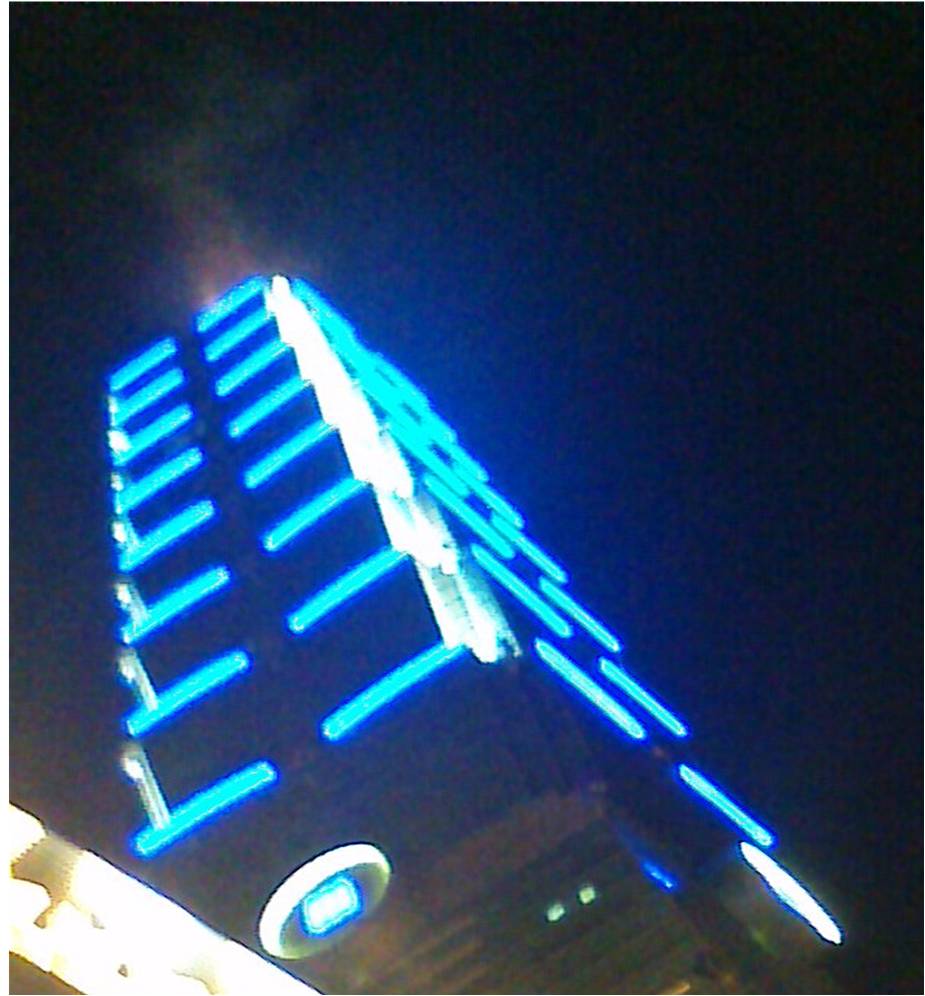
When you land at Taipei Taoyuan International airport, you could be forgiven for thinking that you have arrived at some as yet unvisited Floridian city. The palm-trees, architecture, layout and feel of the terminal is very reminiscent of a major airport in the USA, though perhaps slightly Ballardian. The yellow cabs collecting passengers from the curb outside the spacious terminal reinforce the impression, except that most of them look like a Toyota Prius. But, once you arrive downtown, overtones of a Mods’ weekend at Brighton takeover as scores of scooters roar away from every traffic light when they turn green leaving. In every other way Taipei is a modern, sophisticated Asian city with its towering skyscrapers, including Taipei 101, designer stores, back streets full of tiny shops and busy traffic.

Beijing residents have wholeheartedly taken to the electric motorbike and you have to be careful crossing the road not to be knocked down by these silent two-wheelers. Whereas Taipei residents seem to love their noisy scooters, but Taipei is largely smog-free so maybe there is less incentive to switch to electric bikes.

I said Ballardian above because the road to Taipei from the airport reminded me of the ‘Crash’ by J.G. Ballard. The freeway has been expanded along almost its entire length by constructing additional elevated carriage-ways on both sides, so that on the original freeway you feel fenced in by concrete pillars and bridge-sections.

Some of you might be wondering why I have been wandering around Asia. Well, I visited Beijing and Tianjin [see last week’s post] to give a series of seminars as the Hsue-Shen Tsien Professor of Engineering Sciences at the Chinese Academy of Sciences’ Institute of Mechanics. Then, I went to Taiwan to participate in a bilateral workshop with National Tsing Hua University and to meet with research students on our dual PhD programme.  ‘The World is Flat’ as Thomas Friedman wrote and engineers are a driving force in the global economy, so its not unusual to find engineers abroad either on short trips or living overseas.  Yet, I am constantly surprised by the lack of enthusiasm amongst most UK students to participate in international exchanges, even though such experience increases their employability.