Tag Archives: power stations

Free: Energy! Thermodynamics in Everyday Life

sunTalking to camera is difficult…

For the last few weeks I have been spending a considerable proportion of my working hours in front of a camera shooting video clips for a MOOC, a Massive Online Open Course. The first results of this effort and those of my colleagues Matt O’Rourke and Rob Lindsay in the University’s Centre for Lifelong Learning are now available as a trailer. The initial reviews were ‘cool’ and ‘awesome’, so go ahead and watch it!

Innovation to support learning

Some people have commented on the lack of pedagogical foundation in many MOOCs. However, I think we are being quite innovative in the following ways:

  • we are using an established pedagogy, 5Es (see the next paragraph for more explanation),
  • we have designed three do-it-at-home laboratory exercises,
  • the five-week MOOC will run in parallel with the delivery of the traditional course to first year undergraduates in Liverpool and,
  • the traditional lectures will be repeated at the university’s campus in London two evenings each week.

The lectures in London will allow students living around London to meet each other and me, as well as, of course, experience the energy of the live delivery of the course.

For students worldwide (and in London)

If you are a student who has or is struggling with elementary Thermodynamics then register for the free MOOC which will start in February 2016. I will cover the curriculum content of most ‘A’ level modules and introductory undergraduate courses in Thermodynamics. If you are in London and would like to attend the lectures then contact me and I will send you more details.

For teachers/instructors anywhere

If you are a teacher, tutor or lecturer then consider bringing it to the attention of your students. I will be taking a different approach to the traditional way of teaching classical thermodynamics based on my experience teaching at the University of Liverpool using the Everyday Engineering examples featured on this blog together with the 5Es approach to lecture or lesson plans. If you would like to use it in parallel with your own lectures then get in touch with me so that we can talk about synchronization.

5Es

The 5Es are Engage (the students), Explore (the topic), Explain (the principles underpinning the topic), Elaborate (using the principles to analyse the topic) and Evaluate (ask the students to evaluate their learning by performing some analysis). The course has been well-received by students and nearly a thousand have taken it over last four years. This year we are making into a five-week MOOC so that thousands more can learn using it.

Sources:

Real life thermodynamics

Bybee RW, Taylor JA, Gardner A, van Scotter P, Powell JC, Westbrook A & Landes N, The BSCS 5E Instructional model: origins, effectiveness and applications, BSCS Colorado Srings, 2006.

Sian Bayne & Jen Ross, The pedagogy of the MOOC: the UK view,  Higher Education Academy, 2014

Paul Stacy, The pedagogy of MOOCs, http://edtechfrontier.com/2013/05/11/the-pedagogy-of-moocs/
Enabling or disruptive technology for nuclear engineering?

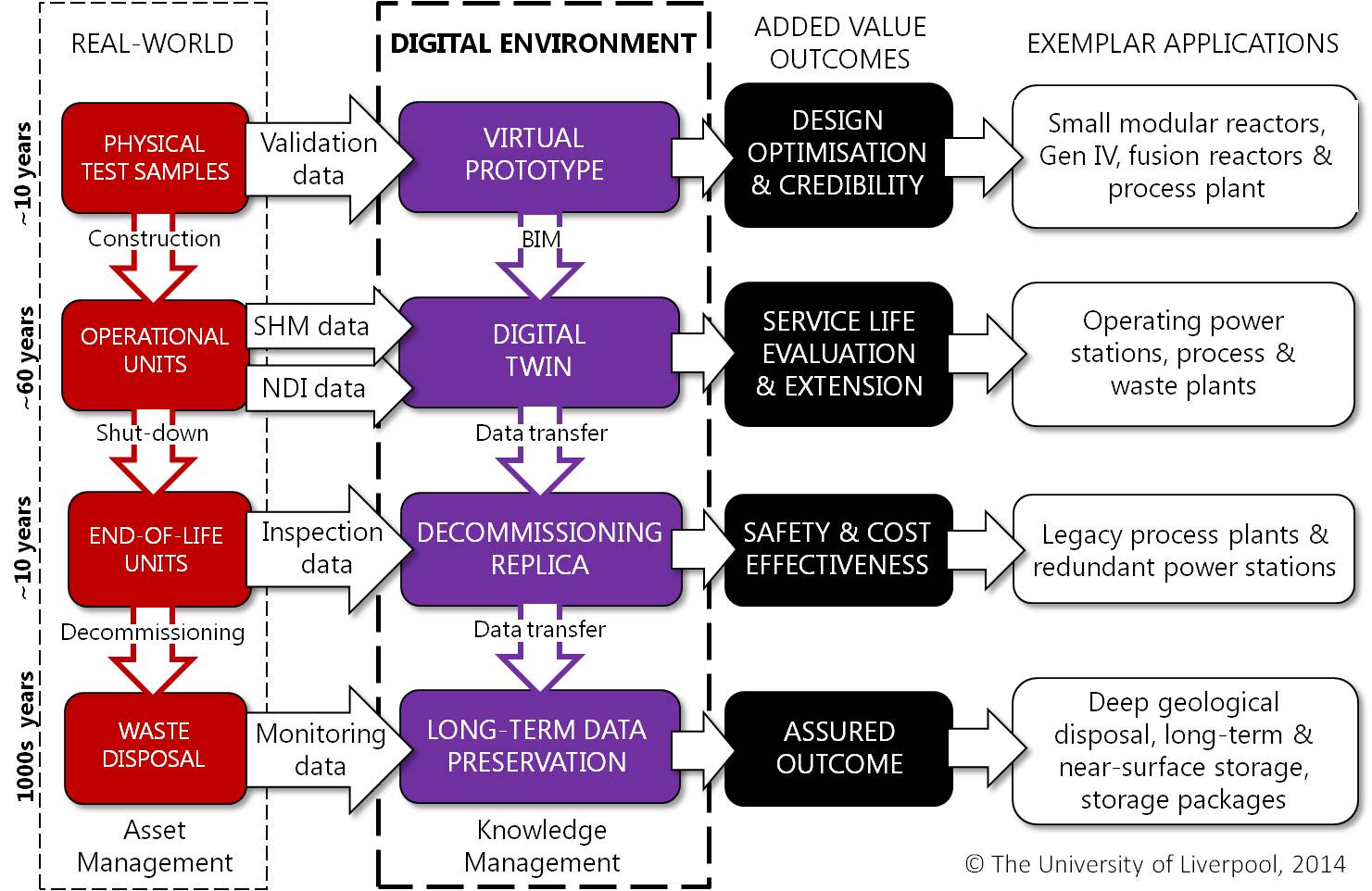
INDEA couple of weeks ago [see ‘Small is beautiful and affordable in nuclear power-stations’  on January 14th, 2015] I ranted about the need to develop small modular reactors whose components can be mass-produced in a similar way to the wings, cockpit, tail-planes, fuselage and engines of an Airbus aeroplane that are manufactured in factories in different countries in Europe prior to final assembly and commissioning in Toulouse, France. The aerospace industry is heavily dependent on computer-aided engineering to design, test, manufacture, operate and maintain aircraft in a series of processes involving a huge number of organisations. The civil engineering and building services industries are following the same model through the introduction of BIM, or Building Information Modelling. I have recently suggested that the nuclear industry needs to adopt the same approach through an Integrated Nuclear Digital Environment (INDE) that has the potential to reduce operating and decommissioning costs and increase reliability and safety for existing and planned power-stations but more importantly would enable a move towards mass-production of modular power-stations.

Recently I presented a paper at a NAFEMS seminar on Modelling and Simulation in the Nuclear Industry held on November 19th 2014 in Manchester, UK.  To judge from the Q&A session afterwards, the paper divided the audience into those who could see the enormous potential (the enablers?) and those who saw only massive problems that rendered it unworkable (the potentially disrupted?). The latter group tends to cite the special circumstances of the nuclear industry associated with its risks and regulatory environment. These are important factors but are not unique to the industry. From my perspective of working with many other industrial sectors, the nuclear industry is unique in its slow progress in exploiting the potential of digital technologies.  Perhaps in the end, as one of my academic colleagues believes, research on solar power will produce such efficient solar cells that even in cold and cloudy England we will be able to meet all of our power needs from solar energy [given incoming solar radiation is about 340 Watts/square meter], in which case perhaps the nuclear power industry will become extinct unless it has evolved.

Schematic diagram showing the digital environment (second column from left in purple), its relationships to the real-world (left column in red) and the potential added value (third column from left) together with exemplar applications (right column). Coloured arrows are processes and coloured boxes represent physical (red) or digital (purple) infrastructure.

Schematic diagram showing the digital environment (second column from left in purple), its relationships to the real-world (left column in red) and the potential added value (third column from left) together with exemplar applications (right column). Coloured arrows are processes and coloured boxes represent physical (red) or digital (purple) infrastructure [from Patterson & Taylor, 2014].

The diagram is an extract from Patterson & Taylor, 2014.  The views expressed in this blog post are those of the author and not necessarily of those of his co-authors on other publications, or their employers.

Small is beautiful and affordable in nuclear power-stations

Most of you will have domestic carbon footprints that are similar to mine, i.e. dominated by energy consumption, probably mainly your car and climate control in your home, and you will struggle to reduce your footprint [see my post entitled ‘New Year Resolution’ on December 31st, 2014]. We live in a fossil fuel economy and so even if you make your home entirely powered by electricity and buy a plug-in car then your utility provider is still very likely to use fossil fuel to generate the electricity supplied to you and your carbon emissions will have been simply moved elsewhere. If you are lucky enough to live in a suitable location then installing geothermal, solar or wind power for your home might be viable; but otherwise the majority of us are dependent on power-stations for our electricity.

I discussed the impossibility, with today’s technology, of providing all of our electrical power needs using renewable sources in my post entitled ‘Energy Blending‘ on May 22nd, 2013. The alternatives are either to reduce our power consumption dramatically, which seems unlikely to happen given that everyone would like to enjoy the lifestyle of typical readers of blogs, or to build a very large number of nuclear power stations.  The scale of the problem facing China was the topic of my post entitled ‘Mass-produced nuclear power plants‘ on November 12th, 2014 and it is many times large on a global scale.

A major obstacle to building nuclear power-stations is their exorbitant capital cost, e.g. £24 billion for the planned Hinckley Point C reactor in the UK. This level of investment is beyond the reach of most companies and the construction of a fleet of such power-stations to provide national needs is beyond the budget of most national governments. Small modular reactors (SMR), whose components could be mass-produced and assembled on-site, have been proposed and both their small size and the manufacturing approach would lead to considerable reductions in unit costs. Although many designs for SMRs are under development, with mature designs in China and India, progress towards implementation and mass-production is slow so that the situation is ripe for a disruptive technology from another industrial sector to transform the nuclear power landscape. One possible candidate is the fusion reactor being developed by Lockheed Martin’s Skunk works [see my post entitled ‘Mass-produced nuclear power plants‘ on November 12th, 2014] or the Travelling Wave Reactor being developed by the spin-out company TerraPower.

We need to think big about small affordable solutions instead of thinking and spending big money on massive projects that tend towards a big unaffordable solution.

Also see Bill Gates on Energy-Miracles

Mass produced nuclear power plants?

A slightly weird picture of the rather unusual House of Porcelain in Tianjin, which is slowly turning black in the smog.

Porcelain House in Tianjin, which is slowly turning black in the smog.

In the pocket of my coat I have a peculiar souvenir of my recent visit to China. It’s a white face-mask with a little filter built-in to one side. It cost 2 Yuan, or about £0.2, and was given to me by a research student in Tianjin, who worked in my lab in Liverpool for a year. She bought it for me one Saturday when we were going out sightseeing in Tianjin because the air quality was so poor it caught on the back of your throat. The smog was so thick you could not see the tops of even modestly tall buildings.

This is a daily reality for millions of people in many of China’s cities. I reported in my blog entitled ‘Year of the Air: 2013’ [November 20th, 2013] about the number of deaths from pollution.  PM2.5 that’s particles with a diameter less than 2.5 microns are damaging to human health. While I was in Beijing the level of PM2.5 was 144 micrograms per cubic metre, compared to 13 at home in Liverpool.  My student’s mother had visited her while she was in Liverpool and I asked what she liked most during her visit – the fresh air was her reply.

I can’t really remember smog in England though I do remember buildings in the city centres being gradually cleaned because the smog had turned them black. And I remember shortly after I finished my PhD, being shown by a collaborator in the Pathology Department, the lungs from a recent post-mortem – they were grey-black from the smog!

The scale of the problem is difficult to grasp. Tianjin is a provincial city about 30 minutes by bullet train south-east of Beijing with a population of 14 million people, almost twice that of London, and 2.4 million cars.  The smog is generated by pollution from factories, power-stations and cars.  Hybrid cars could make a difference but there are none because they are too expensive, a Beijing colleague told me as he drove me in his brand new Volkswagen Passat. Plug-in cars would not solve the problem because the electricity would come mainly from coal-fired power stations, so the pollution would be simply moved elsewhere.

China needs clean energy, fast and lots of it.  In 2011 China’s installed electricity generating capacity was  about 1TW (Tera Watts or 1 with 12 noughts after it), of which about 2% comes from China’s 21 operating nuclear power plants.  Typical modern nuclear power plants take years to build and generate around 1,000 MW; perhaps we should be considering the small-scale mass production of medium-size modular power plants.  Huge, complex, reliable aeroplanes are made in this way, for instance the current Airbus A380 is production rate is about 25 per year.  So why not medium-size nuclear power plants?  Mass-production would also make decommissioning cheaper since it not be a bespoke process for each plant.

Maybe now that the Lockheed Martin’s Skunk Works have turned their attention to developing a fusion reactor, power-stations will be produced like airliners before I retire.

Sources:

Porcelain House, Tianjin

http://blogs.wsj.com/chinarealtime/2014/10/27/desperate-measures-as-world-leaders-visit-beijing-tries-to-reduce-pollution-by-40/

http://aqicn.org/city/united-kingdom/liverpool-speke/

BTW – My pathology colleague and I were interested in whether people with osteoporosis could break their hips and fall, rather than the usual assumption of falling and break their hips. See:

Wilkinson JM, Cotton DWK, Harris SC & Patterson EA, Assessment of osteoporosis at autopsy: mechanical methods compared to radiological and histological techniques, Medicine, Science & the Law, 31(1):19-24, 1991.

Cotton DWK, Whitehead CL, Vyas S, Cooper C & Patterson EA, Are hip fractures caused by falling and breaking or breaking and falling? Forensic Science Int., 65(2):105-112, 1994.