Tag Archives: innovation

Life takes engineering

changingconversationTeachers change lives.  Doctors cure, nurses care. Firefighters are heroic.  What do engineers do?  Engineers shape the future.

Most of the things that engineers do are taken for granted.  I would like to think that we are so good at it that people don’t notice anymore.  Occasionally things go wrong and we get the blame but almost everything you do in life from the moment you are born is shaped by engineering.  A structural engineer designed the structure in which you were born, a team of mechanical engineers designed the vehicle you made your first journey in, if you needed medication a team of chemical engineers designed the factory that produced them and so on through life.  You can repeat the process for an average day – who designed the production system that made the bed you slept on, the alarm clock that woke you, runs the utilities that provided hot water to wash in, designed the supply chain that delivered food to your breakfast table and so on through the day?  Yes, engineers.

Maybe engineering is so ubiquitous that it is difficult to grasp its essence.  The engineering community spends hundreds of millions of dollars annually to promote public understanding of engineering with little measurable impact on young people, according to the US National Academy of Engineering.  Their report called ‘Changing the Conversation‘ recommends using four tag-lines to promote engineering:

1. Engineers make a world of difference.

2. Engineers are creative problem solvers.

3. Engineers help shape the future.

4. Engineering is essential to our health, happiness and safety.

About 40% of their survey groups found these tag-lines ‘very appealing’.  So perhaps none of them really resonated.  Oh, but now I am being an engineer and analysing the data in order to make a very rational, reasoned decision when instead I should be employing my creative, imaginative side.  Maybe we are back to poetaster engineers [see my posting on ‘Poetasting engineers‘ on March 4th, 2015].  As a profession we are not good with words [see last week’s posting entitled ‘Reader, Reader, Reader] and cannot dream up a catchy memorable tag-line.

What do you think?
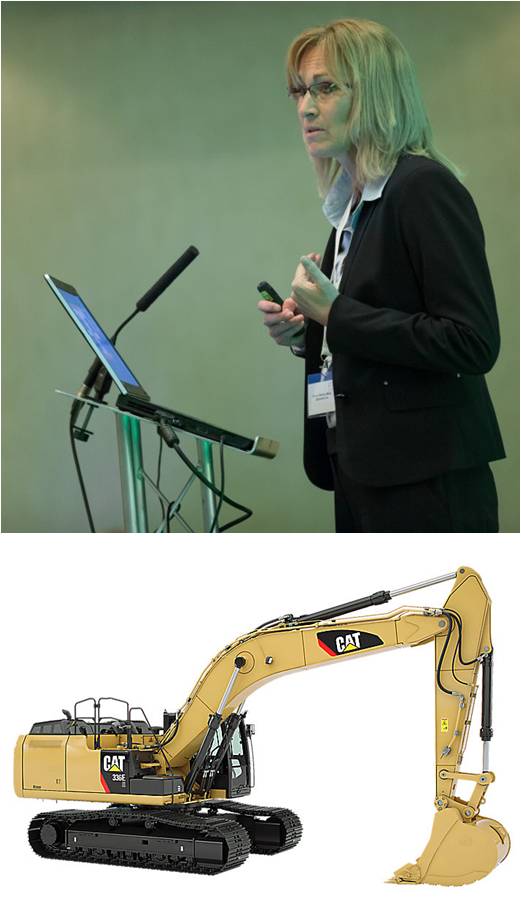
Where there is muck there is an engineer

Dr Lou Balmer-Millar at the FPC 2015 & the CAT 366E

Dr Lou Balmer-Millar at the FPC 2015 & the CAT 366E

Here’s a second post on what engineers do [see my post entitled ‘Press button for exciting ride‘ on March 25th, 2015].

Dr Lou Balmer-Millar leads a team that develops new technology for off-road vehicles.  She is Director of Research and Advanced Engineering at Caterpillar Inc. and she gave a keynote talk at the  Future Powertrains Conference, which I wrote about a couple of weeks ago.  She talked about the innovations that Caterpillar are developing to increase the efficiency of their vehicles.  This includes driverless giant trucks.  If you are worried about driverless cars then what about driverless 226 tonnes trucks?  It is already a reality –   watch the Caterpillar video.

However, what stuck in my mind from her presentation was not the enormous mining trucks but the way in which Caterpillar measure the efficiency of their diggers, such as the CAT 366E Hybrid.  They are not so much interested in miles per gallon as tonnes of dirt (or muck) shifted per gallon.  Efficiency is defined as what you want out of a machine divided by what you have to put in to a machine, or work done for energy supplied [see post entitled ‘Energy efficiency‘ on June 18th, 2014].  So for a passenger car, miles travelled divided by energy used is a reasonable measure of efficiency.  But for digger, tonnes of earth moved is what you are want done, so tonnes moved per gallon is the right measure of efficiency.   The machine in the picture does not look like anything special but Caterpillar claim it is 30% more efficient than its competitors.

So there is money to be made in shifting earth more efficiently than your competitors.  If you enjoy watching machines move earth the watch this video.

Photo credit: Joshua Tucker http://www.apcuk.co.uk/2015/03/future-powertrain-conference-2015-report/

‘Culture eats strategy for breakfast’

130-3071_IMGMy title is unashamedly borrowed from Richard Plepler, CEO of the premium US cable network, HBO.  He was quoted in an interview reported in the Financial Times on January 11th, 2015 [Lunch with the FT by Matthew Garrahan].  It was said in the context of discussing how a company can encourage creativity.  I like it because it sums up my own approach to nurturing an environment in which high-quality innovative research can flourish.  The role of the leader is to establish and maintain that environment in which everyone must feel able to express their opinions and then once the decision is made be prepared to unite in achieving the goal.  This requires a level of transparency that many leaders find hard to implement and ability to listen to dissenting views that most leaders find difficult or impossible to tolerate. Good leaders create a culture in which people feel safe expressing their views.  To quote Richard Plepler again “Someone once said to me, ‘You made the room safe to talk.’ And I said. ‘If you want to win, what other way is there to be?'”.

Engineering is a creative profession in which we need to worry more about culture and less about strategy.  Of course, bringing about culture change is much harder than writing a new strategy!

Dream machine

Painting by Katy Gibson

Painting by Katy Gibson

A machine that can do work indefinitely without any external input of energy.  It would solve the world’s energy problems, eliminate global warming and make the inventor very rich.  There have been so many attempts to design such a machine that a classification system has been established.  My machine, that does work indefinitely with no energy input, would be a perpetual motion machine of the first type because energy is not conserved – a contradiction of the first law of thermodynamics.  The second type contravene the second law of thermodynamics, usually by spontaneously converting heat into work, and the third type eliminates friction and, or other dissipative forces.

I said ‘my machine’ in the sense that I have an on-going sporadic correspondence with the inventor of a machine that is claimed to produce ‘power above the primary power that drives it’.  It is an epistemic impossibility, which means that it cannot exist within our current understanding of the real world.  In other words, if a perpetual motion machine was to be proven to exist then the laws of thermodynamics would have to be rewritten.  This would probably lead to an invitation to Stockholm to collect a Nobel prize.

Such arguments make no difference to inventors of perpetual motion machines.  Many appear to start from the premise that the laws of thermodynamics have not been proven and hence they must not be universally applicable, i.e. there is space for their invention.  Whereas the laws of thermodynamics form part of our current understanding of the world because no one has demonstrated their falsity despite many attempts over the last two hundred years.  This is consistent with the philosophical ideas introduced by Karl Popper in the middle of the last century.  He proposed that a hypothesis cannot be proven to be correct using observational evidence but its falsity can be demonstrated.

So, inventors need to build and demonstrate their perpetual motion machines in order to falsify the relevant law of science.  At this stage money as an input usually becomes an issue rather than energy!


The painting by Katy Gibson is from a series made as part from an art and engine collaboration between Okemos High School Art Program and the Department of Mechanical Engineering at Michigan State University.