Tag Archives: education

Running away from tigers

rsph graphicToday, the probability that you will have to run away from a tiger is very small, no matter where you live.  Tigers have lost 93% of their historical range that used to stretch from Turkey across Asia to Eastern China and southwards to Indonesia.  Tigers have no problem with the first law of thermodynamics – they instinctively know that if they take in more energy than they expend then the excess energy will be stored as fat and when they become overweight they won’t be able to catch you or whatever else they decided to chase for their next meal.

As a species we seem to have lost that understanding of energy balances.   Obesity is increasing in many parts of the world.  The situation is so serious in the UK, where more than two-thirds of the adult population are overweight or obese, that the Royal Society for Public Health has proposed that food should be labelled with the amount of exercise required to burn-off the calories it contains and they have suggested using the infographic in the thumbnail.  Of course, the Royal Society’s position paper does not mention explicitly thermodynamics (or tigers!) though it does effectively cite the first law by stating ‘the cause of obesity is excess energy consumption relative to energy expenditure‘.  By coincidence, this week I interviewed Professor Graham Kemp, in the Institute of Ageing and Chronic Disease in Liverpool, about energy flows through our bodies for a MOOC on Energy: Thermodynamics in Everyday Life.

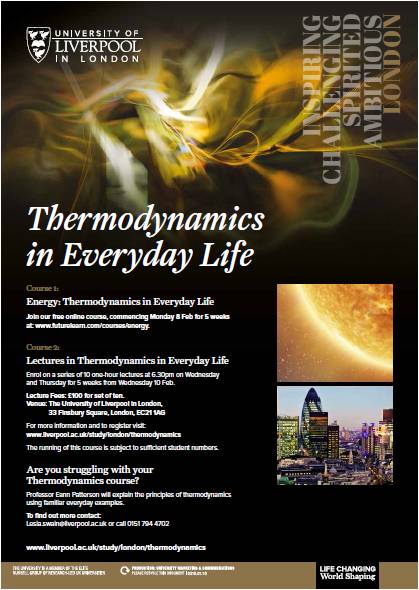
If you wathermolectures posternt to listen to that interview or learn more about the thermodynamics underpinning the energy balances controlling our weight, climate change and your electricity charges, then you need to join the more than 4,500 people who have already enrolled on the MOOC that will run for five weeks from February 8th, 2016.  I will also be giving an accompanying series of lectures in London.
I was astonished to discover that there are fewer tigers in the world than people signed up for our MOOC.  Less than 3,200 tigers exist in the wild mainly because our growing population and prolifigate use of the world’s resources has destroyed their habitat and those of the other species with which we share this planet.


Converting wealth into knowledge and back to wealth

Some months ago I was invited to give the opening lecture at a workshop in China on connecting science and business in the field of experimental mechanics. ‘Connecting science and business’ was the sub-title of a book I wrote with Bob Handscombe some years ago and ‘experimental mechanics’ is a theme that runs deep through my research. So, I felt honored to be invited and confident that I had something relevant to say. However, probably the most succinct statement at the workshop was made by Professor Jian Lu from City University of Hong Kong quoting Geoffrey Nicholson, the inventor of Post-Its: ‘Research is the transformation of money into knowledge. Innovation is the transformation of knowledge back into money creating value.’

The central role that money plays in life is acknowledged in the saying ‘money makes the world go around’. However, the intertwining of money and knowledge is less widely recognised. Although we talk about a knowledge economy not many people understand what it means or how it functions. The diagram below is an attempt to show how research leads to the creation of private information which needs to be disseminated in order to become public information. Public information becomes public knowledge when it is incorporated into our structured, shared understanding through study and learning. Public knowledge is used in innovation processes to create new technology and wealth, which fuels further research, so that there is a feedback loop.  The diagram is modified from one by Max Tegmark‘s book ‘Our Mathematical Universe‘ and, of course is simplified, perhaps too much, but nevertheless illustrates the process of knowledge creation even if sometimes the whole process functions inside an organisation. In the later situation, the creation of knowledge and the benefits to society are likely to be impeded, at least temporarily.

Information triangle

Information triangle

Free: Energy! Thermodynamics in Everyday Life

sunTalking to camera is difficult…

For the last few weeks I have been spending a considerable proportion of my working hours in front of a camera shooting video clips for a MOOC, a Massive Online Open Course. The first results of this effort and those of my colleagues Matt O’Rourke and Rob Lindsay in the University’s Centre for Lifelong Learning are now available as a trailer. The initial reviews were ‘cool’ and ‘awesome’, so go ahead and watch it!

Innovation to support learning

Some people have commented on the lack of pedagogical foundation in many MOOCs. However, I think we are being quite innovative in the following ways:

  • we are using an established pedagogy, 5Es (see the next paragraph for more explanation),
  • we have designed three do-it-at-home laboratory exercises,
  • the five-week MOOC will run in parallel with the delivery of the traditional course to first year undergraduates in Liverpool and,
  • the traditional lectures will be repeated at the university’s campus in London two evenings each week.

The lectures in London will allow students living around London to meet each other and me, as well as, of course, experience the energy of the live delivery of the course.

For students worldwide (and in London)

If you are a student who has or is struggling with elementary Thermodynamics then register for the free MOOC which will start in February 2016. I will cover the curriculum content of most ‘A’ level modules and introductory undergraduate courses in Thermodynamics. If you are in London and would like to attend the lectures then contact me and I will send you more details.

For teachers/instructors anywhere

If you are a teacher, tutor or lecturer then consider bringing it to the attention of your students. I will be taking a different approach to the traditional way of teaching classical thermodynamics based on my experience teaching at the University of Liverpool using the Everyday Engineering examples featured on this blog together with the 5Es approach to lecture or lesson plans. If you would like to use it in parallel with your own lectures then get in touch with me so that we can talk about synchronization.

5Es

The 5Es are Engage (the students), Explore (the topic), Explain (the principles underpinning the topic), Elaborate (using the principles to analyse the topic) and Evaluate (ask the students to evaluate their learning by performing some analysis). The course has been well-received by students and nearly a thousand have taken it over last four years. This year we are making into a five-week MOOC so that thousands more can learn using it.

Sources:

Real life thermodynamics

Bybee RW, Taylor JA, Gardner A, van Scotter P, Powell JC, Westbrook A & Landes N, The BSCS 5E Instructional model: origins, effectiveness and applications, BSCS Colorado Srings, 2006.

Sian Bayne & Jen Ross, The pedagogy of the MOOC: the UK view,  Higher Education Academy, 2014

Paul Stacy, The pedagogy of MOOCs, http://edtechfrontier.com/2013/05/11/the-pedagogy-of-moocs/

Engineers, moral compasses and society

Picture1One of my regular correspondents has commented last week about teaching ethics to engineering undergraduate students in order to reduce the probability of repetition of events similar to the Volkswagen emissions scandal (see my post on October 14th, 2015 on ‘Greed overwhelms ethics‘). My experience of talking to professional engineers is that there is nothing wrong with their ethical values but that they feel helpless in the face of corporate intransigence or worse. Many engineers feel unable to shift the moral compass of the organisation in which they work. Ethics is concerned with one’s personal values whereas morality is about what is permissible and forbidden in particular realms of behaviour, according to AC Grayling. The frequent revelations of scandals across a range of industries would suggest that we have a crisis of morality in our society. I don’t know how to resolve it but perhaps a first step would be for everyone, including the rich and powerful, to admit we have a problem.