Tag Archives: creativity

Reader, reader, reader!

annegreeneAt this time of year many university students are labouring over their dissertations. I have commented before about the difficulties that engineers seem to have in expressing themselves eloquently. So, I thought that I should offer some simple guidance.

The title of this post is the first piece of guidance. Real estate agents like to use the adage ‘location, location, location’ when talking about the relative importance of the features of properties. For technical writing it can be adapted to ‘reader, reader, reader’ – in other words, you have to think about your reader whenever you are writing.

There are lots of books about writing, and although some are admirably short, most engineers and engineering students do not read them. Maybe there is a clue there as to why engineers tend not to write material that is read by others. One of the shortest and most concise of these books is by Anne Greene called ‘Writing Science in Plain English’. I have summarised it below as a simple mnemonic:

R – Reader, reader, reader. Ok, we have done this one already. Anne prefers ‘audience, audience, audience’ (page 36) but that’s American and doesn’t work as well as a mnemonic.

E – [readers] Enjoy a story with a subject that takes rather than receives actions. See Anne on story-telling in science writing (page 12) and on using active rather than passive verbs (page 22).

A – [readers] Appreciate short, non-technical words. See Anne on using short, old words which are used frequently in spoken English (page 30). Introduce technical words slowly and only if absolutely necessary (page 36).

D – [readers] Digest new information when it follows old in sentences that vary in length. See Anne on providing familiar information at the start of a sentence and building on it through the sentence (page 52). But, don’t write strings of long sentences (more than 30 words); see Anne on varying sentence length (page 63).

E – [readers] Expect paragraphs to have a consistent structure with issue, development and conclusion. See Anne on paragraph structure and making the point at the end of the introductory paragraph(s) (page 71).

R – [readers] Remember the last thing that they read, so build arguments progressively from the least to the most important evidence. See Anne on developing persuasive arguments (page 78).

Finally, many of the technical reports that I am expected to read do not appear to have been read by the author because they are littered with typographical, grammatical and stylistic errors. So Read, Edit, Add and Delete (READ).

By the way, Anne also advises that we use ‘parallel lists’ (see page 60). By which she means lists in which the items have a consistent structure, such as in my mnemonic ‘READER’ above.

Sources:

Greene, A.E., Writing science in plain English, The University of Chicago Press, Chicago, 2013.

Williams, J., Style: toward clarity and grace, The University of Chicago Press, Chicago, 1995.

Where there is muck there is an engineer

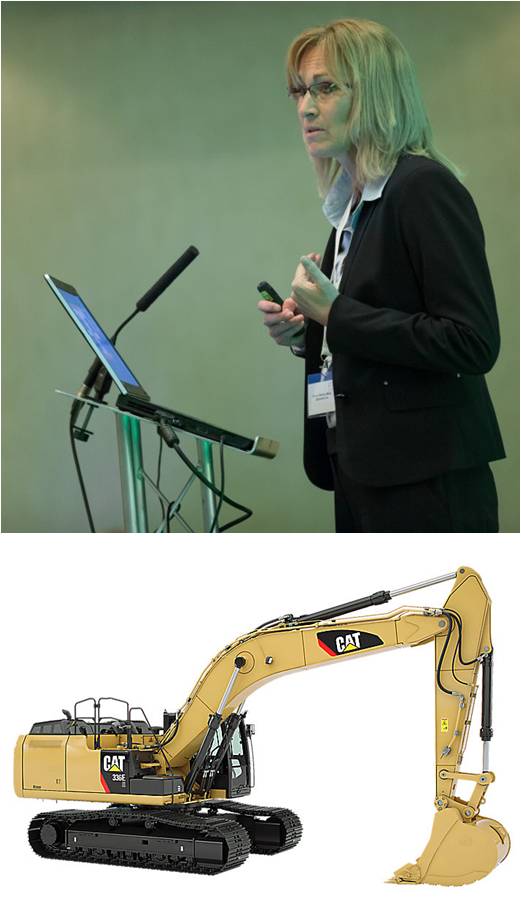
Dr Lou Balmer-Millar at the FPC 2015 & the CAT 366E

Dr Lou Balmer-Millar at the FPC 2015 & the CAT 366E

Here’s a second post on what engineers do [see my post entitled ‘Press button for exciting ride‘ on March 25th, 2015].

Dr Lou Balmer-Millar leads a team that develops new technology for off-road vehicles.  She is Director of Research and Advanced Engineering at Caterpillar Inc. and she gave a keynote talk at the  Future Powertrains Conference, which I wrote about a couple of weeks ago.  She talked about the innovations that Caterpillar are developing to increase the efficiency of their vehicles.  This includes driverless giant trucks.  If you are worried about driverless cars then what about driverless 226 tonnes trucks?  It is already a reality –   watch the Caterpillar video.

However, what stuck in my mind from her presentation was not the enormous mining trucks but the way in which Caterpillar measure the efficiency of their diggers, such as the CAT 366E Hybrid.  They are not so much interested in miles per gallon as tonnes of dirt (or muck) shifted per gallon.  Efficiency is defined as what you want out of a machine divided by what you have to put in to a machine, or work done for energy supplied [see post entitled ‘Energy efficiency‘ on June 18th, 2014].  So for a passenger car, miles travelled divided by energy used is a reasonable measure of efficiency.  But for digger, tonnes of earth moved is what you are want done, so tonnes moved per gallon is the right measure of efficiency.   The machine in the picture does not look like anything special but Caterpillar claim it is 30% more efficient than its competitors.

So there is money to be made in shifting earth more efficiently than your competitors.  If you enjoy watching machines move earth the watch this video.

Photo credit: Joshua Tucker http://www.apcuk.co.uk/2015/03/future-powertrain-conference-2015-report/

Thinking out-of-the-skull

bustLast year after the relaxation of our annual vacation, I wrote about the benefits of ‘Mind wandering‘ [see my post on September 3rd, 2014].  Our brains work in two modes known as central executive mode, for those tasks requiring focussed attention, and mind-wandering mode that involves day-dreaming and surfing from one idea to another leading to the emergence of new ideas.  We tend to feel tired and stressed when we try to switch between the two modes repeatedly.  At the moment, I struggle to set aside time for mind-wandering and indeed writing a weekly blog can induce a headache!

Perhaps this is because our brains are of finite size; and sometimes it feels as if we have reached their limitations.  I wrote about our attention capacity in my post entitled ‘Silence is golden‘ on January 14th, 2014.  More recently, Antonio Macaro and Julian Baggini have written that ‘savants who remember everything often understand very little’.  Probably this is because if you fill your brain with information there is less capacity for processing ideas to create understanding.  I would like to think that maintaining space for understanding is why I can’t remember anything whereas in fact it is probably just the impact of growing old!  However, Macaro and Baggini also suggest that we should use our smart phones and tablet computers as mental prosthetics to extend the capacity of our brains.  In other words, we should let these mental prostheses handle all of the routine processing of information associated with central executive mode tasks and keep the mental processes in our skulls for the creative thinking associated with mind-wandering.

Traditionally, engineers have followed Leonardo di Vinci‘s example by writing and drawing in a series of notebooks;  perhaps in the hope of emulating his creativity but also to extend the capacity of our minds by recording and ordering thoughts.  However, the processing capacity of modern devices creates the opportunity to go even further.  So that thinking out-of-the-skull could lead to more thinking out-of-the-box!

Source: Macaro, A. & Baggini, J., ‘Do we need props?’ in Financial Times magazine, January 10/11, 2015.

Photo credit: Tom

Ada Lovelace astride two cultures

Ada LovelaceRegular readers will have noticed my recent predilection for poetry.  I am going to deviate from the theme, but only slightly, by highlighting the work of Ada Lovelace who has been described as writing about differential calculus with the same passion that her father, Lord Byron wrote about forbidden love.  As I observed last week, we need more people who can write with passion about engineering and science; so it is appropriate following International Women’s Day on Sunday to highlight the work of Ada Lovelace who worked on programs for Babbage’s analytical engine. She could be described as the world’s first computer programmer.  However, she was much more than that because in her writings she foresaw a world in which computers would be aesthetic tools capable of creating language and art.  She was at least hundred years ahead of her time.  Perhaps growing up surrounded by poetry gave her the skills to express her passion for technology and the vision to see its potential.  If that is the case then we should encourage prospective engineers to read English literature and not books on engineering as implied in my post entitled ‘Good reads for budding engineers‘ on February 25th, 2015.  We need engineers to stand astride the boundary between the ‘Two Cultures‘ [see post of the same title on March 5th, 2013].

For more on modern female scientists and the gender imbalance in science watch the short film from the Royal Society entitled ‘A Chemical Imbalance‘  [see my post on of the same title on October 2nd, 2013]

Sources: Steven Johnson, A glitch in time, Financial Times, 18/19 October 2014.