Tag Archives: brain

An expanding universe

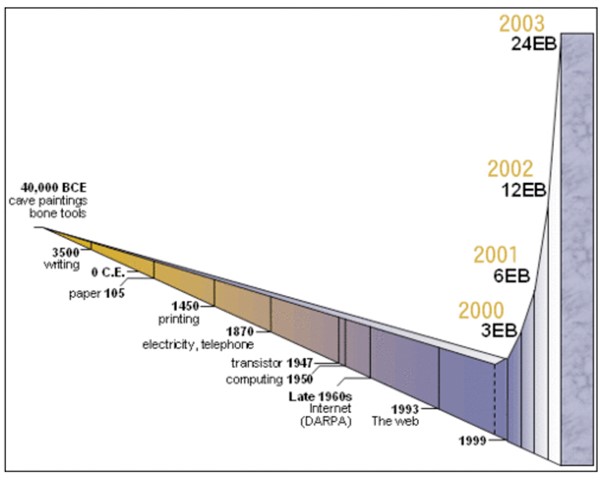
I attended a workshop last month at which one of the speakers showed us this graphic.  It illustrates that the volume of information available to us has been approximately doubling every year.  In 2005, the digital universe was 130 Exabytes (billions of gigabytes) and by 2020 it is expected to have grown to about 40,000 Exabytes.  The second law of thermodynamics tells us that entropy or disorder of the physical universe is always increasing; so, is this also true for the digital universe?  Claude Shannon proposed that information is negentropy, which implies that an increasing growth in information represents a decrease in entropy and this seems to contradict the second law [see my post ‘Entropy on the brain‘ on November 29th, 2017].  Perhaps the issue is the definition of information – the word comes from the Latin: informare, which means to inform or to give someone knowledge.  I suspect that much of what we view on our digital screens does not inform and is data rather than information.  Our digital screens are akin to telescopes used to view the physical universe – they let us see what’s out there, but we have to do some processing of the data in order to convert it into knowledge.  It’s that last bit that can be stressful if we don’t have some control mechanisms available to limit the amount of disorder that we ask our brains to cope with – we are back to Gadget Stress [see my post on April 9th, 2014] and Digital Detox [see my post on August 10th, 2016].

Source: Atsufumi Hirohata, Department of Electronics, University of York www-users.york.ac.uk/~ah566/lectures/adv01_introduction.pps

Image: http://japan.digitaldj.network.com/articles/9538.html
 

Depressed by exams

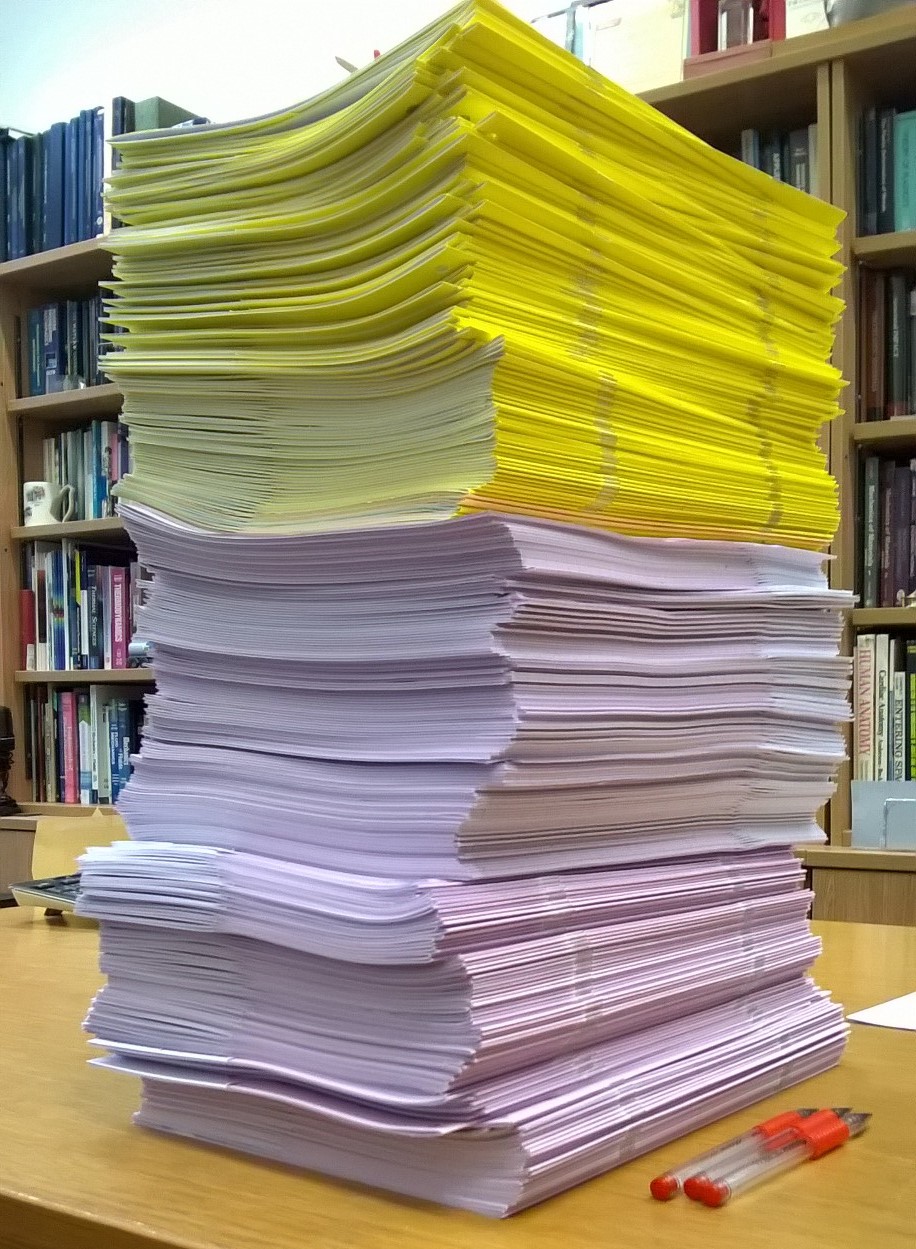
I am not feeling very creative this week, because I am in middle of marking examination scripts; so, this post is going to be short.  I have 20 days to grade at least 1100 questions and award a maximum of 28,400 marks – that’s a lot of decisions for my neurons to handle without being asked to find new ways to network and generate original thoughts for this blog [see my post on ‘Digital hive mind‘ on November 30th, 2016].

It is a depressing task discovering how little I have managed to teach students about thermodynamics, or maybe I should say, how little they have learned.  However, I suspect these feelings are a consequence of the asymmetry of my brain, which has many more sites capable of attributing blame and only one for assigning praise [see my post entitled ‘Happenstance, not engineering‘ on November 9th, 2016].  So, I tend to focus on the performance of the students at the lower end of the spectrum rather than the stars who spot the elegant solutions to the exam problems.

Sources:

Ngo L, Kelly M, Coutlee CG, Carter RM , Sinnott-Armstrong W & Huettel SA, Two distinct moral mechanisms for ascribing and denying intentionality, Scientific Reports, 5:17390, 2015.

Bruek H, Human brains are wired to blame rather than to praise, Fortune, December 4th 2015.

Why playing the piano might enhance our intelligence?

By National Institutes of Health [Public domain], via Wikimedia Commons

Students and lecturers leave all sorts of things in lecture theatres, including lecture notes, pens and water bottles, that accumulate around the edges like flotsam on the beach because no one wants to throw away something for which the owner might return.  A few weeks ago, I found the front page of a letter published in Nature which roused my curiosity. Its title was ‘Verbal and non-verbal intelligence changes in the teenage brain’.  My memories of my teenage years are almost uniformly bad; in part because I was unable to reproduce the academic promise that I had shown when I was younger and the pressure to do so was unrelenting.  I suspect that my experience is not uncommon and the research described in this letter offers a potential explanation for my inability to ace examinations regardless of how hard I tried.

The conventional understanding of human intellectual capacity is that it is constant during our life. However, the authors of this article have shown that the statistics, upon which this understanding is based, hide a variation in our teenage years; because some teenagers experience a reduction and some an increase in intellectual capacity, which leaves the population’s average unchanged.

In addition, using structural and functional imaging, they were able to correlate changes in verbal IQ with changes in grey matter density in a region of the brain activated by speech (the left motor cortex), and changes in non-verbal IQ with changes in grey matter density in regions activated by finger movements (the anterior cerebellum).

The timeline of the reported research does not extend far enough to establish whether or not the changes seen in teenagers is temporary; however, my anecdotal evidence suggests that might be the case.  I would conclude that the effort used to apply psychological pressure on teenagers to ace examinations might be better expended on piano lessons and piano practice to enhance sensorimotor skills which are strongly correlated to cognitive intelligence – but I suspect many parents have already worked that one out!

Source:

Ramsden S, Richardson FM, Josse G, Thomas MSC, Ellis C, Shakeshaft C, Seghier ML & Price CJ, Verbal and non-verbal intelligence changes in the teenage brain, Nature, 479:113-116, 2011.

Entropy on the brain

It was the worst of times, it was the worst of times.  Again.  That’s the things about things.  They fall apart, always have, always will, it’s in their nature.’  They are the opening three lines of Ali Smith’s novel ‘Autumn’.  Ali Smith doesn’t mention entropy but that’s what she is describing.

My first-year lecture course has progressed from the first law of thermodynamics to the second law; and so, I have been stretching the students’ brains by talking about entropy.  It’s a favourite topic of mine but many people find it difficult.  Entropy can be described as the level of disorder present in a system or the environment.  Ludwig Boltzmann derived his famous equation, S=k ln W, which can be found on his gravestone – he died in 1906.  S is entropy, k is a constant of proportionality named after Boltzmann, and W is the number of arrangements in which a system can be arranged without changing its energy content (ln means natural logarithm).  So, the more arrangements that are possible then the larger is the entropy.

By now the neurons in your brain should be firing away nicely with a good level of synchronicity (see my post entitled ‘Digital hive mind‘ on November 30th, 2016 and ‘Is the world comprehensible?‘ on March 15th, 2017).  In other words, groups of neurons should be showing electrical activity that is in phase with other groups to form large networks.  Some scientists believe that the size of the network was indicative of the level of your consciousness.  However, scientists in Toronto led by Jose Luis Perez-Velazquez, have suggested that it is not the size of the network that is linked to consciousness but the number of ways that a particular degree of connectivity can be achieved.  This begins to sound like the entropy of your neurons.

In 1948 Claude Shannon, an American electrical engineer, stated that ‘information must be considered as a negative term in the entropy of the system; in short, information is negentropy‘. We can extend this idea to the concept that the entropy associated with information becomes lower as it is arranged, or ordered, into knowledge frameworks, e.g. laws and principles, that allow us to explain phenomena or behaviour.

Perhaps these ideas about entropy of information and neurons are connected; because when you have mastered a knowledge framework for a topic, such as the laws of thermodynamics, you need to deploy a small number of neurons to understand new information associated with that topic.  However, when you are presented with unfamiliar situations then you need to fire multiple networks of neurons and try out millions of ways of connecting them, in order to understand the unfamiliar data being supplied by your senses.

For diverse posts on entropy see: ‘Entropy in poetry‘ on June 1st, 2016; ‘Entropy management for bees and flights‘ on November 5th, 2014; and ‘More on white dwarfs and existentialism‘ on November 16th, 2016.

Sources:

Ali Smith, Autumn, Penguin Books, 2017

Consciousness is tied to ‘entropy’, say researchers, Physics World, October 16th, 2016.

Handscombe RD & Patterson EA, The Entropy Vector: Connecting Science and Business, Singapore: World Scientific Publishing, 2004.