Tag Archives: aerospace

Thermodynamic Whoopee

man without a countryThe success of our students in the MyCopter project inspired me a couple of weeks ago to write about the prospect for flying cars [see post on October 2nd, 2014 entitled ‘Origami car-planes‘], which are not good essentially because we don’t know how to manipulate gravity. Everything in the universe is controlled by four forces, i.e. electromagnetic, gravitational, weak nuclear and strong nuclear. Adam Frank, described our understanding and control of electromagnetic forces as god-like because we can manipulate photons, electrons and atoms with enormous precision in flat screen TVs, mobile phones, microwave ovens and much more.

Strong nuclear forces hold protons and neutrons together in the nucleus of atoms and weak nuclear forces control the fusion process in stars. We have managed to take a few tottering steps to control nuclear forces in nuclear power stations but we are blundering apprentices compared to our skills with electromagnetism. However, with gravitational forces we are like toddlers trying to feed ourselves – we have some idea about what we are supposed to be doing but we waste an enormous amount in trying to hit the target. So we use our expertise in electromagnetism to combust fuel in an engine which drives an aerofoil through air faster enough to generate lift. This usually involves burning vast amount of fossil fuel and it gets worse when you want to hover with rotating blades or a vertical jet. Kurt Vonnegut in a ‘A Man without a Country‘ has described our reckless use of fossil fuel as making ‘thermodynamic whoopee’ but if we want fly long distances with significant payloads we don’t have much choice at the moment.

If physicists could work out how to manipulate gravitational forces it would not take engineers long to design and build flying cars that would be as advanced relative to today’s private jet as your tablet computer is relative to an abaqus.

Source:

I was promised flying cars‘ by Adam Frank in the New York Times on June 6th, 2014
Holes

Holes, little circular ones. There are billions of them in engineering machines and structures. There are more than a million in a jumbo jet alone. Some of them are filled with fasteners, such as bolts and rivets, others are empty to allow fluids to flow through a surface. Load passing through a structure has to flow around holes, especially when they are empty, and the contours of stress bunch up around a hole to form a stress concentration. For a small hole in a very large plate, the stress on the circumference of the hole is three times the level found in the absence of the hole. This concentration increases for bigger holes or smaller plates, so that holes are a potential source of failure – that’s why sheets of stamps are perforated with lines of holes.

A hole can also stop a failure. For instance a crack extending under repeated loading will often stop when it grows into a hole because the ‘sharpness’ of the crack tip is blunted by the roundness of the hole. Engineers sometimes deliberately drill a hole at a crack tip to arrest its progress. So, holes can be both an engineer’s friend and foe.

Origami car-planes

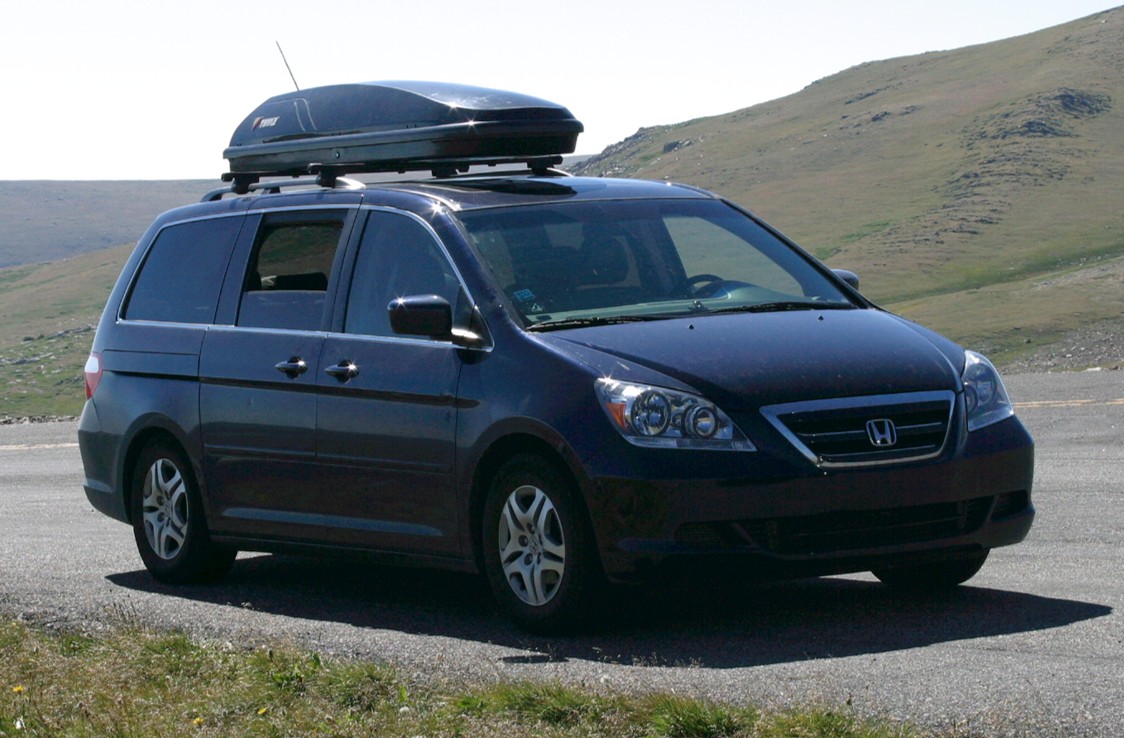
Origami wings in the roof-box?

Origami wings in the roof-box?

A few weeks ago I was fascinated by the competitors’ bikes tessellated on top of the team support cars during the Tour of Britain [see my post entitled ‘Tessallating bikes‘ on September 10th, 2014]. What if instead of tessellating bikes we could use origami to fold away a set of wings? Many people have dreamed of escaping the frustration and congestion of traffic on the road with a convertible. Not the classic convertible but a car that converts to a plane. One small company from Massachusetts, Terrafugiama has already flown a prototype flying car with self-folding wings and is working on an advanced prototype capable of vertical take-off and highway driving. Vertical take-off with wings is difficult so as an alternative a group of universities in Europe is studying the feasibility of a Personal Air Transportation System (PATS) based on a helicopter, known as MyCopter.

These convertibles are difficult to design in practice due to the space constraints for a flying car to take-off and land, the need for two propulsion or at least two transmission systems, the different type of suspension required for comfortable driving compared to landing, the current approach to crashworthiness in cars, and the overwhelming requirement for a light-weight system if there is any hope of getting airborne.   If you add to this list the desire for an environmental-friendly vehicle then perhaps there is no hope, unless we can cross a Tesla with the Airbus prototype electric plane, the E-plane!  [See my post entitled ‘Are electric cars back?‘ on May 28th, 2014]

Sources:

Why we’re not driving the friendly skies‘ by Stuart F. brown in the New York Times on August 22nd, 2014

‘If cars could fly‘ by Nick Bilton in the New York Times on June 30th, 2010

http://www.nytimes.com/2014/08/24/automobiles/pie-in-the-sky-flying-cars-from-the-past.html?action=click&contentCollection=Automobiles&module=RelatedCoverage&region=Marginalia&pgtype=article&_r=0

Detroit

978000655083970256Last week we drove from the south through downtown Detroit on Interstate 75.  Approaching from a distance along the shore of Lake Erie and the banks of the Detroit river, the city looks like many others in the US with glass-clad towers clustered together and stretching towards the clear blue sky.  Close-up and beyond the glass skyscrapers, Detroit offers a different view of derelict apartment blocks, factory buildings and offices covered in graffiti with weeds growing out of them.  These are not isolated buildings but whole city blocks.  It is reminiscent of Hadron in Doris Lessing’s book ‘Mara and Dann’, in which twenty-five towers built for city administrators are left abandoned in preference for fine houses in large gardens.  The mental picture that our drive brought to mind was from Lessing’s book; however, in searching out the book at home I remembered a similar image drawn by JG Ballard in ‘High Rise’ in which civilised life in a 42-storey degenerates as residents abandon all moral and social conventions and a hunter/gatherer culture of competing gangs developed.

Of course Detroit is infamous for having recently become the largest municipal bankruptcy when it filled for Chapter 9 Bankruptcy on July 18th, 2013.  However, not all is doom and gloom in Detroit; it might be suffering from entropic decay but they know how to conserve energy (available energy).  At Detroit  Metropolitan Airport they are replacing more than 6000 light fixtures with LED (light emitting diodes) lights in the parking structures (multi-storey car parks) as well as adding an extra thousand for a total cost of $6.2 million (£4M).  It is anticipated that the resultant reduction in energy consumption will be 7,345,000 kilowatt hours (kWh) worth about $1.2 million per year (£0.77M).  According to Ali Dib, Director of Infrastructure & Engineering for Wayne County Airport Authority, the energy saved by the light replacements will be “equivalent to powering 880 U.S. households for one year, and the reduction of 7,000 metric tons of CO2 per year is equal to taking 1,350 passenger vehicles off the road.” Not something they would be very happy about you doing in the ‘Motor Capital of the World’.  So the other way of looking at the CO2 production saved is that it is equivalent to  25,400,000 passenger air miles not flown or a thousand round-the-world flights.

Oh, and the LEDs will only need changing every ten years instead of every thirteen months for the current light bulbs.

For ‘Mara and Dann’ see: http://www.dorislessing.org/maraand.html And for reviews: http://www.nytimes.com/books/99/01/10/reviews/990110.10upch.html or http://www.theguardian.com/books/1999/may/29/books.guardianreview27

For ‘High Rise’ see: http://www.jgballard.ca/criticism/highrise.html

Information on changing light fixtures from The Metropolitan dEtroit, August 2013 (p.11) and http://www.themetropolitandetroit.com/

Passenger air miles CO2 production from http://www.transportdirect.info/Web2/JourneyPlanning/JourneyEmissionsCompare.aspx