Reader, reader, reader!

annegreeneAt this time of year many university students are labouring over their dissertations. I have commented before about the difficulties that engineers seem to have in expressing themselves eloquently. So, I thought that I should offer some simple guidance.

The title of this post is the first piece of guidance. Real estate agents like to use the adage ‘location, location, location’ when talking about the relative importance of the features of properties. For technical writing it can be adapted to ‘reader, reader, reader’ – in other words, you have to think about your reader whenever you are writing.

There are lots of books about writing, and although some are admirably short, most engineers and engineering students do not read them. Maybe there is a clue there as to why engineers tend not to write material that is read by others. One of the shortest and most concise of these books is by Anne Greene called ‘Writing Science in Plain English’. I have summarised it below as a simple mnemonic:

R – Reader, reader, reader. Ok, we have done this one already. Anne prefers ‘audience, audience, audience’ (page 36) but that’s American and doesn’t work as well as a mnemonic.

E – [readers] Enjoy a story with a subject that takes rather than receives actions. See Anne on story-telling in science writing (page 12) and on using active rather than passive verbs (page 22).

A – [readers] Appreciate short, non-technical words. See Anne on using short, old words which are used frequently in spoken English (page 30). Introduce technical words slowly and only if absolutely necessary (page 36).

D – [readers] Digest new information when it follows old in sentences that vary in length. See Anne on providing familiar information at the start of a sentence and building on it through the sentence (page 52). But, don’t write strings of long sentences (more than 30 words); see Anne on varying sentence length (page 63).

E – [readers] Expect paragraphs to have a consistent structure with issue, development and conclusion. See Anne on paragraph structure and making the point at the end of the introductory paragraph(s) (page 71).

R – [readers] Remember the last thing that they read, so build arguments progressively from the least to the most important evidence. See Anne on developing persuasive arguments (page 78).

Finally, many of the technical reports that I am expected to read do not appear to have been read by the author because they are littered with typographical, grammatical and stylistic errors. So Read, Edit, Add and Delete (READ).

By the way, Anne also advises that we use ‘parallel lists’ (see page 60). By which she means lists in which the items have a consistent structure, such as in my mnemonic ‘READER’ above.

Sources:

Greene, A.E., Writing science in plain English, The University of Chicago Press, Chicago, 2013.

Williams, J., Style: toward clarity and grace, The University of Chicago Press, Chicago, 1995.

Where there is muck there is an engineer

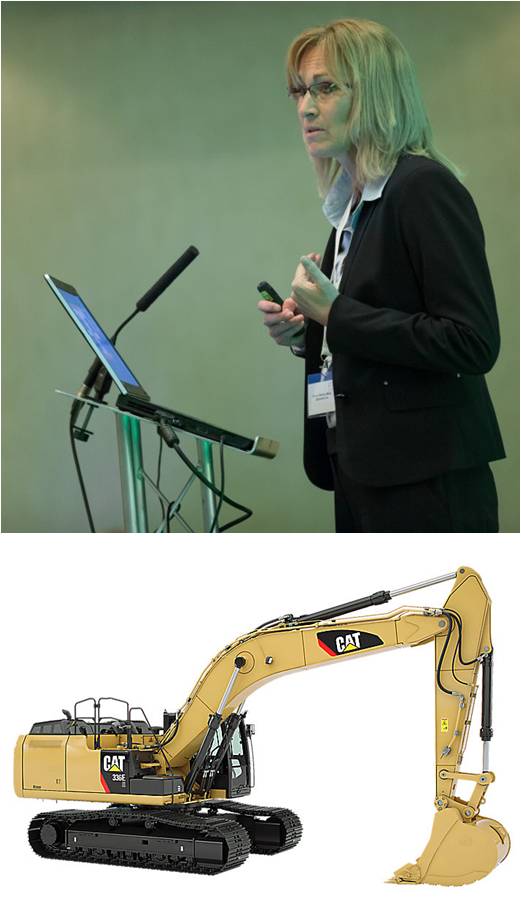
Dr Lou Balmer-Millar at the FPC 2015 & the CAT 366E

Dr Lou Balmer-Millar at the FPC 2015 & the CAT 366E

Here’s a second post on what engineers do [see my post entitled ‘Press button for exciting ride‘ on March 25th, 2015].

Dr Lou Balmer-Millar leads a team that develops new technology for off-road vehicles.  She is Director of Research and Advanced Engineering at Caterpillar Inc. and she gave a keynote talk at the  Future Powertrains Conference, which I wrote about a couple of weeks ago.  She talked about the innovations that Caterpillar are developing to increase the efficiency of their vehicles.  This includes driverless giant trucks.  If you are worried about driverless cars then what about driverless 226 tonnes trucks?  It is already a reality –   watch the Caterpillar video.

However, what stuck in my mind from her presentation was not the enormous mining trucks but the way in which Caterpillar measure the efficiency of their diggers, such as the CAT 366E Hybrid.  They are not so much interested in miles per gallon as tonnes of dirt (or muck) shifted per gallon.  Efficiency is defined as what you want out of a machine divided by what you have to put in to a machine, or work done for energy supplied [see post entitled ‘Energy efficiency‘ on June 18th, 2014].  So for a passenger car, miles travelled divided by energy used is a reasonable measure of efficiency.  But for digger, tonnes of earth moved is what you are want done, so tonnes moved per gallon is the right measure of efficiency.   The machine in the picture does not look like anything special but Caterpillar claim it is 30% more efficient than its competitors.

So there is money to be made in shifting earth more efficiently than your competitors.  If you enjoy watching machines move earth the watch this video.

Photo credit: Joshua Tucker http://www.apcuk.co.uk/2015/03/future-powertrain-conference-2015-report/

Trees are made of air

162-6273_IMGYes, it is April Fools Day but I am serious.  Trees are made of air.  Think about it.  What happens when they are burned?  You are left with a small pile of ash.  So where did the rest of the tree go?  When the tree ‘is burned, in the flaming heat is released the flaming heat of the sun which was bound in to convert air into the tree’.  These words are from Richard Feynman, who explains it much better than me.  Watch him on Youtube.

Sources:

Max Tegmark, Our Mathematical Universe, Penguin Books Ltd, 2014.

National Public Radio blog

Press button for an exciting ride

Painting by Katy Gibson

Artist: Katy Gibson

Someone has suggested that I should write more about what engineers do.  So here is the first in a series of posts in that vein.

A few weeks ago, I went to the ‘Future Powertrains Conference‘ held at the National Motorcycle Museum near Birmingham, UK.  A ‘powertrain’ is the system that creates and delivers power to the wheels of vehicles.  It is at the heart of a motorcycle but they were not discussed at the conference and instead the discussion was about cars and commercial vehicles.  There was a big focus on achieving the EU commitment under the Kyoto Protocol to reduce greenhouse gas emissions (GHG) to below 18% of 1990 levels.

Electric powertrains figured strongly and would certainly improve the air quality in our urban environment but they shift the GHG emissions problem to our powerstations [see my post on ‘Energy Blending‘ on May 22nd, 2013 and on ‘Small is beautiful and affordable in nuclear powerstations‘ on January 14th, 2015]. Even so, the high energy density of fossil fuels means that they remain a very attractive option.  The question that engineers are trying to answer is whether their GHG emissions can be reduced to below 18% of their 1990 levels.

CO2 emissions vs mass of light commercial vehicles (see source below)

CO2 emissions vs mass of light commercial vehicles

When you plot CO2 emissions as a function of kerb weight for all passenger cars the graph reveals that the best in class achieve about 0.1 grams CO2 emitted per kilogram of kerb weight.  Kerb weight is the term used for the weight of a car without passengers or luggage but with a full fuel tank.  Of course, this means the simple answer is that we should all drive lighter cars!

The EU has assumed that most of us will not opt for lighter cars and has introduced legislation which is forcing manufacturers towards 0.02 grams CO2 per kg, which is a huge challenge that is being tackled at the moment by engineers, such as Paul Freeman at Mahle Powertrain Ltd who spoke at the conference.  To help meet this challenge, the UK Automotive Council has produced a series of technology roadmaps such as the one shown below and discussed by Dr Martin Davy from Oxford University during the conference.

As an alternative, we could move more quickly towards driverless cars which would both use the powertrain more efficiently and reduce the risk of accidents to almost zero.  A very small risk of accidents would allow lighter cars to be designed without a heavy crash-resistant cage.  But, as one conference delegate commented on ‘driving’ a driverless car “where would be the fun in that!”  Perhaps that shows a lack of imagination. After all, we can create exciting and safe fairground rides in which you have no control over the ‘vehicle’ into which you are strapped.  So why shouldn’t there be an ‘extra excitement’ button in a driverless car in just the same way that some modern cars have a ‘sport’ button.

passenger_vehicle_roadmap

Source:

Top graphic: http://ec.europa.eu/clima/events/docs/0019/final_report_lcv_co2_250209_en.pdf

Bottom graphic: http://www.automotivecouncil.co.uk/wp-content/uploads/2013/09/Automotive-Council-Roadmaps.pdf