Meta-representation competence

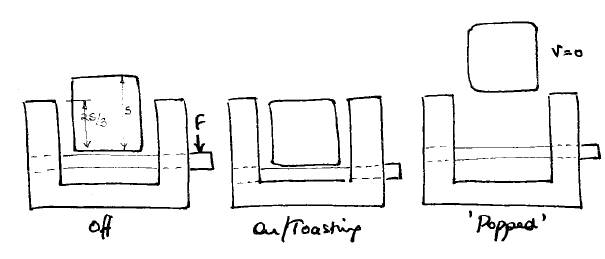
toasterdrawingOk, it’s a challenging title and a strange thumb-nail diagram but stick with it!  Last week I was giving revision lectures for my first year class in thermodynamics which is why my post was about problem-solving.  I mentioned the difficulty in persuading students to represent problems pictorially.  It is called meta-representational competence.  It is a knowledge of when visual representations are likely to be appropriate, how to create them and how to interprete them, according to Disessa and Sherin (2000).

It is hard because you need to become comfortable with the slow and uncertain process of creating representations and exploring the space of possibilities, to quote Martin and Schwartz (2014).  This is achieved through practice. Oh, and now we are back to students testing their skills against problems set by their tutors.  It is what engineers learn to do as part of their formation.  They might not realise it but their meta-representation competence is one of the attributes that make them so attractive to employers.

Now, what about that thumb-nail.  Well, it is my picture drawn as part of the staff answer to the Everyday Engineering Example below, which was given to our new engineering students in their first week at university and subsequently discussed with their personal tutor. Can you solve it with my sketch?  Answers via the comments…

Dynamics Example:

A two-slice toaster is switched on by depressing a slider which causes the slices of bread to fall downwards into the toaster between heating elements and also extends a pair of springs at each end of the toaster. When the toast is ready a pair of triggers releases both springs simultaneously, which in turn cause the toast to ‘pop’ up. If the toast is to just not jump completely out of the toaster when it is ready and in the ‘off’ position rests with two-thirds in the toaster, calculate the force that must be applied to the slider when switching on the toaster. Neglect the weight of the mechanism and assume that there are no losses.

Sources:
Disessa AA & Sherin BL, Meta-representation: an introduction, J. Mathematical Behaviour, 19(4):385-398, 2000

Martin L & Schwartz DL, A pragmatic perspective on visual representation and creative thinking, Visual Studies, 29(1):80-93, 2014.

Martin L & Schwartz DL, Prospective adaptation in the use of external representations, Cognition and Instruction, 27(4):370-400, 2009.

Problem-solving in thermodynamics

Painting from Okemos High School Art Collection at MSUDuring November and December I was handing out a sheet of problems every week in my first-year undergraduate thermodynamics class so that students could evaluate and refine their understanding and problem-solving skills as the course progressed. Of course, most students will not have done this and those problem sheets will have been part of their list of good intentions, which have now become part of their revision schedule. Well, perhaps?  Anyway, to help them is attached ‘Professor Patterson’s Patented Problem-solving Procedure (PPPPP)’ for entry-level thermodynamics problems.

PPPPP is written in the context of thermodynamics but actually it is what engineers tend to do when faced with analysis problems, i.e. draw a sketch including all the known information, identify some simplifying assumptions then apply and solve the relevant physical laws. There is plenty of research that shows most of us are visual problem-solvers [e.g. Martin & Schwartz, 2014] but it is remarkably difficult to persuade people to summarize a problem pictorially.  It takes practice and that’s why we give students lots of problems on which to hone their skills.

See my post entitled ‘Love an engineer‘ on September 24th, 2014 for about creative problem-solving engineers.  Or ‘Mind wandering‘ on September 3rd, 2014.

Sources:

Martin, L., & Schwartz, D.,  2014, ‘A pragmatic perspective on visual representation and creative thinking’, Visual Studies, 29(1):80-93.

Painting from Okemos High School Art Collection at MSU

Engineers are slow, error-prone…

Professor Kristina Shea speaking in Munich

Professor Kristina Shea speaking in Munich

‘Engineers are slow, error-prone, biased, limited in experience and conditioned by education; and so we want to automate to increase reliability.’  This my paraphrasing of  Professor Kristina Shea speaking at a workshop in Munich last year.  At first glance it appears insulting to my profession but actually it is just classifying us with the rest of the human race.  Everybody has these attributes, at least when compared to computers.  And they are major impediments to engineers trying to design and manufacture systems that have the high reliability and low cost expected by the general public.

Professor Shea is Head of the Engineering Design and Computing Laboratory at ETH Zurich.  Her research focuses on developing computational tools that enable the design of complex engineered systems and products.  An underlying theme of her work, which she was talking about at the workshop, is automating design and fabrication processes to eliminate the limitations caused by engineers.

Actually, I quite like these limitations and perhaps they are essential because they represent the entropy or chaos that the second law of thermodynamics tells us must be created in every process.  Many people have expressed concern about the development of Artificial Intelligence (AI) capable of designing machines smarter than humans, which would quickly design even smarter machines that we could neither understand nor control.  Chaos would follow, possibly with apocalyptic consequences for human society.  To quote the British mathematician, IJ Good (1916-2009), “There would then unquestionably be an ‘intelligence explosion’, and the intelligence of man would be left far behind. Thus the first ultra-intelligent machine is the last invention that man need ever make.”  Stephen Cave in his essay ‘Rise of machines’ in the FT on March 20th, 2015, citing James Barrat  suggested that “artificial intelligence could become super-intelligence in a matter of days, as it fixes its own bugs, rewriting its software and drawing on the wealth of information now available online”.

The decisions that we make are influenced, or even constrained, by a set of core values, unstated assumptions and what we call common sense which are very difficult to express in prose never mind computer code.  So it seems likely that an ultra-intelligent machine would lack some or all of these boundary conditions with the consequences that while  ‘To err is human, to really foul things up you need a computer.’  To quote Paul R. Ehrlich.

Hence, I would like to think that there is still room for engineers to provide the creativity.  Perhaps Professor Shea is simply proposing a more sophisticated version of the out-of-skull thinking I wrote about in my post on March 18th, 2015.

Sources:

Follow the link to Kristina Shea’s slides from the workshop on International Workshop on Validation of Computational Mechanics Models.

Stephen Cave, Rise of the machines, Essay in the Financial Times on 21/22 March, 2015.

James Barrat, ‘Our Final Invention: Artificial Intelligence and the End of the Human Era‘, St Martins Griffin, 2015

Life takes engineering

changingconversationTeachers change lives.  Doctors cure, nurses care. Firefighters are heroic.  What do engineers do?  Engineers shape the future.

Most of the things that engineers do are taken for granted.  I would like to think that we are so good at it that people don’t notice anymore.  Occasionally things go wrong and we get the blame but almost everything you do in life from the moment you are born is shaped by engineering.  A structural engineer designed the structure in which you were born, a team of mechanical engineers designed the vehicle you made your first journey in, if you needed medication a team of chemical engineers designed the factory that produced them and so on through life.  You can repeat the process for an average day – who designed the production system that made the bed you slept on, the alarm clock that woke you, runs the utilities that provided hot water to wash in, designed the supply chain that delivered food to your breakfast table and so on through the day?  Yes, engineers.

Maybe engineering is so ubiquitous that it is difficult to grasp its essence.  The engineering community spends hundreds of millions of dollars annually to promote public understanding of engineering with little measurable impact on young people, according to the US National Academy of Engineering.  Their report called ‘Changing the Conversation‘ recommends using four tag-lines to promote engineering:

1. Engineers make a world of difference.

2. Engineers are creative problem solvers.

3. Engineers help shape the future.

4. Engineering is essential to our health, happiness and safety.

About 40% of their survey groups found these tag-lines ‘very appealing’.  So perhaps none of them really resonated.  Oh, but now I am being an engineer and analysing the data in order to make a very rational, reasoned decision when instead I should be employing my creative, imaginative side.  Maybe we are back to poetaster engineers [see my posting on ‘Poetasting engineers‘ on March 4th, 2015].  As a profession we are not good with words [see last week’s posting entitled ‘Reader, Reader, Reader] and cannot dream up a catchy memorable tag-line.

What do you think?