Category Archives: Thermodynamics

Clean fossil fuel?

The amount of energy stored in methane hydrate could be twice that of all other fossil fuel reserves based on data from the US Geological Survey, the New Scientist reported on 31st August, 2013 in an article entitled ‘Buried Treasure’.  At this point, most of you are probably wondering what methane hydrate is and where it is stored.  Microbes on the seabed eating organic matter produce methane molecules that at high pressure and low temperature combine with the water to form a hydrate, which is white crystal.  Large deposits of methane hydrate deposits are believed to lie along continental margins, mostly in ocean sediments.

Natural gas and shale gas (‘Fracking’ on August 28th, 2013) are also methane, which releases less carbon dioxide when it is burned than coal or gas and hence is regarded as cleaner.  However, methane hydrate deposits might have an additional advantage because some research has shown that the methane molecule trapped in the hydrate crystal can be replaced by a carbon dioxide one.  So we might be able to extract methane and simultaneously store carbon dioxide.  Sounds too good to be true and the second law of thermodynamics will ensure that there is a price to be paid somewhere and somehow (see post entitled ‘Sonic Screwdriver’ on April 17th, 2013 for more the 2nd law).

http://www.newscientist.com/article/mg21929320.800-frozen-fuel-the-giant-methane-bonanza.html

https://www.llnl.gov/str/Durham.html

http://www.jogmec.go.jp/english/oil/technology_015.html?recommend=1
Flexible credit

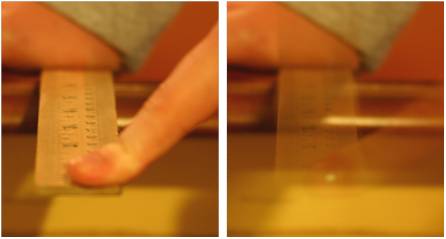
vibrating rulerOne of the major credit card companies used to advertise their card as ‘your flexible friend’.  If you clamp your card over the edge of the table and flip it with your finger then it will vibrate at a resonant frequency which decreases with length of the overhang, or cantilever as engineers might call it.  You could say that your flexible friend can sing too.

I used to use a twelve-inch ruler as everyday example of free and forced vibrations until someone pointed out to me that most engineering students don’t carry them around any longer.  So the credit card is a nice alternative that everyone carries with them, although the embossed text of your name and account number makes them a little too stiff and you might find that your plastic driving licence works better.  Neither will produce middle C as well as a plastic twelve-inch ruler – you can calculate the resonant or natural frequency by equating the kinetic energy and strain energy of the cantilever, as illustrated in the attached 5E lesson plan.  For more on 5E lesson plans see: my post entitled ‘Disease of the modern age’ on June 26th, 2013 and ‘Sizzling Sausages’ on July 3rd, 2013.  By the way, kinetic energy is the energy possessed by an object due to its motion and strain energy is the energy stored in an object as result of elastic (reversible) deformation and is equal to the work done in producing the deformation.

5EplanNoD12_free&forcedvibrations

Stonemasons and skateboards

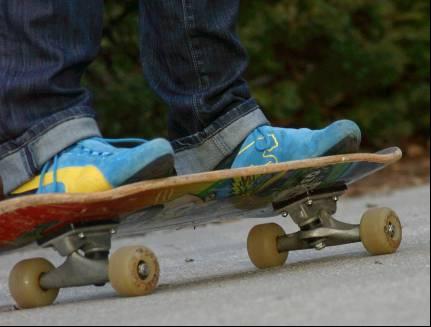
skateboardWalking through campus last week I saw a stonemason carving small chamfers every 30cm or so around the edge of plinth being prepared to receive a new sculpture.  A few days later there were metal tabs fitted in the chamfers, presumably to discourage skateboarders from using the plinth for acrobatics.  These metal tabs are becoming as common in our public places as the skateboarders they are designed to discourage.  I can understand old people being worried by fast moving youngsters on skateboards, but the speed and freedom of movement is part of the attraction for young people.  As a teacher of engineering, I see the skateboard as another everyday example of engineering with which to liven up the classroom and grab students’ attention.  Try riding a board into class to engage attention!

Below is a ‘5E’ lesson plan for beam bending theory based around a skateboard.  For more on Everyday Examples in Engineering ‘Bridging Cultures’ on June 12th, 2013; and ‘Disease of a Modern Age’ on June 26th, 2013.

5EplanNoS8_beambending&skateboarder

Teaching stress

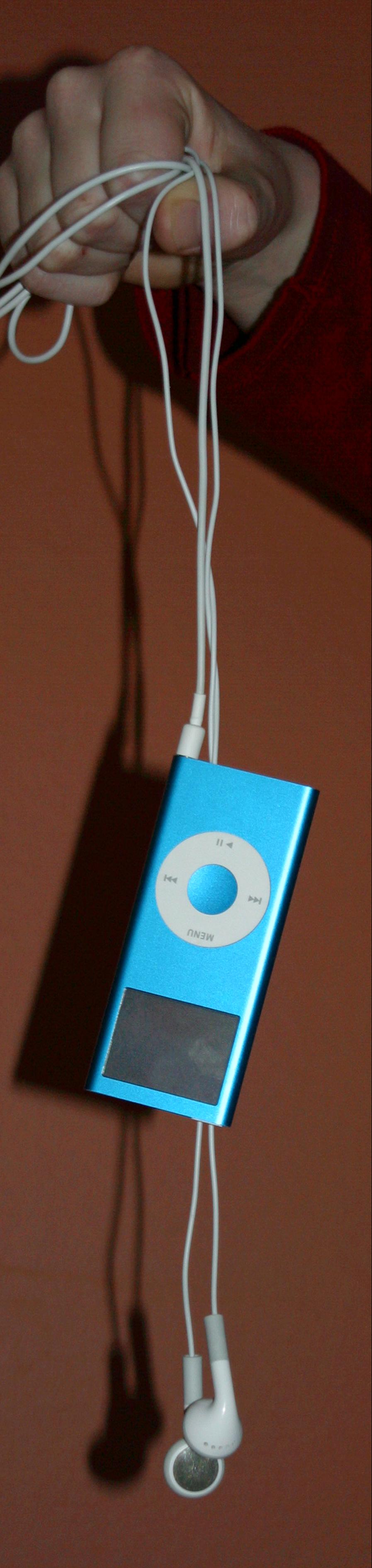
ipodDuring my trip to the US (see post entitled ‘Detroit’, on 21st August, 2013), my earphones for my IPod broke.  This seems to be a common occurrence, perhaps a case of the planned obsolescence I wrote about on May 1st, 2013 under the heading ‘Old is Beautiful’.  Nothing very beautiful or repairable about broken earphones, they are just part of our disposable culture.  However, I collect them and use them when teaching engineering students about stress and strain.  Students have all experienced such a failure and so it is an everyday example of engineering that can be used to teach the principles of stress and strain in a familiar context.  A suggested 5E lesson plan for doing this is provided at the bottom of this post.

The lesson plan deals with the stresses in the earphone cable when the ipod is dangled from them and the discussion in class can be extended to include the stresses induced by spinning the earbuds on the end of the cable or the effect of repeated bending of the cable leading to possible fatigue failure (like when you bend your old credit card back and forth to snap it in half).

For more on Everyday Examples in Engineering ‘Bridging Cultures’ on June 12th, 2013; and ‘Disease of a Modern Age’ on June 26th, 2013.

5EplanNoS1_uniaxialstrain&ipod