Category Archives: energy science

Lost at sea

leaving usa

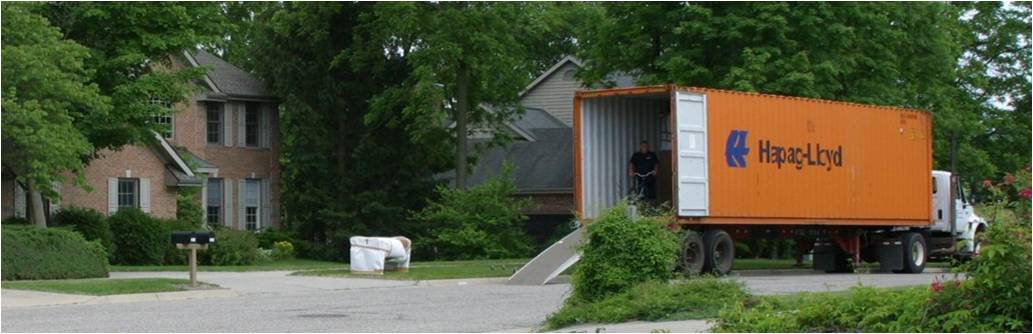
Loading our shipping container to leave USA

Our inability to find flight MH370 was still very prominent in the national media when I was in China last month.  The search for the aircraft and the false alarms caused by floating rubbish at sea has raised awareness about the amount of junk floating around our oceans, for instance 10,000 shipping containers are lost at sea every year,  or more than 1 every hour.  However, there are about 17 million containers in the world, so we only lose about 0.05% per annum which is a negligible amount unless its the one containing all your household goods as you move continents!

I was interested to find a high level of environmental awareness in China.  Alongside the reports on the search for flight MH370 the China Daily had a centre-page spread on Thursday 24th April, 2014 about ‘How pollution affects marine life’ with a focus on the garbage patches in the Pacific and North Atlantic oceans.  The North Atlantic Garbage Patch is more than 100 kilometres in diameter with about 200,000 pieces of debris per square kilometre trapped in the gyre. These are big numbers and if you break it down to small areas then it is one piece of debris per five square metres, which a box 2.24 x 2.24m or 7 x 7 ft.  This doesn’t sound so bad until you consider the impact on wildlife, for instance 86% of all sea turtles are affected by entanglement or ingestion of marine debris and an autopsy on a sperm whale found dead in Spanish waters concluded that the cause of death was ingestion of 24 meters of plastic.  About 300 million tonnes of plastic are produced globally per year of which it is estimated about 6 million tonnes (2%) ends up in the oceans, with 80% being washed into the sea from rivers or blown by the wind from rubbish dumps.

The second law of thermodynamics [see my post on June 5th, 2013 on Impossible Perfection] limits the efficiency of all processes with the result that engineers are used to not worrying about losses of 10% or less so that the losses to the ocean of 0.05% and 2% mentioned above would be considered negligible but the enormous scale of human processes mean that the losses are having a significant impact on the fauna of the planet.  Engineers need to lead society towards a more harmonious and protective relationship with the rest of the planet.

Source: http://www.billiebox.co.uk/facts-about-shipping-containers/

100 Everyday Engineering Examples

bookletsSTOP PRESS – more than 100 Everyday Engineering Examples published in more than 40 lesson plans on a new webpage.

I have been including 5E lesson plans as part my recent posts.  These lesson plans are primarily for people teaching first-year engineering undergraduates, which is pulling me away from the intended focus of this blog. So, I have decided to publish all of the lesson plans that I have written & edited on a separate page.  There are more than 100 Everyday Engineering Examples in the more than forty lesson plans.  If that is not enough Everyday Engineering Examples then you can find more at ENGAGE

Now back to Realizing Engineering – we live in an almost entirely engineered world. Engineers, as a profession, are so good at their job that most people are unaware of their influence on society.  Look around you. Engineers will have designed the machines and transport infrastructure to supply most of what you can see as well as what you are probably sitting in and on.

The Royal Academy of Engineering has produced an ebook to expand on this theme of ‘Engineering in Society’ for first year engineering undergraduates but I think its suitable for anyone considering a career in Engineering.

Rhapsody in Blue

118-1841_IMGLast Saturday we went to a fantastic concert at the Liverpool Philharmonic Hall.  It featured the pianist Michel Camilo playing the UK premier of one of his own compositions, Piano Concert No. 2 ‘Tenerife’ and Gershwin’s Rhapsody in Blue with the Royal Liverpool Philharmonic Orchestra.  He was fabulous – there are a couple clips on YouTube of him playing Rhapsody in Blue so you can some idea of what we experienced on Saturday evening.  I cannot play the piano and so his virtuosity was all the more impressive to me.  The applause at the end was ecstatic and followed by an even more spectacular encore, Caribe.

As we applauded for what seemed like a couple of minutes, I was reminded of an example that I had worked through in class last term for my first year undergraduate course in Thermodynamics.  The worked example is attached and involves estimating the temperature rise in palms of your hands as a consequence of vigorously clapping during which kinetic energy is converted into internal energy in the flesh of your palms and causes the temperature rise, ignoring the energy converted into sound.  The emphasis was on estimating by creating a model using a set of identified assumptions and, once we had an answer, I discussed the influence of those assumptions and introduced the idea of sensitivity analysis – this is not included in the worked example attached.

For twenty enthusiastic claps we found a temperature rise of a quarter of a degree Celsius, which we would probably notice since the hairless skin on the palm at the base of thumb is sensitive to changes as small as a twentieth of a degree, according to Dr Lynette Jones of MIT [doi:10.4249/scholarpedia.7955].

Hot particles

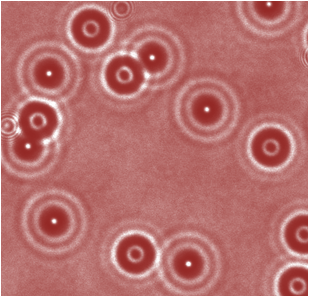
diffraction pattern from nanoparticlesHave you ever wondered why people visiting the site of the Fukushima nuclear accident are only dressed up in coveralls and masks?  In my post on December 18th entitled ‘Hiding in the Basement’, I explained that gamma radiation requires a sheet of lead to stop it so the coveralls are clearly not protecting Fukushima visitors against radiation.

Our bodies cope with low levels of radiation everyday because we absorb about 0.024 Sieverts per year from the natural environment and the same amount is absorbed during a full-body scan in hospital.  One Sievert is equivalent to 1 Joule absorbed per kilogram of body mass. If you hold a tennis ball as high above your head as you can reach and let it fall to the ground, then the ball hits the ground with about 1 Joule of kinetic energy.  Your heart uses about 1 Joule of energy per beat.

The estimated maximum dose received by residents living close to Fukushima was 0.068 Sieverts or about three annual doses.  The visitors’ coveralls and mask are protecting them from ‘hot’ particles that are often produced during a nuclear accident. ‘Hot’ particles can be inhaled or ingested and continue to emit radiation when inside the body thus delivering a large concentrated dose to a relatively small number of surrounding cells, which are disrupted and destroyed by the high-levels of energy.  ‘Hot’ particles are small pieces of radioactive material and vary in size from tens of nanometres to a few millimetres, so that they don’t have high penetrating power and can be detected using a Geiger counter.