Category Archives: sustainability

Exploiting complexity to help society adapt

photograph of a flower for decorative purposes onlyI am worried that engineering has become a mechanism for financial returns in an economic system that values profit above everything with the result that many engineers are unwittingly, or perhaps in a few cases wittingly, supporting the concentration of wealth into the hands of a few capitalists.  At the start of the industrial revolution, when engineering innovation started to make a difference to the way we live and work, very few engineers foresaw the impact on the planet of the large scale provision to society of products and services.  Nowadays most engineers understand the consequences for the environment of their work; however, many feel powerless to make substantial changes often because they are constrained by the profit-orientated goals of their employer or feel that they play a tiny role in a complex system.  Complex systems are often characterised by self-organisation in which order appears without any centralised control or planning and by adaptation to change and experience.  Such systems are familiar to many engineers and perhaps they do not, but should, think of the engineering profession as complex system capable of adaptation and self-organisation in which the actions and decisions of individual engineers will cause the emergence of a new order. Our individual impact might be tiny but by acting we influence others to act and the cumulative effect will emerge in ways that no one can predict – that’s emergence for you.

Collaboration and competition

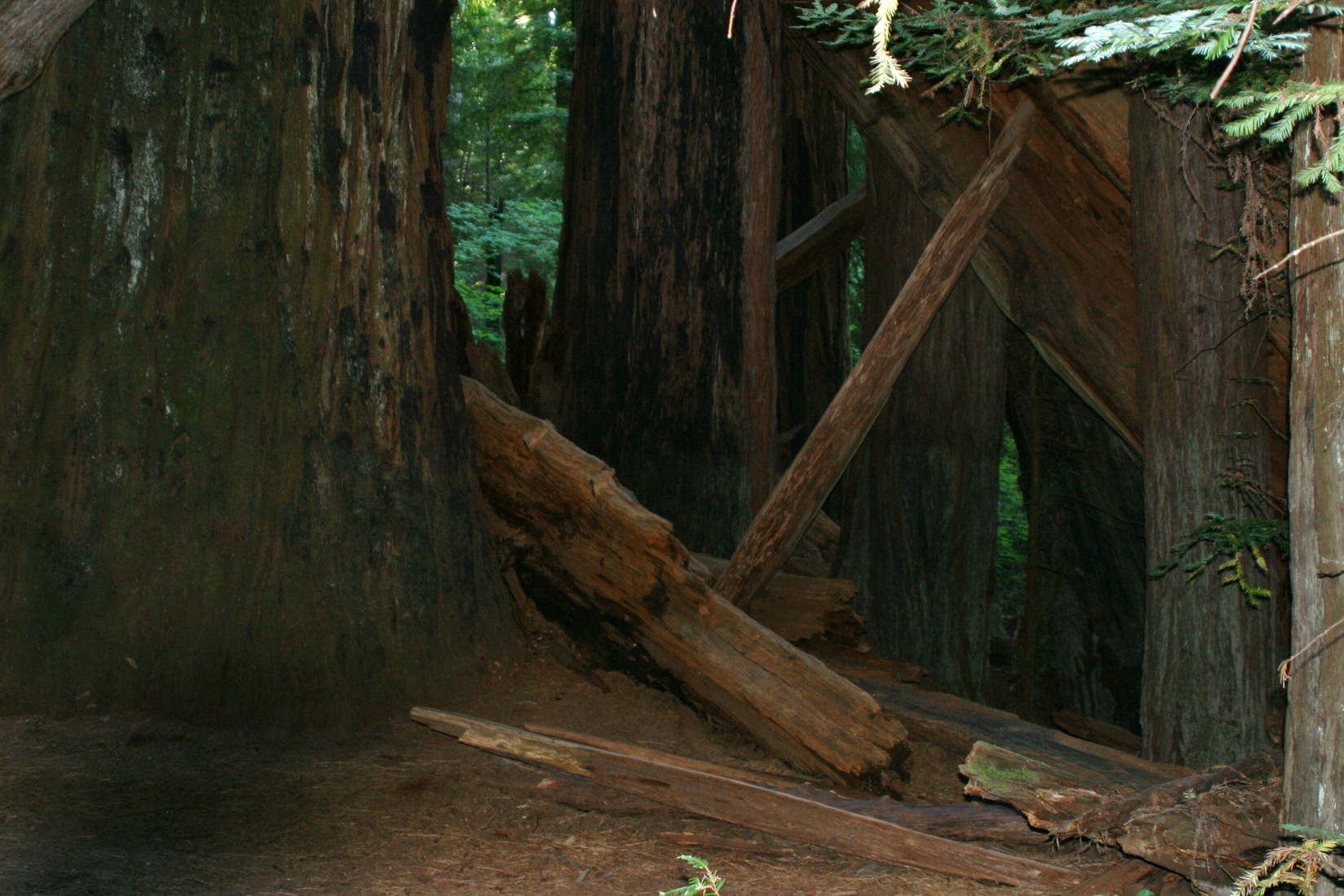
Close-up picture Californian Redwood trees showing some fallen trunks and branches amonst living treesCompetition has become a characteristic of many activities in life, whether it is teams vying to win a trophy, universities attempting to be top of a league table, retailers trying to persuade you to buy from them, or politicians seeking power. Natural selection is often cited to demonstrate that competition is ubiquitous in nature and therefore something to be embraced and celebrated as a route to success. However, Suzanne Simard has highlighted that competition is only part of Darwin’s theory of natural selection. It was popularised following the publication of his book ‘The Origin of Species’ in 1859; however, Darwin also wrote about the ways in which plants co-operate and collaborate and Simard believes that collaboration is ‘as important, if not more important’ than competition in the development of ecosystems. Trees may have a better chance of adapting to climate change because they are adapting faster than us.  A number of mass movements of plants are in progress – the fastest appears to be the northwards migration of white spruce trees in the eastern US which have moved 100 km every decade for the last thirty years. Perhaps it is time to apply some more comprehensive biomimetics to the organisation of society at all levels and consider how greater levels of collaboration rather than competition would help us tackle the challenges facing civilisation.

Sources:

Henry Mance, Lunch with the FT: Suzanne Simard ‘I say to the trees, “I hope I’m helping”‘, FT Weekend, 26 March / 27 March 2022.

James Bridle, The speed of a dandelion, FT Weekend, 2 April / 3 April 2022.

Existential connection between capitalism and entropy

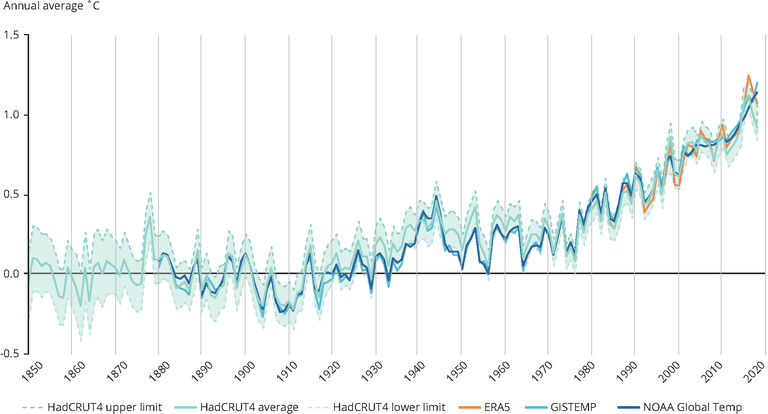
global average temperature with timeAccording to Raj Patel and Jason W Moore, in his treatise ‘Das Kapital’ Karl Marx defined capitalism as combining labour power, machines and raw materials to produce commodities that are sold for profit which is re-invested in yet more labour power, machines and raw materials.  In other words, capitalism involves processes that produce profit from an economic perspective, and from a thermodynamic perspective produce entropy because the second law of thermodynamics demands that all real processes produce entropy.  Thermodynamically, entropy usually takes the form of heat dissipated into the environment which raises the temperature of the environment; however, it can also be interpreted as an increase in the disorder of a system [see ‘Will it all be over soon?’ on November 2nd, 2016].  The ever-expanding cycle of profit being turned into capital implies that the processes of producing commodities must also become ever larger.  The ever-expanding processes of production implies that the rate of generation of entropy also increases with time.  If no profit were reinvested in economic processes then the processes would still increase the entropy in the universe but when profit is re-invested and expands the economic processes then the rate of entropy production increases and the entropy in the universe increases exponentially – that’s why the graphs of atmospheric temperature curve upwards at an increasing rate since the industrial revolution.  As if that is not bad enough, the French social economist, Thomas Piketty has proposed that the rate of return on capital, “r” is always greater than the rate of growth of the economy, “g” in his famous formula “r>g”.  Hence, even with zero economic growth, the rate of return will be above zero and the level of entropy will rise exponentially.  Piketty identified inequality as a principal effect of his formula and suggested that only cataclysmic events, such as world wars or revolutions, can reduce inequality.  The pessimistic thermodynamicist in me would conclude that an existential cataclysmic event might be the only way that this story ends.

Sources

Raj Patel & Jason W. Moore, A history of the world in seven cheap things, London: Verso, 2018.

Thomas Piketty, A brief history of equality, translated by Steven Rendall, Harvard: Belknap, 2022.

Diane Coyle, Piketty the positive, FT Weekend, 16 April/17 April 2022.

Image: Global average near surface temperature since the pre-industrial period from www.eea.europa.eu/data-and-maps/figures/global-average-near-surface-temperature

Planning to give up fossil fuels

Decorative image from video mentioned in postAt the start of last month, I wrote about the need for national plans to ween us from our addiction to fossil fuels [see ‘Bringing an end to thermodynamic whoopee‘ on December 8th, 2021].  If we are to reduce carbon emissions to the levels agreed in Paris at COP 21 then the majority of the population as well as organisations in a country will need to engage with and support the national plan which implies that it must transcend party politics.  This level of engagement will likely require us to have a well-informed public debate in which we listen to diverse perspectives and consider multifarious solutions that address all of the issues, including the interests of a fossil fuel industry that employs tens of millions of people worldwide [see EU JRC Science for Policy report on Employment in the Energy Sector] and makes annual profits measured in hundreds of billions of dollars [see article in Guardian newspaper about $174 billion profit of 24 largest oil companies].  Perhaps, learned societies nationally and universities regionally could collate and corroborate evidence, host public debates, and develop plans.  This process is starting to happen organically [for example, see Climate Futures: Developing Net Zero Solutions Using Research and Innovation]; however, the urgency is such that a larger, more focussed and coordinated effort is required if we are to bring about the changes required to avoid the existential threat [see ‘Disruptive change required to avoid existential threats‘ on December 1st, 2021].