Category Archives: Soapbox

Mind wandering

IMG_0116 (2)

Photo credit: Tom

Most of us have returned from vacation by now but I wonder how refreshed you are feeling.  Was you vacation like the character in the cartoon published recently in the New York Times (INYT Friday, August 8th, 2014), i.e. still connected to the grid?  Or did you follow my advice in the posts entitled ‘Gadget stress‘ (April 9th, 2014) and ‘Reading offline‘ (March 19th, 2014) by engrossing yourself in reading a few good books with all gadgets switched off.  I know some of my colleagues did not because I have received automatic vacation replies to my emails followed by detailed email responses a few hours later or even a minute or two later in one case, often including a reminder that they are on vacation!   David Levitin writing in the NYT (on August 9th, 2014) asserts that a ‘vacation isn’t a luxury’ and I agree with him.  We went to an undisclosed location with no telephone, no internet and no mobile phone signal and even then we thought that two weeks was not long enough!

David Levitin goes on to say that we should not skimp on daydreaming.  He describes how our brains have two modes of operation: central executive mode and mind-wandering mode.  We tend to operate in one mode or the other and the switching between them is controlled by the insula, which is located in our brain about 25mm below the top surface of your skull.  Tasks requiring focussed attention, such as learning and problem-solving are performed in central executive mode while day-dreaming and surfing from one idea to another is undertaking in mind-wandering mode.  Scientists believe that switching too frequently between the modes makes you feel tired.  Central executive mode functions better without distractions and in sustained periods spent on single tasks as recommended in my post entitled ‘Silence is golden‘ [January 14, 2014].  Creativity tends arise from mind-wandering, which can be stimulated by listening to music or taking a walk in nature [see my post entitled ‘The Charismatic Engineer‘ on June 4th, 2014], and allowing ideas to shuffle into perspective or the great breakthrough to emerge, apparently miraculously.

So the recipe for intellectual productivity and creativity seems to be to focus on tasks for sustained periods of times, Levitin suggests 30 to 50 minutes with email closed and phones muted.  Take short breaks and go for a stroll, eight minutes is sufficient according Stanford researchers, Marily Oppezzo and Dan Schwartz.  Set aside specific time to deal with email each day and also time for mind-wandering.

For more, see:

http://www.huffingtonpost.com/tag/working-vacation

http://www.psychologytoday.com/blog/maybe-its-just-me/201408/why-you-might-not-want-hit-the-reset-button-in-your-brain

Benford’s law

We need to learn to think big.  Humans have had a tendency to underestimate the scale of everything that exists.  We have progressed at an increasing rate from believing the earth was the focus of  existence, to understanding that our planet orbits the sun together with a group of other planets, to appreciating that our sun is a tiny speck in a galaxy that we call the Milky Way that is part of a universe and possibly a multiverse.  We have been able to spot mathematical patterns in nature and to describe them using the equations of physics that in turn allow us to predict the existence of phenomena before we have observed them, such as the Higgs-Boson, and also allow us to harness nature to provide goods and services to society.  The former is the role of physicists and the latter of engineers.  So there is a close link between physicists and engineers and it is not unusual to find engineers working in physics labs and physicists working in engineering organisations.  Frank Benford was a physicist working at General Electric in 1938 when he proposed a law that bears his name, though it has also been credited to Simon Newcomb, an astronomer working 50 years earlier.

Benford’s law predicts the frequency with which the numbers from 1 to 9 will appear as the first digit in a collection of numbers from a real-life source.  The frequency declines logarithmically from 30.1% for 1,  17.6% for 2, 12.5% for 3 etc down to 4.6% for 9.  It is probability distribution so you should not expect see the distribution for every collection of numbers but when it does not appear then you should be suspicious about the provenance of the data, particularly when it does not appear repeatedly.  It is used routinely by accountants and is being used increasingly to identify potential scientific fraud.  Of course some people think big and know about Benford’s law, for instance the fraudster Bernard Madoff filed Benford-compatible monthly returns, which perhaps is one reason why it took so long to catch him.

BTW – Benford’s law does not work for reciprocals or square roots, but is does for powers of 2, factorials and the Fibonacci sequence.


Sources:

Big Bang to Little Swoosh by Max Tegmark, New York Times, April 11th, 2014.

Look out for No.1. by Tim Harford in the Financial Times, September 9th, 2011.


Goodhart’s law

blueskyWe used to talk about R&D, i.e. research and development. In broad terms, most research happened in universities and national labs while most development was undertaken by companies. Nowadays we are being pressed to research and innovative. Nearly, every application for research funding from government agencies must include a section on the likely impact of the proposed research. This emphasis on impact is a global trend that was identified by Dr Helen Neville, Vice-President at Procter & Gamble for Global Open Innovation, in a recent talk I heard her give on trends in international research collaboration. The focus of university research used to be blue-sky, i.e. research with no pre-conceived application. We are exploiting the blue-sky research of twenty or thirty years ago now. And by only funding research with identifiable impacts our successors are likely to be short on breakthroughs to exploit in the middle of the century. It is analogous to a forester harvesting trees planted by his parents and not planting any for his children.

Attempting to evaluate the potential impact of a piece of research whose outcome, by definition, is not yet known is problematic and a matter of judgement rather than measurement.  Even for a piece of university research performed twenty years ago it is not possible to make a precise measurement of its impact. There are no international standards against which to make the measurement, as there is for the metre or the kilogram.  Consequently, the impact of research is probably one of those cultural measures that are subject to Goodhart’s law.  In 1975, Charles Goodhart postulated that once a measure is chosen for making policy decisions it begins to lose its value as a measure.  This is because people adjust their behaviour to optimise the value of the measure, e.g. university researchers tend towards research with short-term impact rather than focussing on discovery followed by dissemination and, or development.

Source: Measuring culture.  Robert P Crease in Physics World, April 2013.

Sounds of the city

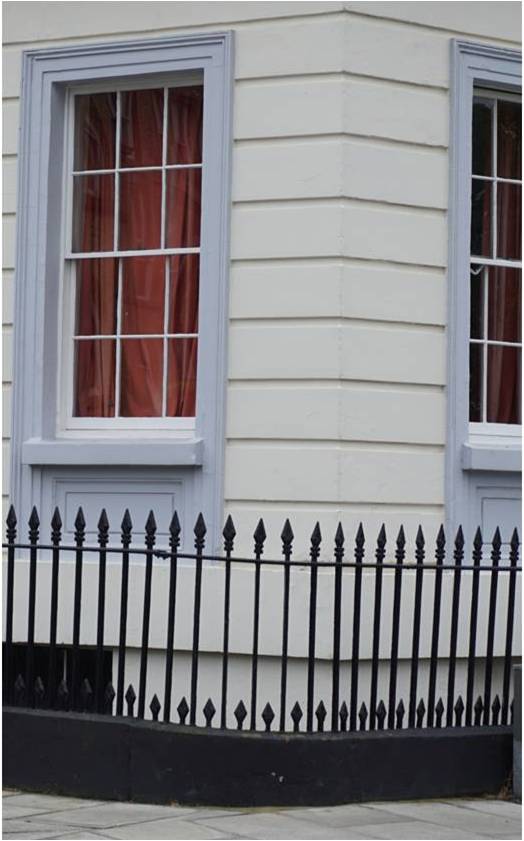
cornerRegular readers of this blog will know that I spent a relaxing day painting railings a few weeks ago [see post entitled ‘Engineering archaeology‘ on July 23rd, 2014].  A day or so later, I went out with my pail of whitewash to paint the walls of the light-well that the railings protect.  ‘The summer world was bright and fresh, and brimming with life’ but unlike Tom Sawyer I was not looking for Jim to do my white-washing for me.  I was looking forward to another therapeutic session painting the walls at the front of our house.  It was an interesting standing in the light-well facing the wall, un-noticed by most passers-by.  We live on a city street close to tourist attractions and there is a constant stream of coaches and taxis stopping to drop-off and pick-up tourists. I have written about the noise insulation in our house before [see Noise Transfer on April 13th, 2013] which means that we don’t notice the constant growl of diesel engines outside but I did while I was painting.  However, there were other sounds in the city.  The voices of pedestrians  deep in conversation as they passed by on the pavement just above my head.  I recognised Chinese, French, Italian and English but there were many different languages that I didn’t recognise.  There were young children asking parents questions as they walked down the street.  For a while I could hear cathedral bells.  When there was a pause in the traffic then it was possible to hear the cooing of pigeons, a neighbour’s radio or television and an ever-present idling diesel engine which I discovered was an ice-cream van dispensing a constant trickle of black soot and an occasional ice-cream.  It is curious that as a society we tolerant high levels of noise pollution at tourist attractions, especially ones that are meant to be places of calm and contemplation. Most tourists are, almost by definition, on holiday seeking relaxation and a lowering of stress levels – how much more pleasant would it be to glide to your destination in a silent electric coach or taxi?

We have the technology to provide such a service [see Are electric cars back? on May 28th, 2014]. Yes, it requires some investment by tour operators and taxi firms in hybrid or electric vehicles and by the city council in re-charging facilities. Induction charging stations at tourist attractions would allow vehicles to recharge while dropping off and picking up passengers. The technology is available and has been used by buses in Genoa and Turin for more than a decade.  So a little bit a regulatory pressure and investment from city councils acting together could create a calmer, quieter and cleaner environment for everyone.

Can we look forward to solar-powered ice-cream vans?

Sources: Thank you to Richard for reminding me about Tom Sawyer.