Category Archives: Soapbox

Our place in the web of life

140-4032_IMGThe seven billion human beings who live on this planet weigh in about 300 million tonnes in total and if you add in our domesticated animals then the scales would hit about 700 million tonnes. Whereas if you weighed all of the animals left in the wild then their total weight would be less than 100 million tonnes, according to Yuval Noah Harari in his book ‘Sapiens: a brief history of mankind’. This explains why many of our landscapes appear empty and barren – they are, at least at the level of large mammals. That’s why you are unlikely to be chased by a tiger or any other predator, see last week’s post entitled ‘Running away from tigers’.

These landscapes are not really barren. We just can’t see what is there. Bacteria are too small for us to see but they have dominated the landscape for most of evolutionary time. They ‘invented’ all of life’s essential biotechnologies including fermentation, photosynthesis, nitrogen fixation, respiration and devices for rapid motion plus probably a few we have haven’t discovered yet. Bacteria exchange up to 15% of their genetic material on a daily basis across all strains so that they could be considered to form a single microscopic web of life.

This web of bacterial life is all around us as well as inside us. If you like to learn more than you probably ever want to know about the bacteria inside us then read Giulia Enders’book ‘Gut: The inside story of our bodies most underrated organ’. We are not alone in being immersed in this web of bacterial life; so is every other living thing which implies we are all intimately connected in a vast ecological network. This microbial web of life in which we are embedded is self-organising – there are no leaders, presidents, generals or CEOs – instead bacteria empower one another. It appears to be one of the secrets of their success.

In an interconnected world, power and control over others in a hierarchy is less appropriate than empowering one another in the network. Many people would find this approach difficult because they identify themselves with their position of power and, hence would tend to resist any attempt to empower the network. To them it begins to sound like anarchy, particularly in the narrow context of human society, but others might suggest it offers a better prospect for addressing the challenges posed by global climate change than world leaders have so far proposed. Well-informed individuals intimately connected in a network are likely to take decisions that support the network, and hence themselves. But, now we are straying into game theory…

Sources:

Yuval Noah Harari, Sapiens: A brief history of mankind. London: Vintage (Penguin, Random House), 2014.

Capri F. & Luisi, P.L., The systems view of life: a unifying vision. Cambridge: Cambridge University Press, 2014.

Enders, G, Gut: the inside story of our bodies most underrated organ. Vancouver: Greystone Books, 2013.

Running away from tigers

rsph graphicToday, the probability that you will have to run away from a tiger is very small, no matter where you live.  Tigers have lost 93% of their historical range that used to stretch from Turkey across Asia to Eastern China and southwards to Indonesia.  Tigers have no problem with the first law of thermodynamics – they instinctively know that if they take in more energy than they expend then the excess energy will be stored as fat and when they become overweight they won’t be able to catch you or whatever else they decided to chase for their next meal.

As a species we seem to have lost that understanding of energy balances.   Obesity is increasing in many parts of the world.  The situation is so serious in the UK, where more than two-thirds of the adult population are overweight or obese, that the Royal Society for Public Health has proposed that food should be labelled with the amount of exercise required to burn-off the calories it contains and they have suggested using the infographic in the thumbnail.  Of course, the Royal Society’s position paper does not mention explicitly thermodynamics (or tigers!) though it does effectively cite the first law by stating ‘the cause of obesity is excess energy consumption relative to energy expenditure‘.  By coincidence, this week I interviewed Professor Graham Kemp, in the Institute of Ageing and Chronic Disease in Liverpool, about energy flows through our bodies for a MOOC on Energy: Thermodynamics in Everyday Life.

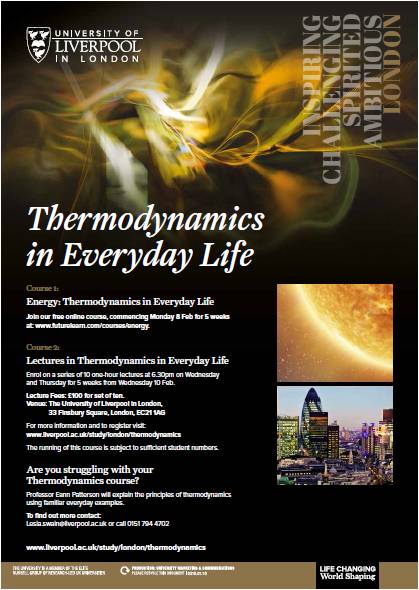
If you wathermolectures posternt to listen to that interview or learn more about the thermodynamics underpinning the energy balances controlling our weight, climate change and your electricity charges, then you need to join the more than 4,500 people who have already enrolled on the MOOC that will run for five weeks from February 8th, 2016.  I will also be giving an accompanying series of lectures in London.

I was astonished to discover that there are fewer tigers in the world than people signed up for our MOOC.  Less than 3,200 tigers exist in the wild mainly because our growing population and prolifigate use of the world’s resources has destroyed their habitat and those of the other species with which we share this planet.


Converting wealth into knowledge and back to wealth

Some months ago I was invited to give the opening lecture at a workshop in China on connecting science and business in the field of experimental mechanics. ‘Connecting science and business’ was the sub-title of a book I wrote with Bob Handscombe some years ago and ‘experimental mechanics’ is a theme that runs deep through my research. So, I felt honored to be invited and confident that I had something relevant to say. However, probably the most succinct statement at the workshop was made by Professor Jian Lu from City University of Hong Kong quoting Geoffrey Nicholson, the inventor of Post-Its: ‘Research is the transformation of money into knowledge. Innovation is the transformation of knowledge back into money creating value.’

The central role that money plays in life is acknowledged in the saying ‘money makes the world go around’. However, the intertwining of money and knowledge is less widely recognised. Although we talk about a knowledge economy not many people understand what it means or how it functions. The diagram below is an attempt to show how research leads to the creation of private information which needs to be disseminated in order to become public information. Public information becomes public knowledge when it is incorporated into our structured, shared understanding through study and learning. Public knowledge is used in innovation processes to create new technology and wealth, which fuels further research, so that there is a feedback loop.  The diagram is modified from one by Max Tegmark‘s book ‘Our Mathematical Universe‘ and, of course is simplified, perhaps too much, but nevertheless illustrates the process of knowledge creation even if sometimes the whole process functions inside an organisation. In the later situation, the creation of knowledge and the benefits to society are likely to be impeded, at least temporarily.

Information triangle

Information triangle

From Russell to Schrodinger on thinking contradictions

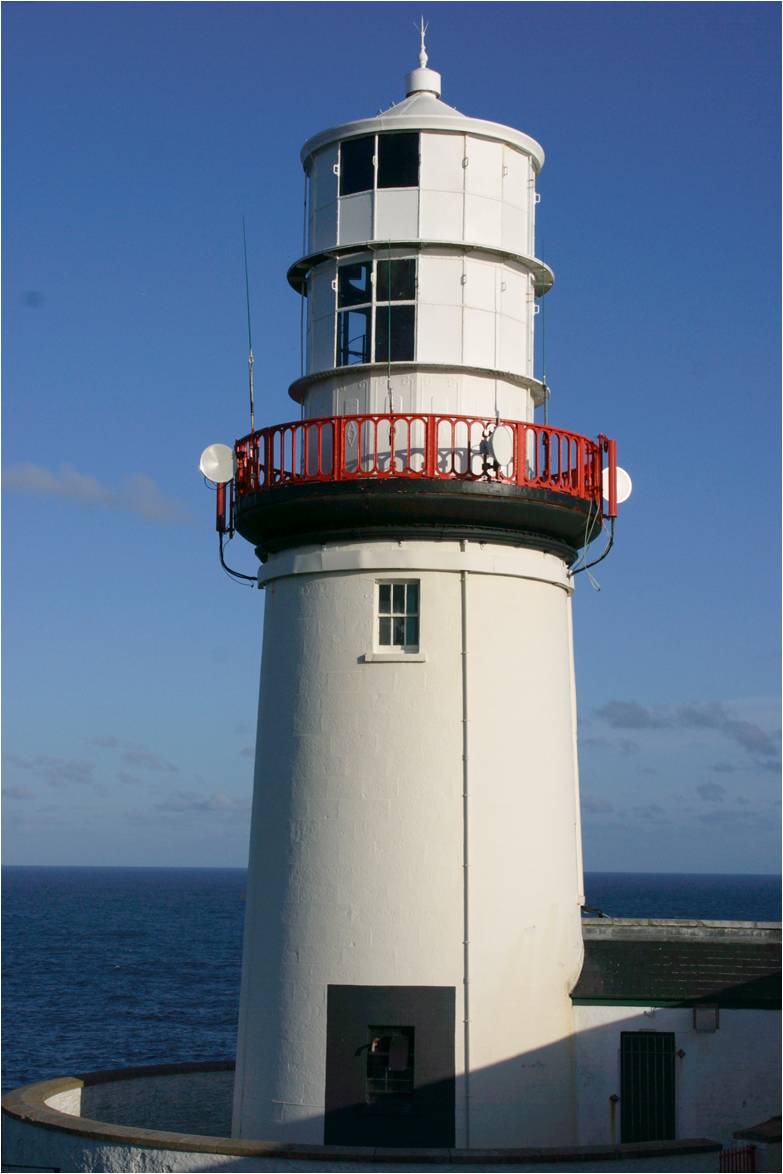
galleyhead lighthouse‘People would rather die than think and most people do’ is a witticism attributed to Bertrand Russell. If this is true then the prospects are poor for the societal conversation on the morality of organizations that I suggested a few months ago, since it requires people to think for themselves. Socrates ran into trouble when he advocated such an approach; so, perhaps I should be careful about what I suggest and return to the silent majority. Now I have contradicted myself, but as Erwin Schrödinger wrote ‘If a man never contradicts himself, the reason must be that he virtually never says anything at all’. I am sure that I have contradicted myself many times in my posts over the last year but you continue to read this blog in increasing numbers [up by 50% compared to 2014]. Thank you for your support during 2015.

Happy New Year!