Category Archives: Soapbox

Compelling presentations

It used to be that you only had to compete with the view out of the window when you were talking to a group of people.  Now, you have to compete with the view of the world available through people’s mobile devices.  You know when your audience arrives and sets up their laptops that you have a challenge ahead of you.  A few of them might be planning to take notes using their laptop but most will be distracted by the constant flow of information delivered by email and messaging applications.  Of course, you can use the same technology to embellish your presentation and to hold their attention; but often the result is ‘death by Powerpoint’ and the audience retreats into their own worlds – doing their own thing.

There’s a nice quote from an interview with Eric Clapton in the San Diego Union Tribune (September 4th, 2005): ‘It’s very hard, so I try and make it as engaging as it can be. But you have to face the fact that, no matter how good it is, you can only hold their attention for a little while.  So, you have to plan you talk in small steps and to re-engage your audience at the start of each step.  There needs to be a narrative and the same rules apply as when writing [see post entitled ‘Reader, Reader, Reader’ on April 15th, 2015].  Powerpoint is not a requisite nor a substitute but preparation is essential.  As a group of undergraduate students told me during a recent visit to another university, they can easily spot the lecturers who prepare conscientiously and are worth listening to.

I am at a scientific conference this week where a wide range of speaking skills will be on display and I have my mobile devices with me to provide alternative stimulation.  The real value of the conference is the opportunity to interact with other researchers in a community of knowledge and for that we need shorter talks and more time for discussion.  But the mechanics of modern scientific conferences is a separate issue!


Image: view from lecture theatre on London campus where I taught science and technology leadership last year [see post entitled ‘Leadership is like shepherding‘ on May 10th, 2017].


Tyranny of quantification

There is a growing feeling that our use of metrics is doing more harm than good.  My title today is a mis-quote from Rebecca Solnit; she actually said ‘tyranny of the quantifiable‘ or perhaps it is combination of her quote and the title of a new book by Jerry Muller: ‘The Tyranny of Metrics‘ that was reviewed in the FT Weekend on 27/28 January 2018 by Tim Harford, who recently published a book called Messy that dealt with similar issues, amongst other things.

I wrote ‘growing feeling’ and then almost fell into the trap of attempting to quantify the feeling by providing you with some evidence; but, I stopped short of trying to assign any numbers to the feeling and its growth – that would have been illogical since the definition of a feeling is ‘an emotional state or reaction, an idea or belief, especially a vague or irrational one’.

Harford puts it slightly differently: that ‘many of us have a vague sense that metrics are leading us astray, stripping away context, devaluing subtle human judgment‘.  Advances in sensors and the ubiquity of computing power allows vast amounts of data to be acquired and processed into metrics that can be ranked and used to make and justify decisions.  Data and consequently, empiricism is king.  Rationalism has been cast out into the wilderness.  Like Muller, I am not suggesting that metrics are useless, but that they are only one tool in decision-making and that they need to used by those with relevent expertise and experience in order to avoid unexpected consequences.

To quote Muller: ‘measurement is not an alternative to judgement: measurement demands judgement – judgement about whether to measure, what to measure, how to evaluate the significance of what’s been measured, whether rewards and penalties will be attached to the results, and to whom to make the measurements available‘.

Sources:

Lunch with the FT – Rebecca Solnit by Rana Foroohar in FT Weekend 10/11 February 2018

Desperate measures by Tim Harford in FT Weekend 27/28 February 2018

Muller JZ, The Tyranny of Metrics, Princeton NJ: Princeton University Press, 2018.

Image: http://maxpixel.freegreatpicture.com/Measurement-Stopwatch-Timer-Clock-Symbol-Icon-2624277

Logarithmic view of the world

Politicians and the media are fond of dazzling us with big numbers: $62m, £35bn, $1.1 tn.  All of these are unimaginable sums of money – uncountable and, for most us, unspendable.  They are respectively: the launch cost for SpaceX’s Falcon 9 rocket, the anticipated ‘divorce cost’ to the UK for leaving the EU and the predicted US government annual deficit for next year based on the additional spending approved in the budget bill early this month.  For most of us, winning $62m in a lottery would be a life-changing event that we might dream about but there’s only about a 1 in 14 million chance of it happening – oops, there’s another unimaginable number.

We seem quite happy handling numbers over a limited interval, from perhaps 1 in 100 [1% or 0.01] to maybe 100,000 but beyond this range our perspective ceases to be linear and probably becomes logarithmic (as in the graphic), or something similar.  In other words, we don’t perceive £35bn as being about 500 times larger than $62m, or $1.1tn being about 18 million times larger.  Instead, we concertina our mental picture into something more manageable, such as the image shown in the graphic.  Does this have the side-effect of lessening the impact of large numbers so that we are less alarmed by costs of £35bn or deficits of $1.1tn? Maybe we would take more notice of a cost of £500 per person in the UK or a deficit of $3600 per person per year in the USA?

At the other end of the scale, something similar happens.  Nanotechnology is a popular buzz word at the moment but few people can conceive of something 2.5 nanometres in diameter – that’s the diameter of a strand of DNA.  It doesn’t help much to tell you that a human hair is 40,000 times thicker!

Maybe, all of this only applies to those of us who ‘see’ numbers in pictorial patterns, and to the rest of you it is nonsensical.  See my post on Engineering Synaesthesia on September 21st, 2016.

Sources:

http://time.com/money/5135565/elon-musk-falcon-heavy-rocket-launch-cost/

https://www.theguardian.com/politics/2017/dec/31/tough-2017-what-does-next-year-hold-theresa-may

Financial Times, Weekend 10 February/11 February 2018.

An expanding universe

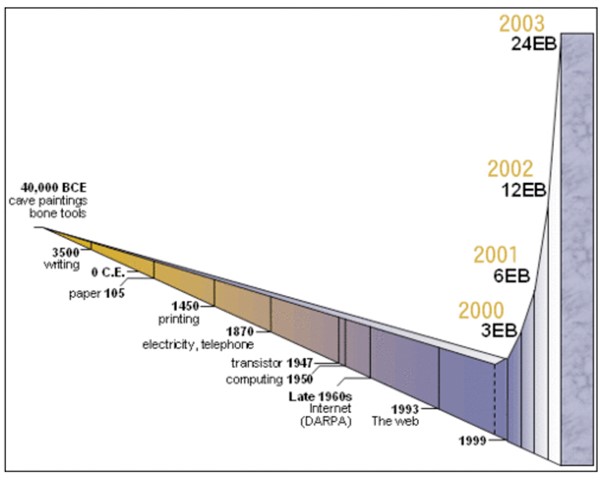
I attended a workshop last month at which one of the speakers showed us this graphic.  It illustrates that the volume of information available to us has been approximately doubling every year.  In 2005, the digital universe was 130 Exabytes (billions of gigabytes) and by 2020 it is expected to have grown to about 40,000 Exabytes.  The second law of thermodynamics tells us that entropy or disorder of the physical universe is always increasing; so, is this also true for the digital universe?  Claude Shannon proposed that information is negentropy, which implies that an increasing growth in information represents a decrease in entropy and this seems to contradict the second law [see my post ‘Entropy on the brain‘ on November 29th, 2017].  Perhaps the issue is the definition of information – the word comes from the Latin: informare, which means to inform or to give someone knowledge.  I suspect that much of what we view on our digital screens does not inform and is data rather than information.  Our digital screens are akin to telescopes used to view the physical universe – they let us see what’s out there, but we have to do some processing of the data in order to convert it into knowledge.  It’s that last bit that can be stressful if we don’t have some control mechanisms available to limit the amount of disorder that we ask our brains to cope with – we are back to Gadget Stress [see my post on April 9th, 2014] and Digital Detox [see my post on August 10th, 2016].

Source: Atsufumi Hirohata, Department of Electronics, University of York www-users.york.ac.uk/~ah566/lectures/adv01_introduction.pps

Image: http://japan.digitaldj.network.com/articles/9538.html