Category Archives: Soapbox

Professor soars through the landscape

When I was younger, I often had dreams when I was asleep in which I raised my arms and flew effortlessly across the landscape.  I had the opportunity to have a similar experience while awake when I was in Taiwan earlier this year.  I am fairly frequent visitor to Taiwan [see ‘‘Crash’ in Taipei: an engineer’s travelogue‘ on November 19th, 2014 and ‘Citizens of the world‘ on November 27th, 2019].  I often go with colleagues from the UK who have not been before and almost without fail we visit the amazing National Palace Museum.  On my last visit in January [see: ‘Ancient standards‘ on January 29th, 2020] there was an exciting blend of art and technology in an exhibit that allowed the visitor to fly through the landscape of a painting.  I stood in front of a projection of the picture on a large screen and lifted my arms for a moment to allow the computer system to register my position before starting to fly into the picture, tilting left or right to turn, and lowering and raising my arms to slow down or speed up.  Although there was no mask or headphones to wear, the experience was absorbing and realistic.  You can watch me flying with my ‘jetpack’ in this video.
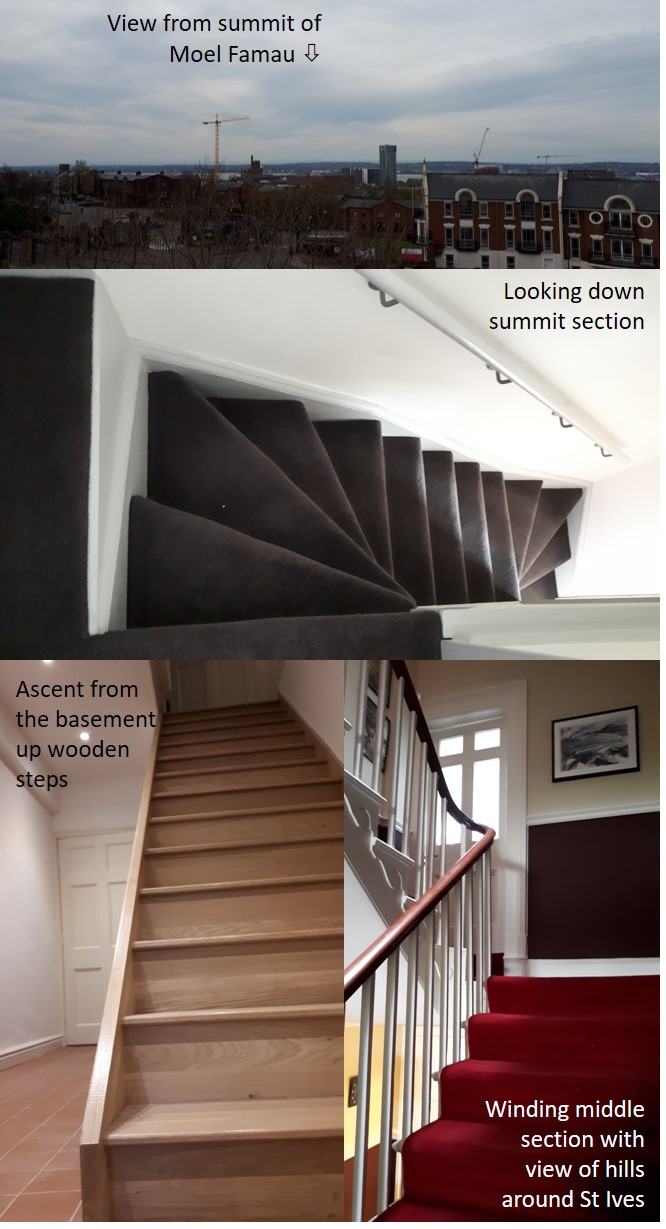
 

Virtual ascent of Moel Famau

Last week I met with research collaborators in Italy where they have been restricted to their homes for the past four weeks and need written permission to move more than 200 yards from the house; in Urbana-Champaign, IL, USA where they closed down the campus two weeks ago on about the same timescale as here in Liverpool; and in Taiwan where they are able to work on campus wearing masks but they are not delivering undergraduate lectures.  Of course, to prevent the spread of the coronavirus, all of these meetings happened electronically via a variety of virtual conferencing tools.  At the weekend, I climbed the Welsh hill, Moel Famau, that we can see from the upper windows of our house.  We climb it most weekends, but last weekend was different because I did it virtually by repeatedly climbing the stairs in our house so that I could abide by the Government’s directions to not visit the countryside.  I had talked about it during our first weekend in lock-down and calculated how many repeats were equivalent to the climb from Cilcain to the summit. A report of a virtual ascent of Everest inspired me to go ahead with my own virtual expedition from the basement to the attic thirty-five times.  The first stage was like the lower slopes of well-used mountain trail where rangers have installed wooden steps to protect the hillside because we have recently installed a new oak staircase to the basement.  The middle stage was a gentler winding ascent with views of hills while the final stage was steep with awkward steps leading to a hidden summit.  To my surprise, I got some of the same feelings of mental well-being and renewal induced by walking in real hills [see: ‘Gone walking‘ on April 19th, 2014 & ‘Take a walk on the wild side‘ on August 26th, 2015].  As I write this post, a Government minister is saying on the radio that we might not be allowed our daily hour outside for exercise, so my virtual expedition will likely be repeated next weekend.

Slow deep thoughts from a planet-sized brain

I overheard a clip on the radio last week in which someone was parodying the quote from Marvin, the Paranoid Android in the Hitchhiker’s Guide to the Galaxy: ‘Here I am with a brain the size of a planet and they ask me to pick up a piece of paper. Call that job satisfaction? I don’t.’  It set me thinking about something that I read a few months ago in Max Tegmark’s book: ‘Life 3.0 – being human in the age of artificial intelligence‘ [see ‘Four requirements for consciousness‘ on January 22nd, 2020].  Tegmark speculates that since consciousness seems to require different parts of a system to communicate with one another and form networks or neuronal assemblies [see ‘Digital hive mind‘ on November 30th, 2016], then the thoughts of large systems will be slower by necessity.  Hence, the process of forming thoughts in a planet-sized brain will take much longer than in a normal-sized human brain.  However, the more complex assemblies that are achievable with a planet-sized brain might imply that the thoughts and experiences would be much more sophisticated, if few and far between.  Tegmark suggests that a cosmic mind with physical dimensions of a billion light-years would only have time for about ten thoughts before dark energy fragmented it into disconnected parts; however, these thoughts and associated experiences would be quite deep.

Sources:

Douglas Adams, The Hitchhiker’s Guide to the Galaxy, Penguin Random House, 2007.

Max Tegmark,  Life 3.0 – being a human in the age of artificial intelligence, Penguin Books, Random House, UK, 2018.


First law of geography: everything is related to everything else

One of the benefits of supervising research students is that you can read a large number of scientific papers by proxy.  In other words, my research students read more papers than I would ever have time to read and then they write reviews of the scientific literature that allow me to quickly gain an understanding of research in a particular field.  Every now and again, a student refers to a paper that raises my curiosity to read it for myself.  One of these was a paper published by Waldo Tobler in 1970 in which he describes the computational modelling of urban growth in Detroit, Michigan.  Although, I used to live in Michigan, it was not the geographical connection that interested me but his invocation of the first law of geography: ‘everything is related to everything else, but near things are more related than distant things’.  Professor Tobler was writing from the University of Michigan in Ann Arbor which he used in an example by highlighting that the population growth in Ann Arbor from 1930 to 1940 depended not only on the 1930 population of Ann Arbor, but also on the 1930 population of Vancouver, Singapore, Cape Town, Berlin and so on.  Perhaps if he had been writing in 2020 he would have suggested that the rate of infection from coronavirus in Ann Arbor depends not only on the number of cases in Ann Arbor, but also on the number of cases Taipei, Milan, Toulouse, Dublin and so on.

Source:

Tobler WR, A computer movie simulating urban growth in the Detroit Region, Economic Geography, vol. 46, Supplement: Proceedings. Int. Geog. Union. Commission on Quantitative Methods, 234-240, 1970.

Image: Crisco 1492Own work