Category Archives: everyday engineering examples

Where there is muck there is an engineer

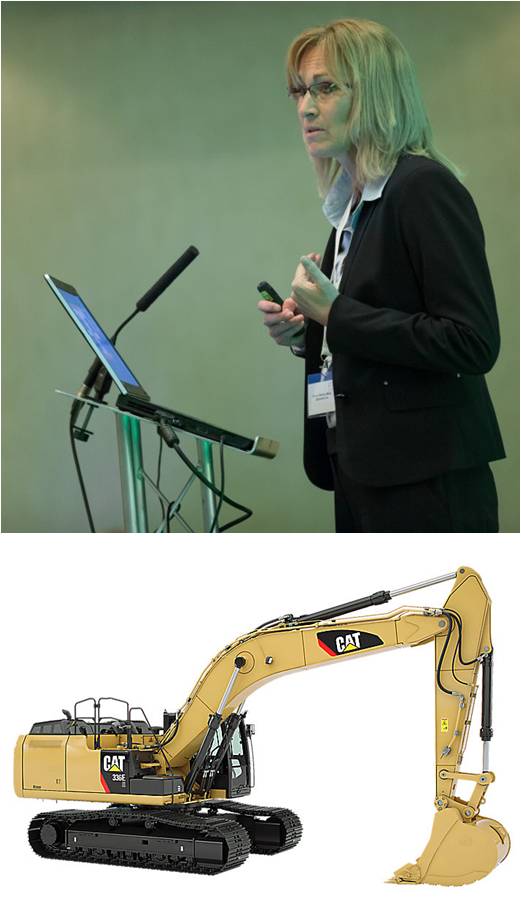
Dr Lou Balmer-Millar at the FPC 2015 & the CAT 366E

Dr Lou Balmer-Millar at the FPC 2015 & the CAT 366E

Here’s a second post on what engineers do [see my post entitled ‘Press button for exciting ride‘ on March 25th, 2015].

Dr Lou Balmer-Millar leads a team that develops new technology for off-road vehicles.  She is Director of Research and Advanced Engineering at Caterpillar Inc. and she gave a keynote talk at the  Future Powertrains Conference, which I wrote about a couple of weeks ago.  She talked about the innovations that Caterpillar are developing to increase the efficiency of their vehicles.  This includes driverless giant trucks.  If you are worried about driverless cars then what about driverless 226 tonnes trucks?  It is already a reality –   watch the Caterpillar video.

However, what stuck in my mind from her presentation was not the enormous mining trucks but the way in which Caterpillar measure the efficiency of their diggers, such as the CAT 366E Hybrid.  They are not so much interested in miles per gallon as tonnes of dirt (or muck) shifted per gallon.  Efficiency is defined as what you want out of a machine divided by what you have to put in to a machine, or work done for energy supplied [see post entitled ‘Energy efficiency‘ on June 18th, 2014].  So for a passenger car, miles travelled divided by energy used is a reasonable measure of efficiency.  But for digger, tonnes of earth moved is what you are want done, so tonnes moved per gallon is the right measure of efficiency.   The machine in the picture does not look like anything special but Caterpillar claim it is 30% more efficient than its competitors.

So there is money to be made in shifting earth more efficiently than your competitors.  If you enjoy watching machines move earth the watch this video.

Photo credit: Joshua Tucker http://www.apcuk.co.uk/2015/03/future-powertrain-conference-2015-report/
Trees are made of air

162-6273_IMGYes, it is April Fools Day but I am serious.  Trees are made of air.  Think about it.  What happens when they are burned?  You are left with a small pile of ash.  So where did the rest of the tree go?  When the tree ‘is burned, in the flaming heat is released the flaming heat of the sun which was bound in to convert air into the tree’.  These words are from Richard Feynman, who explains it much better than me.  Watch him on Youtube.

Sources:

Max Tegmark, Our Mathematical Universe, Penguin Books Ltd, 2014.

National Public Radio blog

Stimulating students with caffeine

milk in coffeeFood and drink seems to have been a recurring theme in my undergraduate lectures recently which as we are approaching a festive season is perhaps not inappropriate. At the moment, I am teaching thermodynamics to three hundred first year undergraduate students.  Zeroth and first laws of thermodynamics before the Christmas break and then the second and third laws in the New Year. Toast, pizza, barbecued steaks, hot coffee, bottled water, and cold milk shakes have all featured as Everyday Engineering Examples of thermodynamic systems in recent lectures. We can define a thermodynamic system as a quantity of matter capable of exchanging energy with its environment. And, most food preparation processes involve heating, chilling and, or doing work on the food by stirring, beating etc. which are all forms of energy exchange, so the opportunities for Everyday Engineering Examples are many and varied.

In one recent lecture, I asked the class to consider the quickest way to cool your coffee with milk. It was a multiple choice question to which students could respond in real-time using their phones and a website called polleverywhere.com. There was more than one correct answer depending on the assumptions you made about the quantity and temperature of the milk as well as the temperature of the coffee and environment. The core issue is that the rate of cooling is proportional to the temperature difference. While discussing the possible answers, I made a throw-away remark about stirring the coffee involving doing work on the coffee and thus increasing its internal energy and temperature, which would be a step in the wrong direction. I was delighted when one of my students picked me up on this and sent me this link about stirring tea.

It is great to know that at least one student is listening and sufficiently engaged to do a little research. Only 299 left to inspire!

Footnote:

The hot coffee will transfer heat to its cooler surroundings by natural convection and radiation at its free surface and by conduction through the ‘walls’ of the cup. Similarly, the cup will transfer heat to its surroundings by natural convection and radiation from its outer surfaces. This process will establish a temperature gradient in the coffee that will induce a very slow convection flow that would be accelerated by stirring, i.e. introducing forced convection. This is likely to increase heat transfer slightly by carrying hotter coffee to the surfaces. The additional heat transfer (loss) might be more or less than the work done to stir the coffee. Who would have thought something as simply as stirring coffee or tea could be so complicated!

Previous posts on Zeroth Law:  ‘All Things Being Equal ‘ on December 4th, 2014, ‘Arbitrary Zero‘ on February 13th, 2013 and ‘Lincoln on Equality‘ on February 6th, 2013.

Previous posts on First Law:Thunderous Applause‘ on July 16th, 2014,  ‘Sizzling Sausages‘ on July 3rd, 2013, ‘Closed system on BBQ‘ on June 19th, 2013 and ‘Renewable energy‘ on January 7th, 2013

Sources:

The Thermodynamics of Pizza‘ by Harold J. Morowitz, Rutger University Press, 1992.

http://what-if.xkcd.com/71/

Tessellating bikes

pelaton

Photo credit: Isobel

Whoosh!  The unexpectedly exhilarating experience of standing on the kerb as more than a hundred cyclists raced past less than an arm’s length away during Stage 1 of the Tour of Britain on a beautifully hot sunny day.  We had walked from our house down to the finish line adjacent to Liverpool’s waterfront and watched from behind crowd-control barriers as the riders raced past on a couple of the eight laps of the course around the city.  The crowds, big screens and team buses at the finish line created a party atmosphere; however it was much more exciting being close enough to feel the riders’ slipstream when we watched in the quieter street next to Cain’s Brewery where there were no barriers and fewer spectators. It was thrilling on the last lap when the pelaton caught up with break away leaders and they all sped downhill in a single charge.

Of course the bikes are marvels of light-weight engineering and make excellent everyday engineering examples for students but we were more fascinated by how the teams tessellated eight or more spare bikes onto the roof of their support cars that cruised along behind them!tesselated

For Everyday Engineering Examples in Dynamics see lesson plans D6, D7 and D11; and in Mechanics of Solids see S2, S3, S7 and S8 for a unicyclist!