Category Archives: Engineering

Model validation

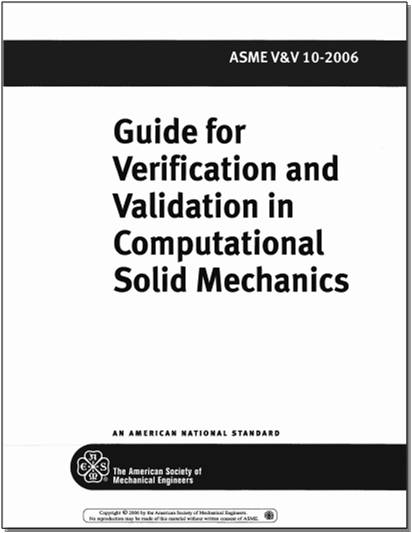
Front cover of ASME V&V 10-2006, Guide for verification and validation in computational solid mechanics, American Society of Mechanical Engineers, New York, 2006.

Why is validation important?  Validation of computational mechanics models is defined as ‘determining the degree to which a model is an accurate representation of the real world from the perspective of the intended uses of the model’, according to  ASME V&V 10-2006.  So, the validation of models of structural integrity for engineering design provides information about the degree to which the simulation results from the model can be believed.  This in turn helps in making decisions about how little material, and in what configuration, should be used to create elegant, sustainable designs that are unlikely to fail. So validation of computational mechanics models is an essential step in solving the ‘two earths’ dilemma (see post on August 13th, 2012).

Model credibility

Last week I spoke at the annual conference of the Associazione Italiana per ‘Analisi dell Sollecitazioni in Vicenza, Italy on the role of experimental mechanics in the validation of computational models used in engineering simulations.  We discussed the conflict between reducing cost and energy consumption and increasing performance and reliability of engineering machines and vehicles.  Generally, the former implies using less material more efficiently, while the latter tends to require the use of more material.  Engineers resolve this conflict by using computational models when optimising designs to simulate engineering behaviour.  The development of elegant and successful designs requires a high level of credibility in the models.  This credibility can be established by comparing the results from models with those from specially-conducted experiments; a process that is known as ‘validation’.

Waste is unavoidable

Image from http://www.nucleartourist.com/systems/ct.htm
Courtesy KKN Liebstadt NPP

If you read my previous post on perfect engines, then you might have thought a heat engine that did not discharge any heat would be more efficient.  However, this would contravene the second law of thermodynamics, which requires that every real process must generate an increase in disorder, in this case by the discharge of waste heat.  Thermodynamicists like to call this increase in disorder, an increase in ‘entropy’.

A consequence of the second law of thermodynamics is that the entropy, or disorder, of the universe is always increasing; but now I have strayed from engineering to physics.  Together with Bob Handscombe, I wrote a book on this topic called the ‘Entropy Vector: Connecting science and business’.  It was not a best-seller but it got some good reviews, see http://www.worldscientific.com/worldscibooks/10.1142/5365#t=reviews.

Perfect engines

We can’t build perfect engines and even if we could they would not be 100% efficient. A heat engine generates power [or does work] by absorbing heat from a source into a working fluid, often water,Image using the hot fluid to create motion, e.g. via a turbine, then discharging waste heat to a heat sink before pumping the fluid back to the heat source.  This is the operating cycle of most power stations.  The heat source might be a fossil fuel furnace, a nuclear reactor or a solar concentrator; and the heat sink is often the environment.

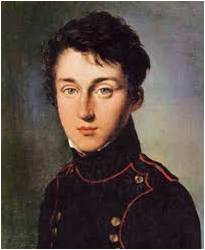
A Frenchman, Nicolas Leonard Sadi Carnot [1796-1832], deduced that the best efficiency achievable by a heat engine was given by one minus the ratio of the temperatures [in Kelvin] of its heat sink to heat source.

A perfect heat engine operating with a heat source at about 350°C [623K] and a heat sink at 20°C [293K] would have a Carnot efficiency of about 45%.  We can only hope to increase this efficiency by finding a naturally occurring very cold heat sink or by increasing the temperature of the heat source, which is why we are interested in strain measurement in very hot components (see post on ‘hot stuff’) –  we don’t want our super-efficient engines to break!