Category Archives: mechanics

Teaching stress

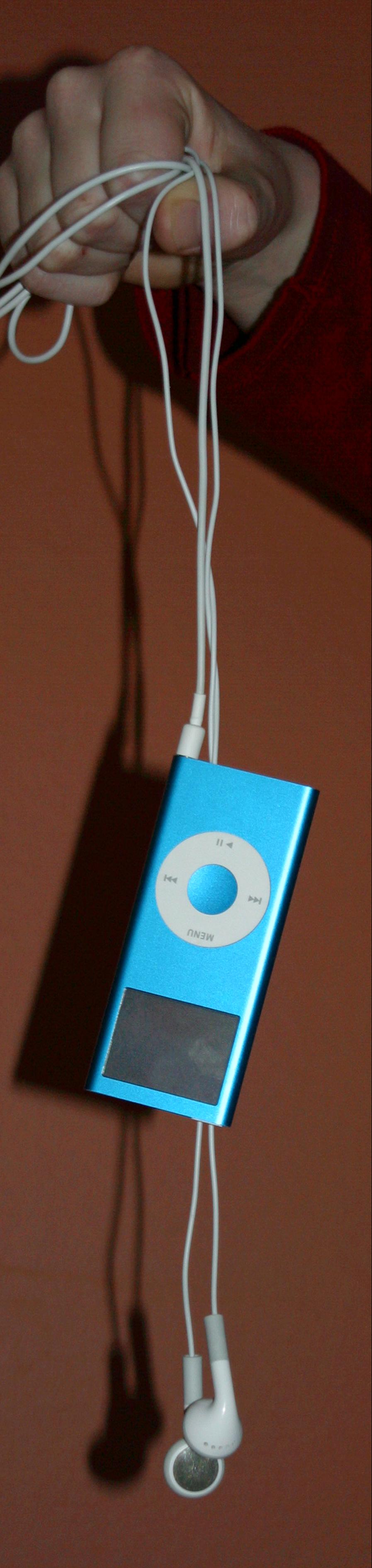
ipodDuring my trip to the US (see post entitled ‘Detroit’, on 21st August, 2013), my earphones for my IPod broke.  This seems to be a common occurrence, perhaps a case of the planned obsolescence I wrote about on May 1st, 2013 under the heading ‘Old is Beautiful’.  Nothing very beautiful or repairable about broken earphones, they are just part of our disposable culture.  However, I collect them and use them when teaching engineering students about stress and strain.  Students have all experienced such a failure and so it is an everyday example of engineering that can be used to teach the principles of stress and strain in a familiar context.  A suggested 5E lesson plan for doing this is provided at the bottom of this post.

The lesson plan deals with the stresses in the earphone cable when the ipod is dangled from them and the discussion in class can be extended to include the stresses induced by spinning the earbuds on the end of the cable or the effect of repeated bending of the cable leading to possible fatigue failure (like when you bend your old credit card back and forth to snap it in half).

For more on Everyday Examples in Engineering ‘Bridging Cultures’ on June 12th, 2013; and ‘Disease of a Modern Age’ on June 26th, 2013.
5EplanNoS1_uniaxialstrain&ipod

Sizzling sausages

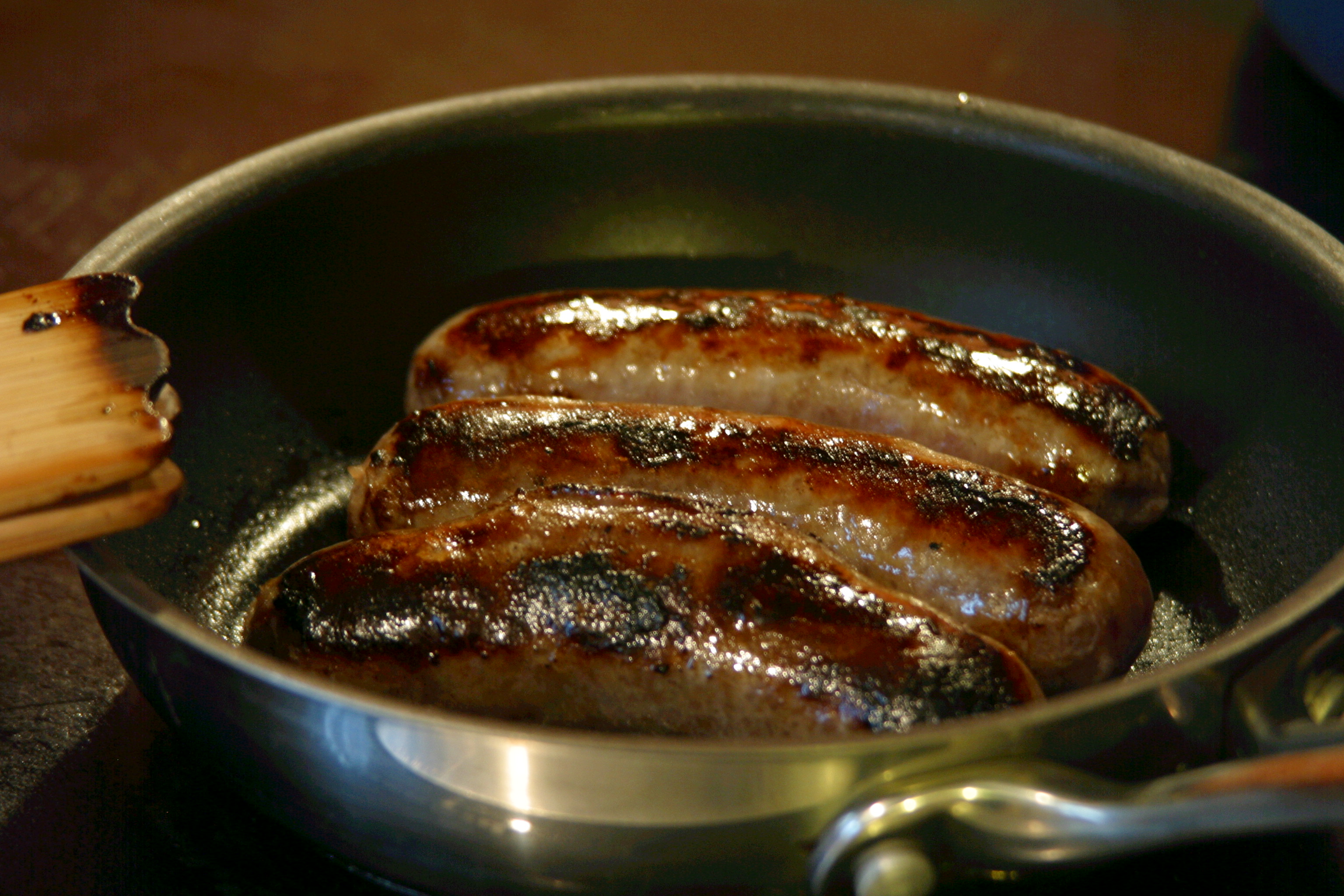
130-3071_IMGIn my post on 19th June 2013 [Closed system on the BBQ], I discussed the thermodynamics of sausages cooking on a barbeque in the context of the first law of thermodynamics.  This is an everyday example of engineering principles [see my post entitled ‘Bridging cultures’ on June 12th, 2013].  I mentioned that the energy gained by a sausage causes it to be cooked and for the water-content to boil as the temperature is raised.  The rise in temperature causes the pressure inside the sausage to increase, which is Gay-Lussac’s law in action.  When the water-content of the sausage starts to boil, the steam produced raises the pressure even further providing the sausage skin remains impervious to the transfer of matter, i.e. the steam.  The sausage as a closed system that becomes a miniature pressure vessel.

Pressure vessels fail as a result of the stresses in their wall.  In engineering, stress is defined as force divided by the area of  material carrying the force.  My sausages always fail longitudinally, i.e. they burst open with splits running along their length.  This is because the stress across the split, known as the circumferential or hoop stress, is the largest stress in the skin.

It is relatively simple to use Newton’s Third Law, about there being an equal and opposite reaction for every action force, to show that the circumferential stress is larger than the longitudinal stress; but it is a level of detail beyond what I feel is appropriate here.  Bursting sausages are a good illustration of Everyday  Examples of Engineering, which became the ‘poster-child’ of the NSF-funded project that developed them in the USA .  The pedagogy underpinning the use of Everyday Examples is explained in detail in a paper in the European Journal of Engineering Education (vol 36, pages 211-224, 2011) and a 5Es lesson plan is available here [for more on 5Es lesson plans see my post entitled ‘Disease of the modern age’ on June 26th, 2013].

You can see a video of me talking about these sausages at http://www.youtube.com/watch?v=nsSxKuRo4H0

EJEE paper: http://www.tandfonline.com/doi/abs/10.1080/03043797.2011.575218#.UbG9TZyPMx4

More material

In previous posts I have mentioned the need for ‘more material’ in order to reduce the probability of failure.  This is a little sloppy, since there are, at least, two options buried in these statements.  Namely, the simple one, which is to add a greater mass of material; and the alternative, which is to use a stronger but lighter material, i.e. a more sophisticated material, e.g. a composite.  These are usually also more expensive but can also provide opportunities to incorporate sustainability via bio-based recyclability [for information on bio-based composites see http://www.ag.ndsu.edu/bioepic/documents/symposium/NDS%20Bio-BasedMaterials-DRZAL-10-07-final.pdf%5D.

Risk definition

A section from a photoelastic model of turbine disc with a single blade viewed in polarised light to reveal the stress distribution.

Risk is defined as the possibility of something happening multiplied by the consequences when it does happen.  The public understanding of risk sometimes only extends to the first half of this definition.  Engineers seek to reduce the risks associated with component failure.  This means accepting a non-zero probability of failure happening and then designing for least catastrophic consequences.  So for instance in a jet engine, this implies designing so that if a crack develops it is in a blade rather than the disc to which all of the blades are attached.  The engine casing can be designed to contain a single blade breaking off and thus protect the rest of the plane from flying debris, but not to contain the rupture of an entire disc and set of blades.

For more information on the photoelastic stress analysis techniques used to generate the image, see http://www.experimentalstress.com